Chapter One – The Knife
The sun stood almost directly above the town, hard and white against the blue sky, flattening every shadow and turning the red earth into a field of heat.
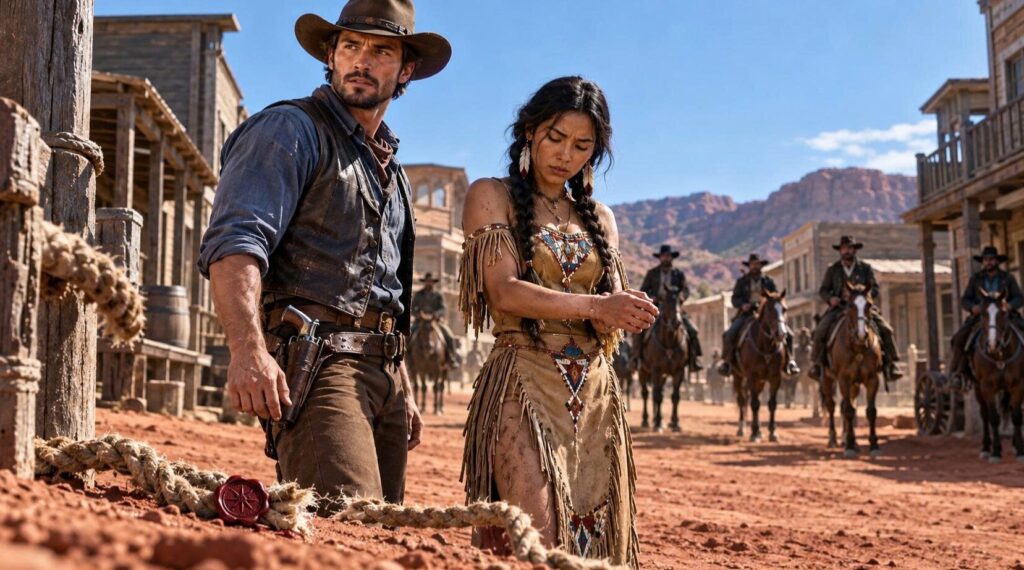
The cowboy knelt in front of the woman with one knee pressed into the dust.
His brown hat cast a narrow shadow across his face, but it did little to hide the tension in his jaw. The short dark beard along his cheeks was streaked with sweat, and the sleeves of his slate-blue shirt had been rolled above his forearms long before the afternoon had become unbearable.
The knife in his hand rested against the thick rope binding the woman’s wrists.
For a moment, he did not move.
Neither did she.
Her long dark hair had been braided into two plaits, and the feather earrings beside her neck stirred slightly in the dry wind. The geometric beadwork across her tan suede top caught the sunlight in small flashes. Yet despite the rope around her wrists, her posture remained straight.
She was not asking him to help.
That mattered.
He had learned, over the past hour, that she disliked being rescued almost as much as she disliked being restrained.
The difference between the two, she had told him, was choice.
Behind them, somewhere beyond the wooden buildings, horses shifted and leather saddles creaked.
The cowboy heard it.
So did she.
There was not much time.
Finally, he pressed the blade into the rope.
The fibres tightened.
Then began to break.
Chapter Two – What He Had Already Risked
He had known from the beginning that cutting the rope would change things.
Until that moment, he could still pretend he was merely watching.
A bystander.
A man passing through.
Someone who had happened upon trouble but had not yet chosen a side.
The lie had lasted longer than it should have.
Now, with the knife in his hand and the rope between his fingers, neutrality was no longer possible.
He pulled the blade toward himself.
A few strands snapped.
The woman looked down at his hands.
“You’re slow,” she said.
He glanced up.
“I’m trying not to cut you.”
“I noticed.”
“That usually earns gratitude.”
“Not yet.”
He almost smiled.
Almost.
Instead, he returned to the rope.
His hesitation had nothing to do with fear of the men behind them.
It came from something older.
Years earlier, before he crossed the Atlantic and learned how quickly the West could strip a man of whatever illusions he had brought with him, he had watched another person ask for help.
He had waited too long then.
Not because he was cruel.
Because he had wanted certainty.
He had wanted to know which side was right before acting.
By the time he understood that waiting was also a choice, there had been nothing left to save.
That memory had followed him farther than any horse ever could.
So when he saw the rope around this woman’s wrists, he had decided that uncertainty would not excuse him a second time.
He cut again.
The rope weakened.
Chapter Three – The Woman Who Would Not Lower Her Eyes
She had refused to tell him why they had tied her.
Not at first.
He had asked only once.
“What happened?”
Her answer had been simple.
“Men decided something belonged to them.”
He had looked at the rope.
“You?”
She shook her head.
“The land.”
That had confused him more.
Only later did he understand.
The woman was not the object of the dispute.
She was the witness.
And witnesses were dangerous when powerful men depended on silence.
She had seen survey markers moved.
She had seen papers exchanged.
More importantly, she had heard names spoken aloud that were not supposed to be connected to one another.
The men behind the deal had believed frightening her would solve the problem.
Instead, it had only revealed what they feared.
Now she watched the cowboy cut through the final strands with an expression that remained unreadable.
“Why are you helping me?” she asked.
He did not look up.
“Because you shouldn’t be tied.”
“That is not an answer.”
“It’s enough.”
“For you.”
He pulled the knife through another section.
The rope began to separate.
She flexed her fingers slightly.
Pain moved across her face, but only for a second.
“Once this falls,” she said, “they will know.”
“They already know.”
“No.”
Her voice stayed calm.
“They know you hesitate.”
He looked at her.
She held his gaze.
“They do not yet know what you have decided.”
Chapter Four – The Sound of Rope Breaking
The final fibres gave way with a dry snap.
The sound was small.
Yet it seemed to travel across the whole street.
The rope dropped from her wrists.
It struck the red dirt between them and collapsed into a loose coil.
For a second, neither moved.
The woman stared at her freed hands.
Dark marks circled her wrists where the rope had pressed into the skin.
She turned one hand slowly.
Then the other.
The cowboy watched.
He expected relief.
Instead, her expression became more serious.
Freedom had arrived, but safety had not.
That difference was clear in the way she checked her wrists rather than rubbing them.
In the way she raised her head.
In the way her eyes moved beyond him toward the open street.
The cowboy folded the knife partly toward his palm, but he did not put it away.
She noticed.
“Are you expecting trouble?”
“I’m expecting men.”
“That is often the same thing.”
This time he did smile.
Briefly.
Then the sound of a horse stamping in the distance erased it.
The woman straightened.
Her shoulders settled.
Something about her changed once the rope was gone.
She was not calmer.
She was simply herself again.
The cowboy realised, with some discomfort, that the restraint had never made her look weak.
Only interrupted.
Chapter Five – Standing Up
He planted one boot firmly into the dirt.
Then he rose.
The low angle of the afternoon light made the movement look larger than it was.
His leather vest shifted against his shirt as he straightened to his full height. The gun belt at his waist settled against his hip. The knife remained visible in his hand.
The woman stood opposite him, still studying the marks on her wrists.
Neither spoke.
Behind them, the wooden structures of the town stood silent beneath the sun.
Open porches.
Dry boards.
Empty windows.
A place built to look permanent in a country where everything seemed temporary.
The cowboy looked toward the street.
Then toward her.
“You should leave.”
She lowered her hands.
“Is that what you’re doing?”
“No.”
“Then why should I?”
“Because they want you.”
“And now?”
He understood the question.
Now they wanted him too.
He exhaled.
“That complicates things.”
She tilted her head.
“You regret it?”
He looked down at the rope.
Then back at her.
“No.”
The answer came faster than either expected.
Something passed between them.
Not trust.
Not yet.
But perhaps the first condition required for it.
Chapter Six – The Men in the Distance
They heard the horses before they saw them.
Several.
Coming slowly.
Not charging.
That was worse.
The rhythm suggested confidence.
Men who believed the street already belonged to them did not need to hurry.
The woman turned first.
The cowboy followed her gaze.
Mounted figures waited beyond the nearest buildings, distant enough that details remained unclear but close enough that neither could pretend they were passing through.
The cowboy tightened his grip on the knife.
The woman noticed.
“You have a gun.”
“Yes.”
“Yet you are holding a knife.”
“I was using it.”
“That is not what I asked.”
He looked at the blade.
Then back at the riders.
“Sometimes putting your hand on a gun answers a question before you know what was being asked.”
She studied him.
“European?”
He glanced at her.
“What makes you say that?”
“You speak like a man who learned to argue before he learned to fight.”
“That insulting?”
“I have not decided.”
Despite the tension, the remark settled something between them.
He lowered the knife slightly.
Not surrender.
Control.
The mounted men remained where they were.
Watching.
Waiting.
The cowboy now understood the shape of the moment.
The rope had fallen.
But the real test had only begun.
Chapter Seven – What the Rope Had Been For
The woman bent and picked up one end of the cut rope.
She held it between her fingers.
The cowboy frowned.
“What are you doing?”
“Remembering.”
She turned it over.
A small section near the knot had been marked with dark wax.
A seal.
Almost invisible beneath the dust.
The cowboy leaned closer.
“That belong to them?”
“No.”
Her expression changed.
That was the first moment he saw fear.
Not for herself.
For something else.
“What is it?”
She hesitated.
Then held the rope toward him.
Pressed into the wax was a small symbol.
A crest.
Simple.
European.
The cowboy stopped breathing.
He knew it.
Not from the town.
From home.
Years ago.
From documents he had tried very hard to forget.
The woman saw his reaction.
“You know this mark.”
He said nothing.
Her eyes sharpened.
“You do.”
The riders waited in the background.
The heat seemed to disappear.
Suddenly, the rope was no longer evidence of one local dispute.
It connected this place to something far older.
Something tied to him.
The woman lowered her voice.
“Who are they?”
The cowboy stared at the wax.
His answer came slowly.
“They are not who I thought they were.”
Chapter Eight – The Old Name
He had not spoken the family name in seven years.
Not since leaving Europe.
Not since deciding that whatever happened across the ocean belonged to a life he no longer intended to claim.
Yet the crest pressed into the rope made denial impossible.
It had belonged to a trading company once controlled by his family.
A respectable name.
A polite name.
One that appeared on shipping papers, contracts, estates, and charitable donations.
It had also appeared on documents his father had kept locked away.
The cowboy had discovered those records shortly before leaving.
Land purchases.
Transport routes.
Unofficial agreements made through other men.
He had never understood all of it.
He had only understood enough to leave.
Now, standing in the red dirt of a town thousands of miles away, he looked at the symbol again.
The woman watched his face.
“You are connected to them.”
“Not by choice.”
“That is rarely how blood works.”
He met her gaze.
“I left.”
“And they followed?”
“No.”
He looked toward the mounted figures.
“Maybe I followed them without knowing.”
That possibility disturbed him more than the riders themselves.
For years, he had believed distance had separated him from his family’s past.
The rope suggested otherwise.
Perhaps the West had never been an escape.
Perhaps it had been where the same story continued.
Chapter Nine – Her Reason for Staying
The cowboy lowered the rope.
“You need to go.”
She did not move.
“I already answered that.”
“This is different.”
“Why?”
“Because now I know who they may be.”
“And I knew what they were before you arrived.”
He looked at her.
She stepped closer.
Her wrists were free now, but the marks remained.
“They moved the boundary posts three nights ago,” she said.
“I know.”
“No. You know they moved them.”
Her voice became quieter.
“I know why.”
The cowboy waited.
“They are not trying to take one piece of land.”
She glanced toward the riders.
“They are building a route.”
“For cattle?”
“For something larger.”
He remembered the old shipping records.
Transport corridors.
Private agreements.
Land acquired in narrow connected strips.
The pattern became clear.
“A rail line,” he said.
She nodded.
“And the men in town?”
“Paid.”
“The law?”
She gave him a look.
He understood.
Also paid.
He stared again at the mounted figures.
The stakes shifted.
This was no longer about freeing one woman.
Nor was it simply about a corrupt town.
The rope had connected local violence to an older network of money.
And to his own name.
The woman watched him closely.
“You still want me to leave?”
“No.”
The answer surprised him.
She noticed.
“Why?”
“Because I think you know the part of this story I don’t.”
“And you?”
He looked at the crest.
“I may know who started it.”
Chapter Ten – Facing the Riders
The rope lay abandoned in the dust.
The woman flexed her wrists one final time.
Then she stepped beside him.
Not behind.
Beside.
The cowboy noticed the choice.
So did the riders in the distance.
The men on horseback shifted slightly.
One leaned toward another.
A conversation passed between them without words reaching the street.
The cowboy folded his knife halfway, but still did not sheath it.
The woman looked at him.
“You understand what happens now?”
“They ask questions.”
“No.”
She turned toward the riders.
“They decide whether you belong to them.”
The cowboy’s expression hardened.
“And if I don’t?”
“Then they decide what to do with you.”
He breathed out slowly.
The bright sky above them felt almost cruel in its beauty.
Nothing in the landscape looked secret.
Nothing looked corrupt.
Everything was visible.
And yet almost every important truth had been hidden.
He glanced once more at the cut rope.
The wax seal remained pressed into its fibres.
A symbol from another continent.
A mark from another life.
The woman followed his gaze.
“You could still tell them you made a mistake.”
He looked at her.
“Did I?”
She said nothing.
That was answer enough.
The cowboy put the knife away.
Not because the danger had passed.
Because the choice had been made.
Then both of them turned toward the mounted horsemen.
The woman stood with her freed wrists at her sides.
The cowboy stood beside her.
The riders remained in the distance, framed between the wooden buildings.
No one reached for a weapon.
Not yet.
That restraint made the silence heavier.
The cowboy finally understood what the rope had truly represented.
It had never been only about holding her.
It had been a message.
Obey.
Stay quiet.
Do not interfere.
And by cutting it, he had answered.
Beside him, the woman spoke without looking at him.
“You know they will remember this.”
“Yes.”
“You know they may use your name.”
“Yes.”
“You know they may know more about your family than you do.”
He hesitated.
Then nodded.
“Yes.”
At last, she turned her head.
“Good.”
“Why good?”
“Because now you are afraid of the right thing.”
He almost asked what she meant.
Then he looked toward the riders again.
For years, he had feared becoming like the men he came from.
Now he understood there was something more dangerous.
Allowing their choices to decide his own.
The rope was on the ground.
The woman was free.
And under the bright desert sky, with the mounted men watching from across the red dirt, the cowboy stood where retreat was still possible.
He simply no longer wanted it.