Chapter One – The Woman at the Door
By the time the younger woman reached the cabin, the sun had already begun to fall behind the western ridge, turning the dry grass outside into long strips of copper and gold. She stood for several seconds at the bottom of the wooden steps, one hand gripping the side of her beige prairie dress while the other rested against the small leather bag hanging from her shoulder. Dust had settled along the hem of the dress, and one sleeve carried a dark smear from where she had slipped against a fence post earlier that afternoon. She had been traveling since dawn, yet exhaustion was not the reason she hesitated.
For most of her life, she had imagined this house differently.
Her mother had rarely spoken of it directly. Whenever the younger woman asked about the years before her birth, the answers became vague and strangely careful. There had been a valley, a small piece of land, and a house that once belonged to people whose names were never mentioned. Occasionally, however, her mother would stop beside a window on rainy evenings and describe a wooden cabin where the floorboards creaked during winter and the sunset entered through the front door as though it had been invited inside.
The younger woman had always assumed those memories were affectionate.
Only after her mother died did she discover the bitterness hidden beneath them.
A folded letter had been tucked into the lining of an old traveling case. Inside were several sentences written in her mother’s hand and one address.
This address.
The letter did not explain everything. In fact, it seemed almost designed to raise questions rather than answer them.
Go to the house before you decide what kind of woman I was.
That sentence had followed her across three counties.
Now, standing before the cabin, she finally understood how much she had expected the place itself to explain.
Instead, the front door opened.
An older woman appeared.
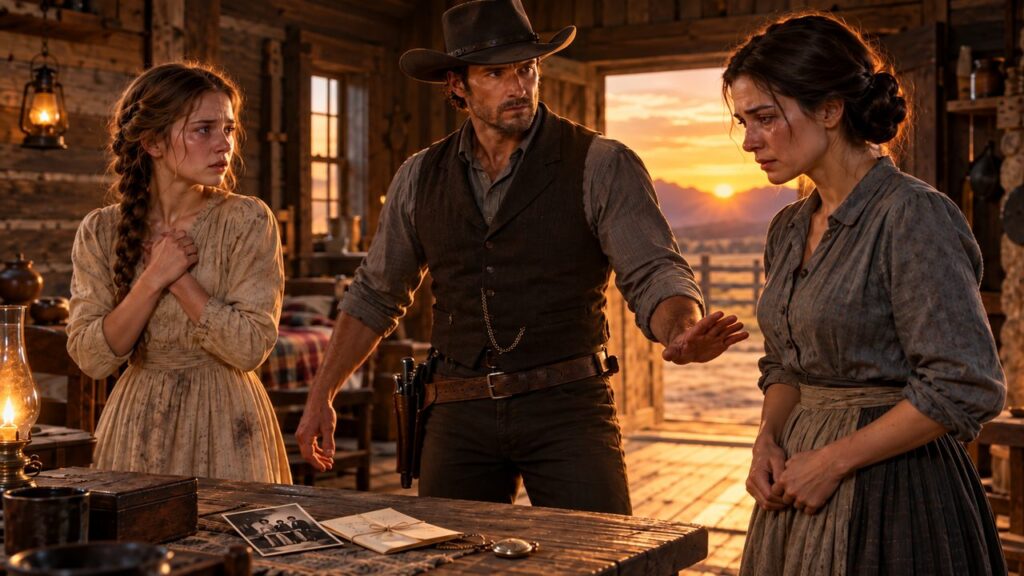
She was perhaps ten years older, dressed plainly in a greyish-blue button shirt, dark skirt, and a waist apron that suggested she had been working moments earlier. Her dark hair was gathered into a low bun. There was nothing threatening about her posture, yet she did not smile.
The two women regarded each other across the porch.
Neither asked who the other was.
Recognition arrived too quickly for that.
The older woman’s expression changed first.
Not shock.
Not exactly.
Something closer to resignation.
“You came,” she said.
The younger woman tightened her fingers around the strap of her bag.
“You knew I would?”
“I knew someone might.”
That answer irritated her more than surprise would have.
She climbed the steps.
“My mother is dead.”
The older woman’s eyes lowered for a moment.
“I heard.”
“From whom?”
No answer came.
Behind the older woman, the cabin was warm with late-afternoon light. A table stood near the wall, along with a stove, simple shelves, and a narrow hallway disappearing into shadow. Everything appeared ordinary.
That somehow made it worse.
The younger woman stepped through the doorway.
She had traveled too far to remain polite.
“Then perhaps,” she said, “you can finally tell me why my mother believed this house belonged to her.”
The older woman closed the door behind them.
Outside, somewhere beyond the cabin, a horse shifted against its tether.
Neither woman noticed that someone had arrived.
Chapter Two – What the Mother Left Behind
The older woman did not immediately answer.
Instead, she crossed the room and removed a kettle from the stove even though the water had not begun to boil. The small gesture was unnecessary, and they both knew it. Yet it gave her something to do with her hands.
The younger woman remained near the center of the cabin.
She disliked the calmness of the room. She had expected neglect, perhaps even evidence of wrongdoing. Instead, the place was clean without appearing staged. A wool blanket rested over the back of a chair. Dried herbs hung near one window. A bowl containing two apples sat on the table.
Someone lived here carefully.
That realization complicated the anger she had been carrying.
“My mother kept the deed,” the younger woman said.
The older woman turned slightly.
“What deed?”
“You know exactly which one.”
“I know about several papers.”
The younger woman opened her leather bag.
From inside, she removed a folded document protected by cloth. She placed it on the table but did not push it toward the other woman.
“This was with her things.”
The older woman stared at it.
For the first time, composure left her face.
Only briefly.
Yet it was enough.
The younger woman saw it.
“You recognize it.”
“I recognize her handwriting.”
“That is not what I asked.”
The older woman inhaled slowly.
The sunlight had shifted farther across the floorboards now, catching one side of her face while leaving the other in shadow.
“She wrote to me once,” she said.
The younger woman froze.
“When?”
“Years ago.”
“How many?”
The answer came quietly.
“Eighteen.”
The room seemed to contract.
The younger woman had been a child then.
“You knew where we were?”
“Yes.”
“And you never came?”
“No.”
“Why?”
The older woman’s gaze moved toward the window.
“Because she asked me not to.”
The younger woman laughed once, but there was no humor in it.
“My mother spent half her life refusing to speak your name, and now you want me to believe she was protecting you?”
“I did not say she was protecting me.”
“Then what were you to her?”
The older woman looked back.
“That is the question she should have answered.”
“But she didn’t.”
“No.”
“So I came here.”
The younger woman reached into the bag again and withdrew the letter she had found after the funeral.
She unfolded it carefully.
“My mother wrote that I should come to this house before judging her.”
The older woman’s expression became heavier.
“She should have written more.”
“She had years to do that.”
“Yes.”
“Did she hate you?”
The older woman looked down.
“No.”
The younger woman’s anger sharpened.
“That almost makes it worse.”
For a few seconds, neither woman spoke.
The cabin seemed filled with everything that had been delayed too long.
Then the younger woman noticed something near the older woman’s wrist.
A narrow silver chain.
Not jewelry one might normally notice.
But hanging from it was a tiny oval charm.
The younger woman had seen the same shape before.
Her mother had worn one identical to it for as long as she could remember.
The older woman quickly drew her sleeve over the chain.
Too late.
The younger woman stared.
“Where did you get that?”
The older woman closed her eyes.
And at that exact moment, footsteps sounded on the porch.
Slow.
Heavy.
Deliberate.
Neither woman turned.
Not yet.
Chapter Three – Silas Outside the Door
Silas had not intended to interfere.
He had ridden to the cabin because the younger woman’s horse had been spotted on the lower trail, and because experience had taught him that people traveling alone with grief often confused determination with preparation. He had known she was coming, though not from her.
The older woman had told him three days earlier.
“She found the letter,” she had said.
Silas had been repairing a saddle strap at the time.
He remembered stopping halfway through the knot.
“You’re certain?”
“She wrote before leaving the city.”
“And you intend to tell her?”
The older woman had looked toward the cabin window.
“I intend to try.”
Silas had heard enough hesitancy in that answer to understand what it meant.
Now he stood outside the open doorway, one hand resting near the frame.
The sunset behind him turned his tall figure into a dark silhouette.
Inside, the two women faced each other.
He could not hear every word, but he had heard enough.
The younger woman had discovered the matching charm.
That was earlier than he had expected.
Silas knew part of the truth.
Not all of it.
Years earlier, he had come through the valley during a winter storm and spent two nights in this same cabin. The older woman had already been living here then. She had been younger, though not young enough to believe silence could solve everything. Still, she had refused to explain why a second bedroom remained closed.
Later, Silas learned there had once been another woman.
A woman who had left.
A woman whose daughter had now arrived wearing a dirt-stained beige dress and the same expression Silas remembered from an old photograph.
That resemblance was what concerned him.
Not because the women looked identical.
They did not.
But certain expressions survived generations more reliably than names.
The younger woman stepped closer to the older one.
“Where did you get the charm?”
The older woman did not answer.
Silas remained outside.
He could have entered.
Yet he understood that entering too early might turn him into an authority where none was required.
This was not his secret.
However, there were moments when being uninvolved became its own form of cowardice.
He had learned that lesson elsewhere.
Long before this cabin.
Long before either woman knew him.
Inside, the younger woman’s voice became sharper.
“My mother wore the same thing.”
“I know.”
“You know?”
“Yes.”
“Why?”
The older woman’s shoulders tightened.
The younger woman took another step.
Silas saw the distance between them narrowing.
Not enough for danger.
Enough for emotion to become difficult to control.
He looked at the floorboards inside the doorway.
Golden light stretched across them.
The two women stood on opposite sides of that light.
It struck him that the room itself seemed divided.
One woman carrying questions.
The other carrying answers she had spent years refusing to speak.
Silas had spent enough time around both to know which burden was heavier.
From inside came the younger woman’s next question.
“Were you my mother’s friend?”
A long silence followed.
Then the older woman said, “No.”
Silas closed his eyes briefly.
The moment had arrived.
Chapter Four – The Photograph Without a Name
The older woman crossed to a narrow cabinet near the wall.
The younger woman watched every movement.
From the lowest drawer came a small box wrapped in faded cloth.
She placed it on the table.
For a moment, her hand remained on the lid.
Then she withdrew it.
“Open it.”
The younger woman did.
Inside were letters.
Not many.
Perhaps a dozen.
Beneath them lay an old photograph.
Two young women stood outside the same cabin.
One was unmistakably her mother.
The other looked like the woman standing across the table, although younger and with her hair loose over her shoulders.
They were not standing like acquaintances.
Nor even friends.
Their shoulders touched.
The younger version of her mother had one arm around the other woman.
Both wore matching oval charms.
The younger woman stared at the photograph until the image blurred.
“Who are you?”
The older woman sat down.
“My name is Ruth.”
“You know that is not what I mean.”
“No.”
Ruth folded her hands together.
“It isn’t.”
The younger woman placed the photograph on the table.
“You said you weren’t her friend.”
“I wasn’t.”
“Then what?”
Ruth’s face changed.
Whatever answer she had rehearsed over the years suddenly seemed impossible to say.
Outside, Silas remained by the door.
The younger woman noticed his shadow for the first time.
She turned sharply.
Silas stood at the threshold.
Cowboy hat low over his brow, dark vest over a grey shirt, gun holster at his side. He did not enter.
“Were you listening?”
“Yes.”
The honesty surprised her.
“And you know who she is?”
“Part of it.”
The younger woman looked between them.
“So both of you knew something about my mother that I didn’t.”
Silas answered carefully.
“That is true.”
“And you thought I should discover it like this?”
“No.”
“Then why didn’t you tell me?”
“Because it wasn’t mine to tell.”
She laughed bitterly.
“Everyone keeps saying that.”
Ruth lowered her eyes.
The younger woman looked at the photograph again.
Her mother appeared perhaps twenty in it.
Happy.
Not the restrained woman she remembered from childhood.
That difference hurt unexpectedly.
Children often believed their parents had always been the people they knew.
Seeing evidence of another version could feel like discovering a stranger hidden inside someone familiar.
“Why did she leave?” the younger woman asked.
Ruth said nothing.
“Why did she never come back?”
Still nothing.
Finally, the younger woman pointed at the photograph.
“Why did she erase you from our life?”
Ruth’s eyes filled, though no tears fell.
“Because she believed it was the only way to keep what remained.”
“What remained of what?”
Ruth looked at her.
“Of our family.”
The word entered the room with almost no volume.
Yet it changed everything.
Chapter Five – The Word Family
The younger woman stared at Ruth.
“Family?”
Ruth nodded.
“Explain.”
The command came quietly.
That made it more severe.
Ruth looked toward Silas.
He understood the question in her eyes.
Should he leave?
The younger woman noticed.
“No.”
Both turned toward her.
“If he already knows part of it, he stays.”
Silas stepped one pace inside but remained near the doorway.
Ruth folded the photograph back into her hands.
“Your mother and I grew up here.”
The younger woman waited.
“Our mother owned the cabin.”
The younger woman’s face tightened.
“Our?”
“Yes.”
The word seemed impossible.
She looked at the photograph again.
Same jawline.
Similar eyes.
Matching charms.
Pieces she had noticed individually now began arranging themselves into something she did not want to understand too quickly.
Ruth continued.
“We had different fathers.”
The younger woman’s mouth opened slightly.
“You were sisters.”
“Yes.”
The cabin fell silent.
Outside, wind moved lightly through the dry grass.
The younger woman walked away from the table.
She stopped near the far wall and faced it for several seconds.
Silas knew better than to speak.
Ruth remained seated.
Finally, the younger woman turned.
“My mother had a sister.”
“Yes.”
“And she never told me.”
“No.”
“Not once.”
Ruth’s voice became softer.
“No.”
The younger woman looked at the charm again.
“How old were you when she left?”
“Nineteen.”
“And her?”
“Twenty-two.”
“Why?”
Ruth’s gaze shifted to the table.
“There was an argument about the house.”
The younger woman almost smiled from disbelief.
“A house?”
“It wasn’t only the house.”
“Then what?”
Ruth hesitated.
“That is where the story becomes difficult.”
“It already is.”
Ruth accepted the rebuke.
Their mother had died unexpectedly, leaving ownership of the land uncertain. One document named both daughters. Another, written later but never properly witnessed, appeared to leave everything to the older daughter—the younger woman’s mother.
For months, neither sister knew which paper was valid.
Then something happened.
The elder sister left.
Ruth stayed.
Years passed.
No legal challenge came.
The cabin simply became Ruth’s life.
The younger woman looked down at the deed she had brought.
“This says my mother inherited everything.”
“Yes.”
“Then why are you living here?”
“Because she told me to.”
The younger woman lifted her eyes.
Ruth continued.
“She signed the house back to me before she left.”
“That makes no sense.”
“No.”
“Then where is that paper?”
Ruth did not answer.
And that silence caused the younger woman’s anger to return.
Because there was only one reason to hide a document that could settle everything.
Unless there was something written on it that mattered more than ownership.
Chapter Six – The Accusation
The younger woman picked up the deed.
Her hands were steady now.
That steadiness worried Silas more than anger would have.
“You have a document proving she gave this place to you?”
Ruth nodded.
“And you never showed it to me.”
“I was going to.”
“When?”
“When you were ready.”
The younger woman’s face hardened.
“You don’t know me well enough to decide when I am ready.”
“No.”
“Then stop deciding for me.”
Ruth stood.
“I was trying to protect what your mother asked me to protect.”
“My mother is dead.”
The sentence struck both women.
The younger woman immediately looked away.
Regret appeared, but she did not apologize.
Ruth accepted the words in silence.
“You had eighteen years,” the younger woman continued. “You knew where we lived. You knew I existed. You knew she was raising me alone.”
“Yes.”
“And you did nothing.”
“That is not true.”
“Then what did you do?”
Ruth’s hands tightened around the edge of her apron.
“I wrote.”
“To whom?”
“Your mother.”
“And she answered?”
“Sometimes.”
“Where are the letters?”
Ruth looked toward the box.
The younger woman understood.
Those were not only letters from her mother.
They were a conversation.
Years of it.
She stepped toward the table and began opening them.
Ruth moved instinctively.
“Please.”
The younger woman looked up.
That single word stopped her.
Not because it commanded.
Because it begged.
“What is in them?”
Ruth’s face had lost all composure now.
“Things she never expected you to read.”
“She is dead.”
“That does not erase her right to privacy.”
The younger woman stared.
“And what about my right to understand my own life?”
Ruth had no immediate answer.
That was enough.
The younger woman pushed the letters aside.
Her voice rose—not into a scream, but into the sharp, brittle tone of someone who had spent too many years being given partial truths.
“You let me believe she abandoned this place because she hated it.”
Ruth flinched.
“You let me believe she had no family.”
Silas took one step forward.
Neither woman noticed.
“You let me bury her without knowing she had a sister who was still alive.”
Ruth’s eyes lowered.
The younger woman pointed directly at her.
“So tell me the truth now.”
Ruth looked up.
“What truth?”
“All of it.”
The finger remained extended.
The room held perfectly still.
Then Silas stepped through the threshold.
Chapter Seven – Silas Between Them
Silas crossed the room without hurrying.
The sunset behind him threw his figure first into silhouette, then gradually revealed his face as he entered the warmer interior light.
Neither woman moved.
The younger woman’s arm remained raised, finger directed toward Ruth.
Ruth stood beside the table, pale and exhausted.
Silas positioned himself between them.
Not as a barrier.
As a pause.
“That’s enough.”
His voice was calm.
The younger woman stared at him.
“Move.”
“No.”
“This has nothing to do with you.”
“Maybe not.”
“Then move.”
Silas looked at her.
“You came here for the truth.”
“Yes.”
“You won’t hear it if both of you spend the evening defending yourselves.”
Her jaw tightened.
“I am not defending myself.”
“No. You’re prosecuting someone before hearing the evidence.”
The words landed badly.
She lowered her hand.
“Do not speak to me as though I am unreasonable.”
“I don’t think you’re unreasonable.”
“Then what do you think?”
“I think you’re grieving.”
The younger woman’s eyes sharpened.
Silas continued before she could answer.
“And I think grief has been asking questions your mother should have answered while she was alive.”
Ruth looked away.
The younger woman said nothing.
“That isn’t your fault,” Silas continued. “But it isn’t entirely Ruth’s either.”
Ruth looked at him.
“Silas.”
He raised one hand slightly.
“You asked me once to stop you if you tried to protect the secret longer than the people involved.”
Ruth’s expression changed.
The younger woman looked between them.
“You knew this would happen.”
Silas answered.
“I knew Ruth was afraid to tell you.”
“Why?”
He glanced at Ruth.
“Because the truth does not make your mother innocent.”
The younger woman froze.
“Of what?”
Silas did not answer.
Instead, he looked at Ruth.
She closed her eyes.
The room seemed to darken as the sun slipped lower outside.
When Ruth opened her eyes again, something had settled inside her.
Decision.
“There is another letter,” she said.
The younger woman’s breath caught.
“Where?”
Ruth looked toward the stove.
“Behind the loose board beneath it.”
Silas stepped aside.
For the first time since entering, there was no one physically between the two women.
Yet the argument had changed.
The confrontation was no longer about who was lying.
It was about who had been brave enough to tell the whole truth.
Chapter Eight – The Letter Beneath the Floor
Ruth knelt beside the stove.
She removed a narrow wooden strip from the floor with practiced care.
Beneath it was a shallow space wrapped in cloth.
The younger woman watched in silence.
Ruth pulled out a sealed envelope.
The handwriting on the front was unmistakable.
It belonged to the younger woman’s mother.
Her name had been written across it.
Not Ruth’s.
Hers.
The younger woman did not immediately reach for it.
“When was this written?”
Ruth looked at the date.
“Seventeen years ago.”
The younger woman was a child then.
“Why didn’t she give it to me?”
“She asked me to keep it until you came here on your own.”
“And if I never came?”
Ruth’s answer took time.
“Then I would have died with it.”
The younger woman looked almost physically wounded by the idea.
“That was the agreement?”
“Yes.”
“With my mother?”
“Yes.”
Silas stood near the center of the cabin, saying nothing.
The younger woman finally took the envelope.
She broke the seal.
The letter was longer than she expected.
At first, she read silently.
Then her expression changed.
She stopped halfway down the first page.
“No.”
Ruth remained still.
The younger woman looked up.
“She says she left because of me.”
“Not because of you.”
“That is what this says.”
“Read the rest.”
She did.
Her mother had discovered she was pregnant shortly before leaving the valley.
At the same time, the dispute over the property had become serious enough that creditors were threatening to claim the land.
The younger woman’s mother had secretly transferred the cabin to Ruth because property held in Ruth’s name could not easily be connected to the debts associated with her own father.
She had not abandoned her inheritance.
She had protected it.
However, there was another paragraph.
One harder to understand.
The younger woman read it twice.
Then looked toward Ruth.
“My father knew about you.”
“Yes.”
“He came here.”
“Yes.”
“When?”
“Before you were born.”
“Why?”
Ruth swallowed.
“He wanted the deed.”
The younger woman stared.
“He knew the property might become valuable.”
Silas looked down.
The younger woman returned to the letter.
Her mother had left not only to protect Ruth and the cabin.
She had left because the man she loved had tried to turn the family dispute into profit.
She had chosen her daughter over him.
But instead of telling her child that truth, she had allowed the father’s absence to remain unexplained.
The younger woman’s hands trembled.
For twenty years, she had believed her mother left this house because she had been rejected.
The truth was almost the opposite.
She had walked away because staying might have cost everyone else too much.
Chapter Nine — What Ruth Had Sacrificed
The younger woman lowered the letter.
“Why didn’t you come after us?”
Ruth leaned against the table.
“Because she asked me not to.”
“That answer isn’t enough anymore.”
“No.”
Ruth looked toward the open doorway.
The last light of sunset stretched across the floor.
“I wanted to.”
The younger woman waited.
“For years,” Ruth continued, “I imagined arriving at your door and telling you everything. I imagined your mother being angry. I imagined you asking why you had never met me.”
“Then why didn’t you?”
“Because she was afraid your father would find you through me.”
The younger woman’s expression tightened.
“He knew where we lived.”
“Not always.”
Ruth explained that there had been periods when the letters stopped arriving.
Addresses changed.
Names were shortened.
Information became vague.
Their correspondence had never been regular because regularity created a trail.
“Was he dangerous?”
Ruth shook her head.
“Not in the way you mean.”
“Then why hide?”
“Because not every dangerous man carries a weapon.”
Silas looked toward Ruth.
The younger woman understood.
Her father had influence.
Money.
The ability to turn documents into leverage.
The cabin had not been worth much then, but land around the valley had begun to attract buyers.
Ruth had protected the title.
Her mother had protected the child.
And both women had protected each other through silence.
The younger woman looked at the old letters.
Suddenly they no longer seemed like proof of betrayal.
They were evidence of a relationship maintained under terrible conditions.
She sat down slowly.
“I hated her for this place.”
Ruth’s face softened.
“She knew.”
“What?”
“She knew you might.”
The younger woman looked up.
“She wrote once that children eventually create explanations for every silence their parents leave behind.”
The younger woman’s eyes filled.
Ruth continued.
“She said the tragedy was that children usually blame either themselves or the person who stayed away.”
The words remained between them.
Neither woman moved.
Finally, the younger woman asked, “Did she blame you?”
Ruth shook her head.
“No.”
“Did you blame her?”
“For a while.”
“And afterward?”
Ruth looked at the matching charm around her wrist.
“Afterward, I missed her.”
The younger woman covered her mouth briefly.
Silas turned his gaze toward the door.
Some grief deserved privacy.
After a while, the younger woman stood.
She walked toward Ruth.
Not close enough to embrace her.
But much closer than before.
“I don’t know what you are to me yet.”
Ruth nodded.
“That is fair.”
“You are my aunt.”
“Yes.”
“I should have known you.”
“Yes.”
“And I am still angry.”
“You should be.”
The younger woman looked at her carefully.
Then, for the first time, Ruth allowed herself to cry.
Quietly.
Without turning away.
Chapter Ten – The Door Left Open
Night had not yet arrived when the confrontation ended.
The sky beyond the doorway remained orange at the horizon, though blue shadows had begun gathering across the valley.
Silas stood near the entrance.
He had removed his hat and held it loosely in one hand.
The two women remained inside.
The younger woman had read the letter again.
This time slowly.
Not searching for accusation.
Searching for meaning.
Ruth had prepared tea.
Neither had touched it.
The cabin was quiet, but the silence no longer felt hostile.
It was simply tired.
The younger woman walked toward the doorway.
Silas shifted aside.
“You leaving?”
She looked outside.
“Not tonight.”
Ruth heard.
A subtle breath left her.
The younger woman continued.
“I’m not staying forever either.”
“No one asked you to.”
Ruth’s answer was careful.
The younger woman almost smiled.
Almost.
Silas replaced his hat.
“That sounds like progress.”
She looked at him.
“You enjoy interfering.”
“No.”
“You walked directly between us.”
“You were pointing at her.”
“I was not going to hurt her.”
“I know.”
“Then why?”
Silas considered the question.
“Because sometimes people need someone to interrupt the moment before they say the thing they’ll spend twenty years wishing they could take back.”
The younger woman studied him.
There was history beneath the answer.
She did not ask for it.
Not tonight.
Ruth came to stand several steps behind her.
For a moment, the three of them formed an uneasy line between the interior of the cabin and the sunset outside.
The younger woman reached into her bag and removed the original deed.
She looked at it.
Then handed it to Ruth.
“I don’t want this.”
Ruth did not take it.
“It belongs to you too.”
“No.”
The younger woman shook her head.
“I mean I don’t want to decide anything tonight.”
That was different.
Ruth accepted the paper.
“We can wait.”
The younger woman looked around the cabin.
“I want to know about her.”
Ruth’s expression softened.
“The parts I never knew.”
“There are many.”
“Good.”
Outside, the wind moved through the grass.
The younger woman touched the oval charm around Ruth’s wrist.
Not taking it.
Only confirming it was real.
“Did my mother wear hers until the end?”
“Yes.”
“She did.”
Ruth closed her eyes.
That answer seemed to matter more than anything else that evening.
Silas stepped out onto the porch.
He gave them the room.
Behind him, the younger woman finally asked her first question that was not an accusation.
“What was she like here?”
Ruth looked toward the doorway, where the last light of day still crossed the floorboards.
“She laughed more.”
The younger woman’s face changed.
“Tell me.”
So Ruth did.
Not everything.
Not yet.
Only enough to begin.
The confrontation had ended without victory because there had never truly been two opposing sides.
Only two women shaped by the same silence from different directions.
One had inherited the questions.
The other had inherited the responsibility of keeping the answers.
And between them stood the memory of a woman who had tried to protect everyone by disappearing from the story she had created.
Outside, Silas looked toward the fading horizon.
Inside, Ruth began describing a summer twenty years earlier.
The younger woman listened.
The cabin door remained open.
For the first time in years, nothing inside needed to be hidden.