Chapter One – The Private Room Above the City
The suite had been designed to resemble a place where nothing truly terrible could happen.
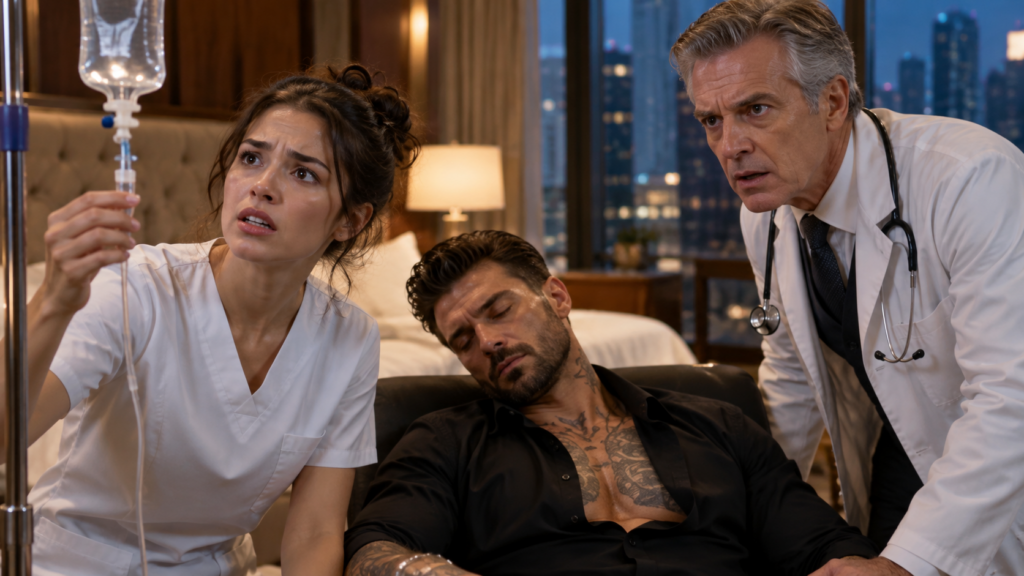
Beyond the wall of glass, the city stretched beneath a winter-dark sky, thousands of windows shining between towers like scattered embers. Inside, everything had been chosen to soften reality: walnut paneling, thick carpets, cream-coloured curtains, a chandelier whose warm light was reflected in polished brass, and furniture so carefully arranged that even silence seemed expensive.
Yet at the centre of that luxury sat an unconscious man.
He was still young, no more than his late twenties, tall enough that the deep armchair looked slightly too small beneath him. A black shirt hung open at the chest, revealing dark tattoo work that crossed his collarbone and disappeared beneath the fabric. More ink covered his forearms. His beard was neatly trimmed, but his complexion had become too pale for the warmth of the room.
Beside him stood a young nurse.
Her white medical scrubs looked almost severe against the rich interior. She was slim, composed, her dark hair gathered into a high bun that had begun to loosen after several hours of work. A few strands had escaped around her face, though she seemed unaware of them.
Her attention was fixed on the intravenous bag hanging beside the chair.
She had checked it once.
Then twice.
The third time, she stopped pretending she was merely being thorough.
Something was wrong.
Not dramatically wrong.
That was what frightened her most.
There was no broken seal obvious enough to turn suspicion into certainty, no label torn away, no visible contamination. Instead, several small inconsistencies sat beside one another like pieces of a sentence she did not want to finish.
The timing was wrong.
The patient’s response was wrong.
And the private notes left for her did not entirely match what she was seeing.
She glanced at the man.
His head rested against the chair, turned slightly toward the window. Earlier that evening, before his condition worsened, she had seen those same features animated by irritation and stubbornness.
He had not wanted a nurse.
He had made that clear.
“I’m not dying,” he had said.
She had been checking his pulse at the time.
“I didn’t say you were.”
“You have the expression.”
“What expression?”
“The one medical people have when they’re trying not to frighten someone.”
She had almost smiled.
“That’s simply my face.”
His mouth had curved despite himself.
It was the first sign that beneath the tattoos, expensive surroundings and guarded manner, he possessed a gentleness he rarely displayed.
Then his condition had deteriorated.
Now he was unconscious.
The memory made her look at the IV again.
Behind her came the quiet sound of a door opening.
The senior doctor entered the bedroom.
He was in his late fifties, grey-haired, distinguished, dressed in a dark suit and vest beneath a white medical coat. A stethoscope hung around his neck. He looked more like the private physician of an old European family than someone expected to manage an emergency in a bedroom overlooking the city.
He saw the nurse immediately.
Then he saw her hand on the IV line.
His expression changed.
“What are you doing?”
The nurse did not remove her hand.
“Checking something.”
“I can see that.”
She turned slightly toward him.
“How long has he been receiving this?”
The doctor’s face tightened.
“You have the notes.”
“The notes and the patient don’t agree.”
“You’re tired.”
“So is his body.”
The doctor stepped closer.
“Nurse.”
The single word carried authority.
She had heard that tone from senior physicians before. It was designed to remind a younger person of hierarchy without having to mention rank directly.
Usually, she respected it.
Tonight, she did not move.
Her fingers remained near the IV.
The doctor looked at the bag.
Then at her.
“What exactly have you changed?”
The nurse’s eyes hardened.
“Enough to find out whether my suspicion is right.”
For the first time, the doctor appeared genuinely unsettled.
Outside, the city remained beautiful.
Inside, something had already begun to unravel.
Chapter Two – What She Had Seen Before
The young nurse had learned early in her career that emergencies were rarely as dramatic as people imagined.
Most disasters did not announce themselves with alarms.
They began with small departures from the expected.
A pulse slightly different from the previous one.
Skin too cool.
A patient answering half a second too slowly.
A number on a chart that seemed harmless until placed beside another number recorded an hour earlier.
Medicine, she believed, was partly the discipline of refusing to ignore small things.
That belief had cost her popularity before.
It was about to cost her more.
The senior doctor stood several steps away, watching her.
“What did you change?” he repeated.
She did not answer immediately.
Instead she examined the unconscious man again.
His breathing had altered.
Barely.
But enough.
She bent closer, watching the rise and fall of his chest.
The doctor noticed.
“What?”
She pressed two fingers to the man’s wrist.
“His response is worsening.”
“He has been unstable all evening.”
“That is not an explanation.”
“It is a clinical fact.”
She looked at him.
“No. It’s a description.”
The doctor’s mouth tightened.
He had treated powerful families for decades. People trusted his discretion precisely because he never looked surprised, never raised his voice, and never allowed uncertainty to become visible.
The nurse was beginning to understand why his calmness bothered her.
It was not that he was composed.
It was that he seemed determined to remain composed even when reality changed.
She remembered the first time she had entered the suite that evening.
The unconscious man had still been awake then, though clearly unwell.
He had been sitting near the window with his black shirt open at the chest, one arm resting across his stomach. He had refused the bed because he said lying down made him feel worse.
The doctor had told him it was exhaustion.
The man had laughed.
“People keep calling everything exhaustion when they don’t want to explain it.”
The nurse had glanced up.
The doctor had not appreciated the comment.
Later, when she was alone with the patient for several minutes, he asked her quietly, “Do you believe him?”
She had known who he meant.
She should have answered professionally.
Instead she said, “I believe what I can verify.”
He had looked at her for a long moment.
“That sounds lonely.”
“What does?”
“Trusting evidence more than people.”
She had adjusted the blood-pressure cuff.
“Evidence usually doesn’t take it personally.”
That earned another faint smile.
There had been nothing romantic in the exchange.
Not really.
Yet the nurse remembered it now because of the way he had looked at her afterward.
Not as staff.
Not as a young woman expected to obey the older man in the room.
As someone whose opinion mattered.
That mattered more than she wanted it to.
Now he could not speak at all.
The doctor approached the IV stand.
“Step away.”
She remained where she was.
“You need to call emergency services.”
“No.”
The answer was immediate.
Too immediate.
The nurse stared at him.
“No?”
“He is already receiving care.”
“In a bedroom.”
“In a controlled private environment.”
“With no full resuscitation team, no immediate imaging, and no proper emergency support.”
The doctor’s expression sharpened.
“You are exceeding your role.”
“His condition is exceeding this room.”
For several seconds neither moved.
The chandelier gave off a soft, luxurious glow above them.
It was absurd how calm the room looked.
The nurse glanced again at the IV bag.
There it was.
The detail that had first bothered her.
Not a dangerous secret she could name yet.
Only an inconsistency.
Enough to demand caution.
She adjusted the line carefully, changing its flow and isolating what concerned her rather than allowing it to continue unquestioned.
The doctor saw.
“What have you done?”
She looked directly at him.
“What you should have done when he stopped responding normally.”
The doctor’s face lost colour.
Not much.
Only enough for her to see it.
And suddenly she understood something worse than disagreement.
He was afraid she might be right.
Chapter Three – The Man Who Had Not Wanted Saving
The unconscious man’s name had been spoken only twice that evening.
Once by the doctor.
Once by the man himself.
The nurse had remembered it anyway.
Perhaps because it did not suit the image she had first formed of him.
She expected someone arrogant.
Men treated in private suites rather than hospitals usually belonged to worlds built around insulation: money, reputation, family names, people who answered phones at impossible hours and arranged problems before they became public.
He looked like one of those men.
The tattoos complicated the impression.
So did the dark shirt.
So did the fact that when she had first entered, he had looked at her as though he disliked needing anyone.
Yet within minutes she realised his arrogance was partly embarrassment.
He hated being watched while weak.
She recognised that feeling.
Many people did not fear illness itself as much as they feared becoming visible through it.
At one point earlier in the evening, she had held a glass of water toward him.
He stared at it.
“I can hold it.”
“I know.”
“You’re still holding it for me.”
“Because your hand is shaking.”
He looked down.
It was.
His expression had changed then, the irritation giving way to something quieter.
“Don’t tell him.”
“Tell whom?”
“The doctor.”
She raised an eyebrow.
“I’m a nurse.”
“So that’s a no.”
“That’s a very definite no.”
He almost smiled.
Then he took the glass.
His fingers brushed hers accidentally.
A brief contact.
Nothing more.
Yet she remembered the coldness of his hand.
That detail returned now as she stood beside his unconscious body.
His hand was colder.
The senior doctor moved toward the chair.
“His pulse?”
“Less steady.”
“That can happen.”
The nurse looked at him.
“With what you believe is wrong?”
A pause.
“Yes.”
She did not like the pause.
“What exactly do you believe is wrong?”
“I told you.”
“No. You told me he was exhausted and under strain.”
“That remains likely.”
“Likely is not a diagnosis.”
The doctor’s patience finally cracked.
“You are not in a hospital ward, and I am not required to explain every clinical judgment to you.”
The nurse became very still.
There it was.
Not medical reasoning.
Authority.
She looked at the man in the chair.
“If he were conscious, would you explain it to him?”
“That is irrelevant.”
“No.”
Her voice softened.
“That is the only thing that matters.”
The doctor looked at her carefully.
“You are becoming emotionally involved.”
The accusation struck harder than she expected.
Not because it was completely false.
But because she had been trying so carefully not to examine that possibility.
She had met the man only hours ago.
She knew almost nothing about him.
Yet something in his guarded humour, his refusal to dramatise his condition, and the brief moments when he allowed uncertainty to appear had affected her.
Not romantically in the simple sense.
Not yet.
It was closer to recognition.
He seemed like someone accustomed to being judged before he spoke.
So was she.
Young.
Female.
A nurse rather than a doctor.
People often decided the limits of her intelligence before hearing her conclusion.
The man had not.
Earlier, when she questioned one of the instructions, he had simply asked, “Why?”
And then listened to the answer.
No condescension.
No smile.
No glance toward the senior doctor for confirmation.
She looked at him now.
“Being concerned is not the same as being compromised.”
The doctor crossed his arms.
“And what do you think is happening?”
“I think something in the treatment is not matching the condition we’re seeing.”
“That is vague.”
“Because I refuse to pretend certainty.”
The doctor’s gaze moved to the IV bag.
The nurse saw it.
A small flicker.
Again.
He was looking at it too often.
She felt cold.
“You knew.”
The doctor’s eyes returned to hers.
“Knew what?”
“You knew something about this wasn’t right.”
“That is an accusation.”
“No.”
She stepped closer to the IV.
“It is a question.”
Outside, a distant siren moved through the city streets far below.
For one strange second it sounded close enough to matter.
Then it faded.
The unconscious man shifted slightly in the chair.
Both medical professionals turned immediately.
His head moved.
His shoulders tightened.
The nurse stepped toward him.
“Can you hear me?”
No response.
Then his body began to slide.
And the evening changed.
Chapter Four – The Fall
At first the movement seemed small.
The unconscious man’s shoulder slipped against the back of the chair.
His head tilted.
The nurse reached toward him instinctively.
Then his entire weight shifted.
“Doctor.”
The warning came just before the man slumped sideways.
The nurse caught part of his upper body, but he was too heavy for her to hold alone. His long frame slid from the chair toward the carpet.
The senior doctor moved at last.
Together they prevented the fall from becoming uncontrolled, lowering him as safely as they could.
Yet the sight of him on the floor transformed the room.
Until then, the luxury suite had allowed the illusion that this was merely private treatment.
Now there was a young man lying unconscious beneath a chandelier.
No furniture could disguise that.
The nurse dropped to her knees beside him.
“Call an ambulance.”
The doctor stared down.
“Wait.”
She looked up.
“No.”
“We need to reassess.”
“I am reassessing him.”
Her voice was sharp now.
“Call an ambulance.”
The doctor did not move.
The nurse reached toward her phone.
He saw it.
“Stop.”
She froze.
The word itself was not what shocked her.
It was the fear behind it.
The doctor had finally lost his composure.
“Why?”
He looked toward the windows.
Toward the door.
Anywhere except her.
The nurse’s suspicion hardened.
“Why do you not want him transferred?”
“That is not what I said.”
“It is exactly what you keep doing.”
The unconscious man’s breathing remained present but worrying.
The nurse focused again on him.
She did not allow herself to imagine consequences beyond the next minute.
She checked what she could.
Observed.
Protected his position.
Spoke his name.
No response.
“Ambulance,” she said again.
The doctor remained standing.
“Nurse—”
She looked up with such controlled anger that he stopped.
“If you want to explain yourself, do it while help is coming.”
The doctor’s face hardened.
“You do not understand the circumstances.”
“Then explain them.”
He said nothing.
“Is this about privacy?”
Silence.
“His family?”
Still nothing.
“His reputation?”
The doctor finally spoke.
“You have no idea what you’re interfering with.”
The nurse stared at him.
Then, unexpectedly, her anger cooled.
Because she understood something.
Whatever the secret was, the doctor believed it mattered.
Perhaps deeply.
Perhaps for reasons that were not entirely selfish.
But none of that changed the man on the floor.
“He is not a reputation,” she said.
The doctor looked at her.
“He is not an arrangement. He is not a family problem. He is not something to manage quietly.”
She glanced toward the unconscious man.
“He is a patient.”
The doctor closed his eyes briefly.
For the first time that evening he looked old.
Not distinguished.
Old.
The nurse dialled emergency services.
He did not stop her.
As she spoke, giving the location and describing the collapse without speculation, she watched the doctor.
He stood near the IV bag.
His gaze fixed on it.
Something in his face had changed.
Recognition.
Not of the collapse.
Of the reason.
When the call ended, the nurse followed his eyes.
“You know.”
The doctor did not answer.
She stood slowly.
“What is it?”
He looked at the bag again.
Then at the man on the floor.
His mouth opened.
No words came.
The nurse felt fear move through her more sharply than before.
Because the doctor was no longer defending his judgment.
He was staring at the IV as if seeing the truth for the first time.
Chapter Five – A Truth Without a Name
The ambulance was on its way.
That fact should have brought relief.
Instead the room grew more tense.
The nurse remained beside the unconscious man, monitoring him while listening for changes.
The doctor stood near the IV stand.
He had not touched it.
The nurse noticed that too.
Earlier he had been determined to control everything.
Now he seemed afraid of disturbing evidence he did not yet fully understand.
“Tell me what you’re seeing,” she said.
The doctor looked at her.
“You changed the line.”
“I reduced what concerned me and isolated it.”
“You should not have done that without instruction.”
“If I hadn’t?”
He did not answer.
She looked at his face.
“If I hadn’t, would he have deteriorated faster?”
Silence.
The nurse felt her stomach tighten.
“I’m not asking whether I followed hierarchy. I’m asking whether my concern was medically justified.”
The doctor removed his glasses.
He cleaned them though there was nothing on the lenses.
A delaying gesture.
When he put them back on, his expression had become heavier.
“There may have been an error.”
The nurse stared.
“An error?”
“Do not turn one sentence into a conclusion.”
“You just spent an hour telling me there was nothing wrong.”
“I said the situation was controlled.”
“It wasn’t.”
The words landed with unusual force.
The doctor looked toward the man.
“No.”
It was the first clean admission.
The nurse swallowed.
The doctor lowered himself into the chair the patient had fallen from.
For a moment he looked defeated by the shape of the room.
“What happened?” she asked.
“I don’t know yet.”
“That’s not enough.”
“It is what I have.”
She wanted to be furious.
Instead she heard exhaustion in his voice.
He was not behaving like someone caught deliberately harming a patient.
He looked like someone realising that his confidence had prevented him from seeing something.
The distinction mattered.
It did not excuse anything.
But it mattered.
The doctor looked at the IV again.
“The preparation should have been reviewed.”
“By whom?”
He hesitated.
“I reviewed it.”
The nurse became still.
“And?”
“I believed it matched the plan.”
“You believed.”
“Yes.”
“What changed?”
“I may have been working from an earlier instruction.”
The nurse stared at him.
“How much earlier?”
He did not answer immediately.
“Doctor.”
“Long enough that it should have been rechecked.”
She looked away.
Her anger returned.
Quietly this time.
“This is why I questioned the notes.”
“I know.”
“You dismissed me.”
“I know.”
“You accused me of becoming emotionally involved.”
His eyes lowered.
“Yes.”
For several seconds the only sound was the low hum of the suite ventilation.
Then the nurse said something she had not expected to say.
“You were frightened before I was.”
The doctor looked up.
She continued.
“That is why you wanted control.”
His face changed slightly.
He did not confirm it.
He did not need to.
The nurse understood now that the luxury suite was not merely a preference.
It was part of a larger effort to keep the man’s condition private.
Perhaps because the man had demanded it.
Perhaps because others had.
Perhaps because the doctor had convinced himself discretion was kindness.
The reasons could be examined later.
Right now, the man remained unconscious.
The nurse looked down at him.
His beard, dark against pale skin.
The tattoos.
The black shirt.
The hand that had trembled around a glass of water earlier.
She remembered his question.
Do you believe him?
At the time, she thought he meant the doctor’s diagnosis.
Now she wondered whether he had been asking something larger.
Whether he had already suspected that something about the arrangement was wrong.
The nurse felt a painful tenderness she did not want.
He had trusted her instinct before she trusted it herself.
And now he could not know that she had finally acted on it.
She looked toward the window.
Far below, traffic moved aside.
A siren was approaching.
This time, it did not fade.
Chapter Six – Before He Lost Consciousness
While they waited, the nurse found herself remembering the last conversation she had had with him.
It had happened less than an hour before he became unresponsive.
He was still sitting near the window then.
The doctor had briefly left the suite to take a call.
The nurse was checking equipment.
The man watched her.
“You don’t like this arrangement.”
She did not look up.
“What arrangement?”
“Being here.”
“I’m working.”
“That wasn’t what I asked.”
She glanced at him.
His eyes were tired but alert.
“You should be in a proper medical setting.”
“I’ve been told.”
“And?”
“And I dislike hospitals.”
“So does almost everyone in them.”
He smiled faintly.
“Very comforting.”
She returned to the equipment.
After a pause, he said, “My father died in one.”
The nurse stopped.
It was the first personal thing he had told her.
She looked back.
He stared toward the city.
“I was seventeen. Everything smelled like disinfectant and burnt coffee. Every person who came through the door had a new expression they were trying to hide.”
“I’m sorry.”
He shrugged.
Not dismissively.
Defensively.
“I know it’s irrational.”
“No.”
He looked at her.
“No?”
“Fear doesn’t need to be rational to be real.”
Something changed in his face.
It was a small thing.
The guarded expression loosened.
“That’s almost kind.”
“Don’t become attached to it.”
He laughed.
The sound surprised her.
It was low and brief, but genuine.
For one moment the room seemed less clinical.
Then his smile faded.
“What would you do?”
“If?”
“If you were me.”
The nurse frowned.
“I’m not you.”
“I know.”
“That makes the question dangerous.”
“Still.”
She considered.
“I would want to know what was actually wrong before deciding where I wanted to be treated.”
He watched her.
“That is exactly what I asked him.”
“The doctor?”
“Yes.”
“And?”
“He said the same thing three different ways.”
She understood the implication.
No clear answer.
He looked at the IV.
“Do you trust this?”
The nurse followed his gaze.
“At the moment, I have no reason not to.”
He smiled faintly.
“That sounds less reassuring than you think.”
She almost replied.
Then the doctor returned.
The conversation ended.
Now, kneeling beside him after his collapse, the nurse remembered every word.
Do you trust this?
She looked at the IV bag.
Her throat tightened.
Perhaps he had noticed something before anyone else.
Not technically.
Intuitively.
He had known his body felt wrong.
And because the doctor carried authority, everyone had treated that feeling as anxiety rather than information.
Including her.
The realisation hurt.
She leaned slightly closer to the unconscious man.
“I’m sorry.”
The doctor heard.
“For what?”
She did not look up.
“For not listening soon enough.”
The doctor’s expression shifted.
“You did listen.”
“Eventually.”
“That matters.”
She looked at him.
“Does it?”
“Yes.”
His answer carried more emotion than she expected.
Perhaps he was speaking to himself too.
The approaching siren grew louder.
The nurse felt the strange urge to take the unconscious man’s hand.
She did not.
Professional boundaries mattered, especially now.
Instead she adjusted the blanket beneath his shoulder and spoke his name again.
There was no response.
Yet she kept talking.
“Help is here.”
The doctor watched her.
“You care about him.”
The nurse’s hands stopped.
She looked up.
“That is my job.”
“No.”
The doctor’s voice was quiet.
“That is not what I meant.”
The nurse looked back at the unconscious man.
Her answer took a long time.
“I don’t know him well enough to care the way you mean.”
The doctor nodded.
Perhaps accepting the denial.
Perhaps not.
The nurse continued more quietly.
“But I think he deserved to be believed.”
Outside the suite, the lift bell sounded.
Help had arrived.
Chapter Seven – The Doctor’s Confession
The arrival of the emergency team stripped the suite of its illusion.
Suddenly there were professional bags on the carpet, urgent voices, clipped questions, and movement that belonged to a hospital rather than a luxury bedroom.
The nurse gave a concise account.
She did not speculate.
She explained the man’s deterioration, the collapse, and the concern surrounding the infusion.
When one of the responders asked who had authorised the treatment, the senior doctor answered.
“I did.”
The nurse looked at him.
His voice was steady again.
But this time the steadiness felt different.
Not concealment.
Responsibility.
The doctor handed over the relevant information and did not attempt to soften what had happened.
The nurse noticed.
So did he.
Their eyes met briefly.
Neither spoke.
As the team worked, the nurse stepped back enough to give them space.
Her hands began trembling only then.
Adrenaline leaving the body was cruel in that way.
It allowed calm when calm was necessary and demanded payment afterward.
The doctor saw her.
“You should sit.”
She almost laughed.
“That is the first sensible order you’ve given me tonight.”
A faint shadow of a smile crossed his face.
Then vanished.
He stood beside her near the window.
For a while they watched the emergency team prepare the patient for transfer.
Finally the doctor spoke.
“I should have listened to you.”
The nurse kept her eyes forward.
“Yes.”
He seemed almost surprised by the directness.
She turned toward him.
“You want me to tell you it was understandable.”
“No.”
“Good.”
The doctor nodded.
“I was wrong.”
There was no defence in the statement.
The nurse’s anger loosened slightly.
Not disappeared.
Changed.
“Why did you keep him here?”
The doctor looked toward the patient.
“He insisted.”
“That’s all?”
“No.”
She waited.
“His family values privacy above almost everything.”
The nurse said nothing.
“He has spent his adult life being photographed, discussed, watched. Every weakness becomes a story for someone else.”
“So you protected his privacy.”
“I thought I was.”
“At the expense of safety.”
The doctor closed his eyes briefly.
“Yes.”
The nurse looked toward the man.
“That sounds like something he would hate.”
The doctor opened his eyes.
“What?”
“People deciding for him in order to protect him.”
The older man considered that.
Then, unexpectedly, he smiled sadly.
“You understood him quickly.”
The nurse felt heat rise unexpectedly to her face.
“I observed him.”
“That is not quite the same thing.”
She ignored the comment.
The doctor continued.
“He does not trust easily.”
“I noticed.”
“He also rarely asks directly for help.”
“I noticed that too.”
The doctor studied her.
“You are very observant.”
“That is supposed to be part of my job.”
“Yes.”
There was shame in the word.
Because he had not respected that skill when it challenged him.
The emergency team began moving the patient toward the door.
The nurse instinctively stepped forward.
One of them asked whether she was coming.
She looked at the senior doctor.
He answered before she could.
“She should.”
The nurse stared.
The doctor met her gaze.
“He knows her.”
The words affected her more than they should have.
Technically, the man barely knew her.
A few conversations.
A few observations.
A glass of water.
Questions exchanged across an expensive room.
Yet the doctor had seen something she had been refusing to name.
Trust had formed.
Small.
Fragile.
But real.
The nurse followed the stretcher.
At the door she stopped.
The doctor remained behind for a moment, looking at the IV bag.
His face had changed completely since the evening began.
Authority had given way to uncertainty.
But perhaps uncertainty was not the worst thing that could happen to a doctor.
Sometimes it was the beginning of honesty.
He picked up the bag carefully to accompany the transfer.
Then followed them out.
Chapter Eight – The Lift Down
The lift descended slowly.
Too slowly.
The unconscious man lay secured on the stretcher.
The nurse stood beside him.
The senior doctor occupied the opposite corner, holding the documentation and the isolated IV materials that would need further review.
No one spoke at first.
The mirrored walls made the small space feel crowded.
The nurse looked at the man’s reflection.
His face appeared paler beneath the artificial light.
She remembered how different he had looked earlier, sitting beside the window with irritation in his eyes.
She wanted that version back.
The thought arrived before she could stop it.
Not simply awake.
Him.
She had seen dozens of unconscious patients.
She cared about them.
She worried.
She worked.
But this felt different.
She disliked admitting it.
The senior doctor seemed to read something in her expression.
“You are afraid.”
She looked at him.
“So are you.”
“Yes.”
That honesty surprised her.
The older man looked toward the stretcher.
“I have known him since he was a child.”
The nurse stared.
“You never said that.”
“It was not relevant.”
“It seems relevant now.”
The doctor nodded.
“Perhaps.”
He loosened his tie slightly.
Another small sign of collapse in the formal armour he had worn all night.
“He has always hated being treated as fragile.”
“Because of his father?”
The doctor looked at her sharply.
“He told you?”
“Yes.”
The doctor was quiet.
“He rarely speaks about that.”
The nurse looked down.
Again, she felt the significance of something she had assumed was casual.
The man had trusted her with a memory.
Not because they were close.
Perhaps because they were strangers.
Sometimes strangers were safer.
No history.
No expectations.
The doctor said, “His father’s death changed the entire family.”
The nurse did not ask for details.
The doctor continued anyway.
“Afterward, everyone became obsessed with preventing another loss.”
“And that became control.”
The doctor looked at her.
“Yes.”
The lift continued downward.
The nurse watched the changing floor numbers.
“He knew you were doing it.”
“What?”
“Protecting him too much.”
The doctor gave a tired smile.
“He has accused me of that for years.”
“Maybe you should have believed him.”
“I am beginning to understand that.”
The nurse looked at the man on the stretcher.
She wondered what he would say when he woke.
If he woke quickly.
The thought frightened her.
She immediately corrected herself.
When.
She did not usually indulge in comforting language.
Tonight she needed one word.
When.
The lift doors opened.
Cooler air rushed in from the lobby.
The emergency team moved quickly.
The city beyond the glass entrance remained awake.
Cars passed.
People walked beneath umbrellas.
No one outside knew that a man had nearly disappeared quietly in a bedroom high above them.
The nurse followed.
Before they reached the ambulance, the senior doctor touched her elbow lightly.
She turned.
He withdrew his hand immediately.
“I owe you an apology.”
“You already said you were wrong.”
“That was professional.”
“And this?”
“Personal.”
She waited.
“I treated your concern as emotion because that was easier than reconsidering my own judgment.”
The nurse looked at him.
The words mattered.
Not enough to erase the mistake.
Enough to mark it honestly.
“Don’t do it again.”
The doctor nodded.
“I won’t.”
She turned toward the ambulance.
Then he said, “He was right about you.”
She stopped.
“What?”
“Earlier. Before he lost consciousness.”
The nurse’s heart tightened.
“What did he say?”
The doctor looked toward the stretcher.
“That you were the only person in the room who kept looking at him instead of the problem around him.”
The nurse could not answer.
The ambulance doors opened.
She climbed inside.
Chapter Nine – The Hours Without Answers
Hospitals had a different kind of night.
In the luxury suite, darkness had been softened by chandeliers and skyline views.
Here, night was fluorescent.
Corridors remained bright regardless of the hour. Machines sounded from behind curtains. Shoes moved quickly across polished floors. Coffee cooled untouched beside workstations.
The nurse belonged in this environment.
Yet she had never felt more uncertain.
The unconscious man had been transferred into the appropriate care pathway.
The senior doctor remained available, answering questions and providing records.
The nurse had technically completed her role in the private suite.
She could leave.
She did not.
At first she justified staying professionally.
There might be questions.
She had observed the progression most closely.
She had adjusted the IV and needed to explain exactly what she had changed.
All true.
After those questions were answered, she remained.
That truth was harder.
She sat alone for several minutes near a window at the end of the corridor.
The city looked different from here.
Lower.
Less beautiful.
More honest.
The senior doctor eventually joined her.
“He’s stable enough for continued evaluation.”
The nurse exhaled slowly.
“Stable.”
“Yes.”
Not safe.
Not recovered.
But better than before.
She nodded.
The doctor sat several chairs away.
They had become cautious with one another.
Neither wanted false familiarity after conflict.
After a while, he said, “You were correct.”
The nurse looked at him.
“About the IV?”
“There was enough discrepancy to justify stopping and reassessing.”
She absorbed the words.
“What caused it?”
“We don’t have the complete answer yet.”
She appreciated that he did not invent certainty.
“Was it deliberate?”
The doctor looked at her carefully.
“There is no evidence that it was.”
The nurse nodded.
That mattered.
She did not want a melodramatic villain.
Reality was often more frightening.
A chain of assumptions.
An outdated instruction.
A rushed review.
A private environment chosen because it seemed comfortable.
One error amplified by another.
People did not need evil intentions to create danger.
Sometimes confidence was enough.
The nurse stared through the window.
“He asked me whether I trusted the IV.”
The doctor turned.
“When?”
“Before he became unconscious.”
The older man’s expression changed.
“He did?”
“Yes.”
“What did you say?”
“That I had no reason not to.”
The nurse looked down at her hands.
“He knew something felt wrong.”
“You could not have known.”
“I could have listened more.”
“You did listen.”
“Not immediately.”
The doctor leaned back.
“Be careful.”
She looked at him.
“You are about to make my mistake in reverse.”
“What does that mean?”
“I believed expertise made me responsible for everything. You are beginning to believe awareness should have made you responsible for everything.”
The nurse was silent.
The doctor continued.
“Neither is true.”
She hated that he had a point.
After several minutes, the nurse asked, “When he wakes, will he remember?”
“Probably most of the evening before losing consciousness.”
She nodded.
The thought of seeing him awake created an unexpected nervousness.
She did not understand why.
She had done nothing wrong.
Yet their last real conversation had occurred before everything collapsed.
He had trusted her.
Then she had acted.
What would exist between them now?
Gratitude?
Embarrassment?
Nothing?
The doctor watched her.
“You should go home.”
“I know.”
“You won’t.”
“No.”
A faint smile touched his face.
“You are stubborn.”
“So is he.”
“Yes.”
The doctor looked toward the treatment area.
“That may become a problem.”
The nurse smiled despite herself.
It was the first moment of humour since the collapse.
And because she smiled, she finally admitted something privately.
She wanted him to wake up not only because she was his nurse.
She wanted to hear his voice again.
Chapter Ten – When He Opened His Eyes
It was almost morning when the message came.
He was awake.
The nurse stood too quickly.
The senior doctor saw.
Neither commented.
She followed him into the room.
The patient looked different beneath hospital lighting.
Less mysterious.
More human.
His black shirt had been replaced by appropriate hospital garments during treatment, but the tattoos across his arms remained visible. His beard looked darker against tired skin.
His eyes were open.
Unfocused at first.
Then they moved toward the doctor.
Finally toward her.
The nurse stopped near the foot of the bed.
Recognition came slowly.
His brow tightened.
“You.”
His voice was rough.
She felt something inside her loosen.
“Yes.”
He looked around.
“This is a hospital.”
“Yes.”
A faint expression of betrayal appeared.
“I specifically requested…”
The nurse folded her arms.
“You collapsed.”
He closed his eyes.
“That seems unfair.”
The senior doctor laughed once.
The patient opened his eyes again and looked at him.
“You’re laughing?”
“I am relieved enough to allow myself one.”
The man’s attention returned to the nurse.
“What happened?”
She glanced at the doctor.
The older man nodded.
No concealment now.
The nurse explained simply.
She did not dramatise.
She said that his condition worsened, she became concerned about the treatment setup, the doctor challenged her intervention, and then he collapsed.
His eyes moved toward the senior doctor.
“You challenged her?”
The doctor sighed.
“Yes.”
“That sounds stupid.”
“It was.”
The patient stared.
The doctor added, “You may enjoy repeating that later.”
“I intend to.”
The nurse almost smiled.
The patient caught it.
For a second their eyes held.
The earlier room returned between them.
His question.
Her answer.
Evidence usually doesn’t take it personally.
He looked at her.
“You believed yourself.”
She frowned.
“What?”
“When it mattered.”
The nurse felt unexpectedly exposed.
“I almost didn’t.”
“But you did.”
The room became quiet.
The doctor looked between them.
Then, with considerable tact for someone who had lacked it earlier, he stepped toward the door.
“I need to speak with the team.”
Neither stopped him.
The door closed.
The nurse immediately became aware that she was alone with the man.
He looked at the chair beside the bed.
“You can sit.”
“I’m fine.”
“That means you’re tired.”
She raised an eyebrow.
“You’ve known me one evening.”
“Long enough to learn that.”
She sat.
For a moment neither spoke.
Then he said, “Thank you.”
The nurse looked down.
“You don’t have to.”
“I know.”
“That makes it worse.”
His mouth curved faintly.
“Why?”
“Because people say thank you when they think a debt has been created.”
“And?”
“I don’t want you to feel indebted.”
He studied her.
“Then I won’t.”
The simplicity of the answer surprised her.
He looked toward the ceiling.
“Was I right?”
“About what?”
“That something was wrong.”
She hesitated.
“Yes.”
He closed his eyes briefly.
Not triumph.
Relief.
When he opened them again, he looked at her differently.
“I thought I was imagining it.”
The nurse felt the weight of that sentence.
“No.”
He nodded.
Then, quietly, “You were the only person who didn’t make me feel ridiculous.”
She looked away.
The emotion in her chest had become dangerous.
Not dramatic.
Not a love story born from crisis.
Something slower.
The possibility of being seen.
She stood.
“You should rest.”
He watched her.
“Will you be here later?”
The question stopped her.
She turned.
Professionally, she had no reason to promise.
Personally, she wanted to.
“I don’t know.”
He nodded, accepting the answer.
That made it harder.
At the door, she looked back.
His eyes were already closing.
She left before he could see her smile.
Chapter Eleven – What the Doctor Finally Understood
The senior doctor was waiting in the corridor.
He stood beside the window with his coat folded over one arm.
For the first time, he looked like an ordinary man nearing the end of a difficult night.
The nurse stopped beside him.
“He asked whether you would come back.”
She looked at him.
“You were listening?”
“No. He asked me before you went in.”
That surprised her.
“What did you say?”
“That it was your decision.”
She smiled faintly.
“You’re learning.”
“So I’m told.”
They stood in silence.
The city was becoming pale beyond the glass.
Morning.
The doctor looked at his reflection.
“I became a private physician because I believed continuity mattered.”
The nurse listened.
“I watched hospitals become places where patients were transferred between people who knew only fragments of them. I wanted to offer something different.”
“That isn’t wrong.”
“No.”
He looked toward the patient’s room.
“But somewhere along the way, I began confusing continuity with control.”
The nurse said nothing.
He continued.
“His family trusted me because I could keep difficult things quiet.”
“And eventually quiet became more important than right.”
The doctor nodded.
“Yes.”
There was no melodrama in the confession.
That made it more painful.
The nurse looked through the glass.
“You know what frightened me most?”
“What?”
“You were not careless.”
The doctor turned.
“You were experienced.”
He absorbed the words.
She continued.
“If someone careless makes a mistake, everyone understands the danger. But when someone experienced stops questioning himself…”
The doctor gave a sad smile.
“That is harder to see.”
“Yes.”
He nodded.
“You were right.”
She almost laughed.
“Please stop saying that. I’m beginning to dislike hearing it.”
“Why?”
“Because I don’t want the story to become that I was right and you were wrong.”
The doctor looked genuinely surprised.
“What should it become?”
“That he survived because eventually people stopped protecting their pride.”
The doctor considered this.
Then nodded.
“That is fair.”
They stood together for another moment.
The nurse looked toward the patient’s room.
The doctor followed her gaze.
“You like him.”
She sighed.
“We are not doing this.”
“I am nearly sixty. I have earned the right to notice obvious things.”
“It is not obvious.”
“It is extremely obvious.”
She looked at him sharply.
The doctor smiled.
For the first time, warmth existed between them without tension.
The nurse looked away.
“I barely know him.”
“That has never prevented interest.”
“Interest is not romance.”
“No.”
“And crisis can create false closeness.”
“Yes.”
She looked at him.
“You’re not going to argue?”
“I learned something tonight.”
She laughed softly.
Then became serious.
“I don’t want him to think I stayed because I expect something.”
“Then tell him that.”
“I don’t want to complicate his recovery.”
“Then don’t.”
She frowned.
“That is unhelpful.”
The doctor shrugged.
“You wanted less control from me.”
She smiled despite herself.
Fair.
The patient’s room remained quiet.
The doctor began walking away.
Then stopped.
“One thing.”
She waited.
“He noticed you before you noticed him.”
The nurse’s expression changed.
“What?”
“Earlier in the evening.”
The doctor looked almost amused now.
“He asked who you were.”
“Why?”
“He said you were the only person in the suite who looked annoyed by the furniture.”
The nurse stared.
The doctor walked away before she could answer.
She looked through the glass again.
The man was asleep.
For the first time that night, the nurse allowed herself to imagine another conversation after all of this.
Not as patient and nurse.
Not as rescuer and rescued.
Simply two people.
The possibility frightened her.
That was how she knew it mattered.
Chapter Twelve – Morning Without a Chandelier
Several hours later, sunlight entered the hospital room.
It was weak winter light, pale and ordinary.
No chandelier.
No polished wood.
No skyline glowing against darkness.
The luxury suite now felt like a dream from another life.
The patient was awake again.
The nurse had almost left twice.
Both times she found another practical reason to remain.
On the third attempt, she admitted there were no more practical reasons.
She entered his room anyway.
He looked toward her.
“You came back.”
She leaned against the doorframe.
“For five minutes.”
“That sounds strictly regulated.”
“It is.”
He smiled.
Colour had returned slightly to his face.
The sight relieved her more than she allowed herself to show.
“How do you feel?”
“Like everyone knows something I don’t.”
“That is because you were unconscious for the interesting part.”
“I hate missing important meetings.”
“This one was badly organised.”
He laughed.
Then winced slightly.
The nurse became serious.
“Don’t do that.”
“Laugh?”
“Pretend you’re fine.”
His expression softened.
“Yes, nurse.”
She gave him a look.
“Do not make that sound flirtatious.”
“I didn’t.”
“You did.”
“Maybe a little.”
She looked away to hide a smile.
For a moment, the tension became surprisingly light.
Then his face grew serious.
“Why did you stay?”
The question she had been avoiding.
She could have answered professionally.
She chose not to.
“Because I wanted to know you were all right.”
He studied her.
“That sounds personal.”
“It may be.”
Silence.
The nurse felt her pulse quicken.
She continued before fear could make her retreat.
“But I don’t want you confusing gratitude with anything else.”
He nodded.
“I won’t.”
“And I don’t want this night turning into some dramatic story where you think I saved you.”
“You didn’t?”
She raised an eyebrow.
He smiled.
“Sorry.”
She continued.
“You were already telling us something was wrong. I finally listened.”
The man looked at his hands.
“It didn’t feel like anyone was listening.”
“I know.”
He looked up.
“That is why it mattered.”
The room became quiet.
Outside, carts moved along the corridor.
A nurse laughed somewhere far away.
Ordinary morning sounds.
The young woman suddenly appreciated them.
The patient looked at her.
“When I’m discharged…”
She waited.
He hesitated.
For the first time since meeting him, he seemed genuinely nervous.
“When I’m discharged, would it be inappropriate to ask you for coffee?”
The nurse stared.
He added quickly, “After everything professional is finished.”
She crossed her arms.
“Extremely inappropriate.”
His face fell slightly.
She let him suffer for two seconds.
“Which does not necessarily mean no.”
His expression changed.
“That was cruel.”
“I’ve had a difficult night.”
He smiled.
“So have I.”
She moved toward the door.
He called her name.
She stopped.
He had remembered it.
Something about that touched her more than the invitation.
“Yes?”
His expression became serious again.
“Thank you for believing what you saw.”
The nurse looked at him.
Then she thought of the luxury suite.
The IV.
The confrontation.
His body sliding from the chair.
The doctor staring at the bag when truth finally replaced certainty.
She thought about how close everything had come to remaining hidden behind beautiful furniture and professional confidence.
“No,” she said softly.
“Thank you for telling me something felt wrong before I knew how to prove it.”
He held her gaze.
A quiet understanding passed between them.
Nothing dramatic.
No promise.
No declaration made under the pressure of survival.
That would have been too easy.
Instead, there was simply the recognition that each had given the other something small and difficult.
He had trusted her attention.
She had trusted her doubt.
The senior doctor appeared briefly outside the room.
He looked through the glass.
The nurse noticed him.
For a moment, their eyes met.
He glanced toward the patient, then back toward her.
A small nod.
Nothing more.
It carried an entire night inside it.
The nurse turned toward the door.
“I have to go.”
The patient looked disappointed but did not ask her to stay.
That mattered.
She paused.
“Rest.”
“I’ll try.”
“And listen to your doctors.”
His eyebrow lifted.
“All of them?”
She smiled.
“Especially the ones who admit when they’re wrong.”
He laughed softly.
This time she let him.
She left the room and walked down the corridor.
Morning light stretched across the floor.
Behind her, the man remained alive, awake, and no longer hidden in a private room high above the city.
Ahead of her waited another shift, another set of patients, another ordinary day.
Yet she knew the night had changed something.
Not because it had produced a romance.
That would come later, if it came at all.
It had changed her because she had learned that professional courage was not certainty.
Sometimes courage was the willingness to say, something is wrong, while everyone more powerful insisted otherwise.
The doctor had learned something too.
Experience without doubt could become dangerous.
Protection without consent could become control.
Privacy without accountability could become a wall no one knew how to cross.
And the unconscious man, once he recovered, would perhaps learn the hardest lesson of all.
Needing help did not make him weak.
It simply made him human.
Weeks later, if they met over coffee without uniforms, IV lines, doctors, or fear between them, perhaps neither would mention the exact moment the connection began.
Maybe it began when he asked whether she trusted the treatment.
Maybe when she refused to stop questioning it.
Maybe when he woke and recognised her.
Or perhaps it began even earlier, with two strangers looking at one another in an expensive room and sensing that both were tired of being told what they were supposed to believe.
Some relationships began with attraction.
Others began with coincidence.
Theirs, if it became anything at all, began with doubt.
And with the quiet decision to take another person seriously.