At 3:17 on a Tuesday afternoon, fourteen-year-old Amina Yusuf was sitting in the medical room of a secondary school in Birmingham because she had forgotten her inhaler.
Nothing about the afternoon seemed important.
Outside, rain tapped against the narrow windows. Students were moving between lessons. Somewhere in the corridor, a teacher was telling a group of Year Nine boys to stop running.
Amina sat on the edge of the examination couch in her school blazer while the school nurse, Helen Ward, filled in a routine form.
“Still the blue inhaler?”
Amina nodded.
“Any changes to your medication?”
“No.”
“Going anywhere nice over the summer?”
Helen asked the question without looking up.
She asked almost every student the same thing at that time of year.
Amina hesitated.
“Maybe.”
Helen continued writing.
“Maybe where?”
“The Gambia.”
That made sense. Amina’s mother, Mariama, had grown up there and still had relatives outside Banjul.
“How long?”
“Three weeks.”
“Family visit?”
Amina nodded.
Then she added:
“My aunt says it’ll be different after this one.”
Helen looked up.
“What will be different?”
Amina immediately shrugged.
“I don’t know.”
Helen smiled gently.
“All right.”
She did not push.
Amina found her spare inhaler, thanked her, and left.
The conversation should have ended there.
But while Helen was putting the paperwork away, she noticed something written in the section completed by Amina’s mother.
Travel dates:
19 July to 11 August.
Beside them, in pencil, someone had written:
Family ceremony — second week.
Helen stared at the words for a moment.
A family ceremony could mean anything.
A wedding.
A naming ceremony.
A birthday.
A religious celebration.
There was no reason to assume the worst.
She closed the file.
At 3:40, she reopened it.
For the next two days, nothing happened.
Then Amina’s English teacher, Rachel Morgan, mentioned something casually in the staff room.
“Amina Yusuf seems distracted.”
Helen looked up.
“How?”
“She normally hands everything in early. Yesterday she forgot her homework.”
“That happens.”
“Yes.”
Rachel stirred her coffee.
“She also asked me whether parents can make you travel somewhere.”
Helen stopped.
“What exactly did she ask?”
Rachel thought about it.
“She said, ‘If your parents buy a ticket, do you have to go?’”
“Did you ask why?”
“She said it was nothing.”
Helen felt the same small discomfort return.
Still, nothing proved anything.
On Friday morning, she asked Amina to stop by the medical room before lunch.
Amina arrived looking suspicious.
“Am I in trouble?”
“No.”
“Then why am I here?”
Helen indicated the chair.
“Sit down.”
Amina stayed standing.
Helen did not mention FGM.
She simply asked about the trip.
“Are you looking forward to seeing your family?”
Amina looked toward the door.
“Some of them.”
“Not all?”
“My aunt talks too much.”
“What does she talk about?”
Amina gave a nervous smile.
“Everything.”
Helen waited.
Amina finally sat down.
“She says English girls forget where they come from.”
“What does she mean?”
“I don’t know.”
“You do know.”
Amina stared at her hands.
Her fingernails were painted pale purple.
“My cousin had a ceremony last year.”
Helen kept her face neutral.
“What kind of ceremony?”
Amina shook her head.
“She said I shouldn’t talk about it.”
“Who?”
“My mum.”
Helen’s voice became quieter.
“Did your mother tell you what will happen during your trip?”
“No.”
“Has anyone said something will happen to your body?”
Amina froze.
It was a very small reaction.
But it was enough.
Helen leaned forward slightly.
“Amina?”
“My aunt says everyone in the family does it.”
“What does she mean by ‘it’?”
Amina’s eyes filled immediately.
“I don’t know.”
Helen did not ask her to describe anything.
She did not need to.
“Are you frightened?”
Amina nodded.
“Has anyone threatened you?”
“No.”
“Has your mother said you have to do something?”
Amina wiped her face with her sleeve.
“She says it’s not like people here say.”
“What does she say?”
“That people exaggerate.”
Helen felt a knot tighten in her stomach.
Amina continued.
“She says Grandma would never hurt me.”
Helen answered carefully.
“Do you want this ceremony?”
“No.”
The answer came instantly.
That changed everything.
By midday, the school’s designated safeguarding lead had been informed.
Amina was kept in school while the appropriate safeguarding procedures were started.
Nobody confronted her mother immediately.
Nobody called the newspapers.
Nobody posted anything online.
The school treated it as a child-protection concern.
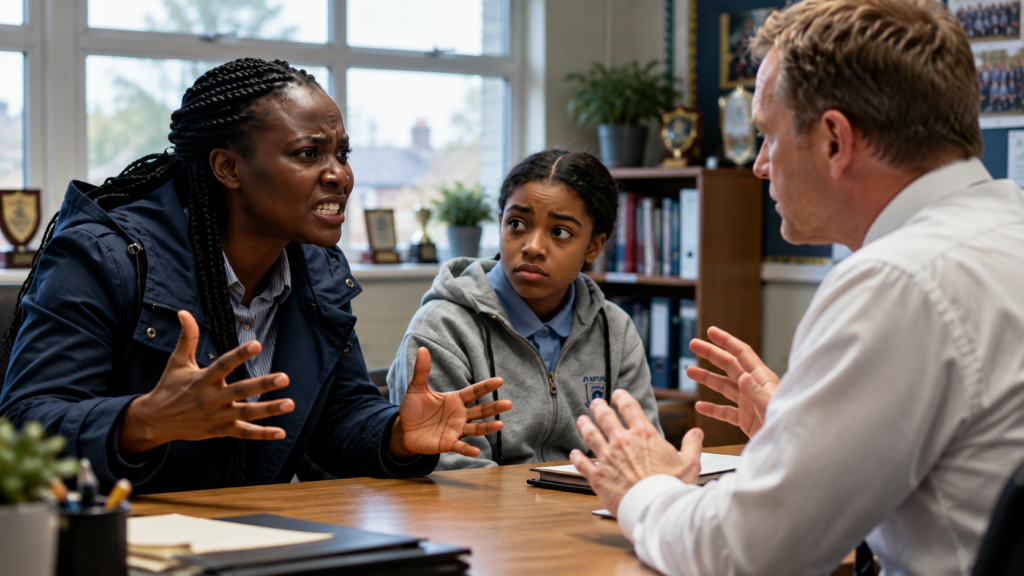
At 2:10, Mariama Yusuf received a phone call asking her to come to the school.
She arrived thirty-five minutes later.
Mariama was thirty-eight and worked part-time in a care home. She wore a navy raincoat and carried a supermarket bag containing bread, milk and washing powder.
She looked annoyed, not frightened.
“What has happened?”
The safeguarding lead, David Price, asked her to sit down.
Amina was not in the room.
Helen was.
David began carefully.
“We need to discuss Amina’s planned summer travel.”
Mariama frowned.
“What about it?”
“We understand she’s travelling to The Gambia.”
“Yes.”
“For a family ceremony.”
Mariama’s expression changed.
Only slightly.
“Who told you that?”
“Amina mentioned the trip.”
“What did she say?”
David did not answer immediately.
Mariama looked at Helen.
“You questioned my daughter?”
Helen said, “We spoke to her because she appeared worried.”
“She is fourteen. She worries about everything.”
“The concern is specific.”
Mariama put her shopping bag on the floor.
“What concern?”
David used the words directly.
“Female genital mutilation.”
The room went completely still.
Mariama stared at him.
Then she laughed once.
Not because she found it funny.
Because she seemed genuinely shocked that anyone had said it aloud.
“This is ridiculous.”
David remained calm.
“We have a safeguarding duty.”
“My family has done nothing.”
“We haven’t said they have.”
“You are accusing us.”
“We are asking whether Amina is at risk.”
“No.”
“Is there a ceremony planned for her?”
“There are many ceremonies.”
“For Amina?”
Mariama crossed her arms.
“You people hear Africa and immediately think the worst.”
Helen answered:
“This isn’t about where your family comes from.”
“It certainly sounds like it.”
“Then help us understand.”
Mariama stood.
“I don’t have to explain my family to you.”
David said:
“Please sit down.”
“No.”
“Mrs Yusuf—”
“No. You’ve embarrassed my daughter and insulted me.”
She picked up the shopping bag.
“The trip is a holiday.”
“Then what is the ceremony?”
Mariama looked toward the door.
“My mother’s birthday.”
Helen watched her face.
“Is that what Amina has been told?”
Mariama turned sharply.
“What exactly did she tell you?”
Nobody answered.
That made her angrier.
“You’re trying to turn my daughter against us.”
David said:
“No one is trying to do that.”
Mariama walked out.
That evening, the family argument began at 6:20.
Amina was sitting at the kitchen table when Mariama came home.
Her father, Idris, was already there.
He drove a delivery van and had been called home early by his wife.
The plane tickets were lying on the table.
“Amina,” he said, “what did you tell the school?”
Amina stared at the tickets.
“Nothing.”
“Your mother says they accused us of something.”
“I didn’t accuse anyone.”
“What did you tell them?”
“That Auntie Hawa said there was a ceremony.”
Mariama closed her eyes.
“I told you not to discuss private family matters at school.”
Amina’s voice shook.
“Why?”
“Because people don’t understand.”
“Then explain it.”
Mariama looked at Idris.
He looked away.
That frightened Amina more than if he had shouted.
“What is happening when we go?”
Mariama sat down.
“Nothing is happening to you.”
“Promise?”
Her mother hesitated.
Amina saw it.
“Promise.”
Mariama said:
“We’re going to see Grandma.”
“That isn’t what I asked.”
Idris interrupted.
“Enough.”
Amina looked at him.
“Do you know?”
“Amina—”
“Do you know?”
Idris rubbed both hands over his face.
“I know people have been talking.”
“About me?”
He did not answer.
Mariama snapped:
“Stop making it sound like some conspiracy.”
Amina stared at her mother.
“What ceremony?”
Mariama’s voice hardened.
“You are too young to understand the arguments around this.”
“Then why am I old enough for the ceremony?”
Nobody spoke.
Amina started crying.
Not loudly.
She simply lowered her head and cried into both hands.
Idris looked at his wife.
“Cancel the tickets.”
Mariama turned.
“What?”
“Cancel them.”
“You agreed to this trip.”
“I agreed to visiting your mother.”
“You knew there would be discussions.”
“Discussions.”
“Yes.”
“Not this.”
Mariama lowered her voice.
“My mother believes it’s important.”
“I don’t care.”
“You’ve cared for fourteen years.”
“No. I’ve avoided the argument for fourteen years.”
Mariama stared at him.
Idris continued:
“That’s different.”
“You’re going to humiliate my mother.”
“Our daughter is terrified.”
“She is terrified because the school frightened her.”
Amina looked up.
“No.”
Her mother turned toward her.
“The school didn’t tell me to be scared.”
Mariama’s face tightened.
“Auntie Hawa did.”
That sentence changed the room.
“What did Hawa say?” Idris asked.
Amina hesitated.
“She said I would stop being a child after the ceremony.”
Mariama immediately said:
“She talks nonsense.”
“She told me not to tell my teachers.”
Idris looked at his wife.
Mariama said nothing.
“Did you know she said that?”
“No.”
“Did you?”
“I said no.”
“Then call her.”
Mariama stared at him.
“Call her.”
“This is absurd.”
“If it’s all a misunderstanding, call her.”
Mariama stood.
“I don’t have to prove anything in my own house.”
She walked upstairs.
Idris cancelled the tickets that night.
Or at least he tried to.
The bookings had been made through Mariama’s sister, Hawa, using a travel agency account.
Idris did not have access to the reservation.
The next morning, he asked Mariama for the booking details.
She refused.
“We are not travelling,” he said.
“You don’t decide everything.”
“This isn’t a holiday argument.”
“You’re letting strangers interfere in our family.”
“They’re interfering because our daughter is afraid.”
Mariama picked up her handbag.
“I’m going to work.”
Idris stood between her and the kitchen door.
Not touching her.
“Give me the booking reference.”
“Move.”
“Give me the reference.”
“You’ve lost your mind.”
“Maybe.”
“Move.”
Amina was standing in the hallway listening.
Idris stepped aside.
Mariama left.
By then, however, the school had already escalated the safeguarding concern.
Because the suspected risk involved possible travel abroad, professionals from children’s services and police safeguarding teams became involved.
Amina was interviewed with appropriate support.
Again, she was not asked for graphic details.
She simply repeated what she knew.
Her aunt had discussed a ceremony.
Her grandmother expected it.
Her mother had told her not to talk about family matters.
And the tickets had already been purchased.
Later that afternoon, officers visited the Yusuf home.
Mariama was furious.
Idris looked exhausted.
An officer explained that the purpose at that stage was protection and investigation.
Mariama repeatedly said:
“Nothing has happened.”
The officer answered:
“The concern is that something may happen.”
“You can’t prosecute people for thoughts.”
“No one said we are.”
“You are treating us like criminals.”
“We’re asking you to cooperate.”
Mariama folded her arms.
“I’ve done nothing.”
The officer asked for the travel documents.
Mariama refused.
Idris went upstairs.
He returned carrying three passports.
His.
Mariama’s.
Amina’s.
Mariama stared at him.
“What are you doing?”
He placed them on the table.
“Ending this.”
Mariama’s face went pale.
“You had no right.”
“Our daughter isn’t going.”
“You’ve chosen strangers over your own family.”
“No.”
Idris looked at Amina.
“I chose her.”
For the first time, Mariama began crying.
But the investigation did not end there.
The police examined the travel arrangements.
Messages were recovered from family group chats with the appropriate legal authority.
Most were ordinary.
Photographs.
Birthday wishes.
Arguments about accommodation.
Requests to bring medicine and children’s clothes from England.
Then investigators found a series of messages between Mariama and Hawa.
They did not describe a medical procedure.
They did not need to.
They discussed the date Amina would arrive.
Which women would be present.
Why Idris should not be told everything beforehand.
And, most damagingly, one message from Hawa:
“Once she is there, he cannot stop it.”
Mariama had replied:
“I just don’t want trouble before we travel.”
That message became the centre of the case.
When detectives showed it to her during a formal interview, Mariama stared at the printed page for a long time.
Then she said:
“You don’t understand what I meant.”
“What did you mean?”
“That I didn’t want arguments.”
“Arguments about what?”
“My family.”
“About the ceremony?”
Mariama said nothing.
“You knew Amina didn’t want it?”
“She is a child.”
“That wasn’t the question.”
Mariama’s lawyer asked for a pause.
The interview stopped.
The case became publicly known months later when charges were brought.
Reporters gathered outside the court.
The story attracted international attention partly because it echoed a broader global argument that had become especially intense in countries such as The Gambia and Somalia: whether appeals to tradition or community acceptance could ever justify a practice that law and child-protection authorities treated as serious violence against girls.
But inside the courtroom, the case was much smaller than the headlines.
There was no debate about an entire culture.
There was one girl.
One planned journey.
Several messages.
And several adults who had each had opportunities to stop what was happening.
The prosecution’s case focused heavily on preparation and failure to protect.
Mariama’s defence argued that she had been caught between an older generation and her daughter, that she had never personally intended to harm Amina, and that no procedure ultimately took place.
Idris was not prosecuted.
Investigators accepted that although he had been passive for too long, he had acted once he understood the specific risk and had cooperated with safeguarding authorities.
Hawa’s position was more complicated because she lived outside the UK, and jurisdiction and evidence had to be considered separately.
The proceedings lasted months.
Amina never attended most of them.
She did not want to become the public face of anything.
She moved temporarily to live with an aunt on her father’s side while her parents separated.
At school, only a few staff members knew the full story.
Most students believed she had simply had a difficult summer.
The strongest moment came during Mariama’s final court appearance.
The prosecutor referred to the message:
“Once she is there, he cannot stop it.”
Mariama sat completely still.
Her lawyer had already argued that the words were ambiguous.
That they referred to family pressure.
That Mariama herself had not planned to carry anything out.
Then the prosecutor displayed Mariama’s reply.
“I just don’t want trouble before we travel.”
Amina was not in the courtroom.
But Idris was.
He looked at his wife.
Mariama looked down.
For months, she had insisted that everyone else had misunderstood.
The school.
Her husband.
The police.
Social workers.
Her daughter.
Now the two sentences were on a screen above her head.
For the first time, she stopped arguing about what other people had misunderstood.
When asked whether she accepted that Amina had believed the ceremony was going to happen, Mariama answered:
“Yes.”
Then came the second question.
“Did you know she did not want it?”
A long silence followed.
“Yes.”
That answer did not resolve every legal question in the case.
But it resolved the human one.
After the proceedings, Mariama received a criminal sentence and remained subject to restrictions intended to protect Amina. The exact legal findings concerned her own conduct and evidence, rather than some broad judgment on her extended family or community.
Hawa never returned to Britain during the case.
Idris and Mariama divorced the following year.
Amina stayed in Birmingham.
Two years later, when she was sixteen, she was asked whether she wanted to speak at a school safeguarding event.
She refused.
“I don’t want people looking at me like a case study.”
The teacher accepted that.
Amina paused at the door.
Then she added:
“But tell them one thing.”
“What?”
“If a girl suddenly gets scared about a family trip, don’t assume she’s just being difficult.”
The teacher nodded.
Amina left.
The original airline tickets were never used.
For months, Idris kept them printed in a kitchen drawer with old receipts and takeaway menus.
Eventually he threw them away.
They had originally looked like the most ordinary part of the summer:
three names,
two flight numbers,
one departure date.
Nobody looking at them alone would have known why one fourteen-year-old girl was so afraid to board the plane.