Chapter One – The Table Near the Window
There were restaurants designed to make people forget the world outside, and this was one of them. Beyond the tall windows, the evening city carried the muted silver of recent rain, its pavements reflecting lamps and passing headlights in long broken ribbons. Inside, everything had been arranged to suggest permanence: dark wood paneling polished until it held the light, linen folded with exact precision, glasses thin enough to tremble beneath a fingertip, and candles positioned so that every face appeared slightly kinder than it might have looked beneath daylight.
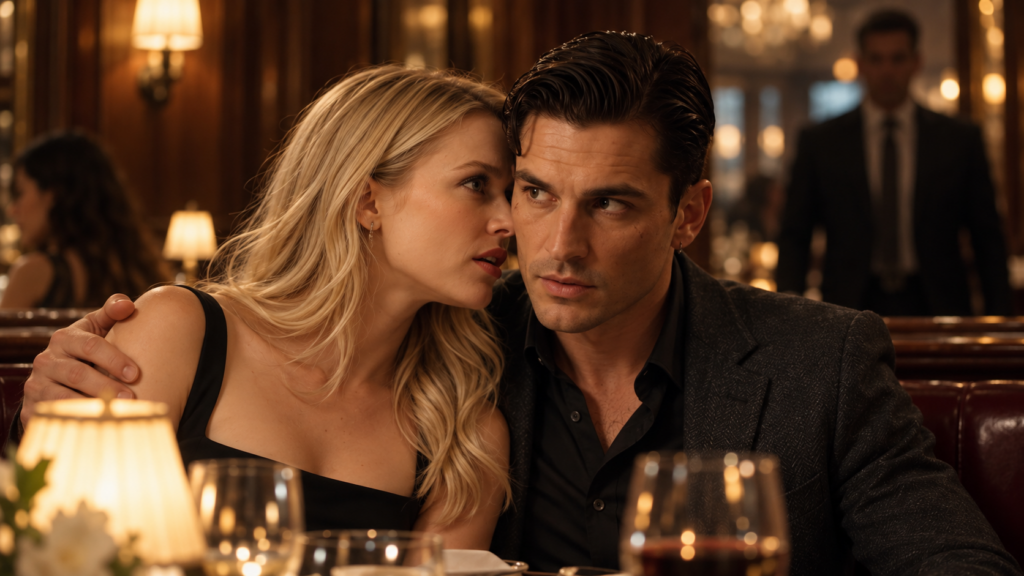
The blonde woman sat in a curved booth beneath a brass wall lamp, wearing a black square-neck dress that made her seem composed in the effortless way of someone who had spent years learning not to reveal discomfort. Her long, wavy hair fell over one shoulder, catching the warm restaurant light in pale strands. Small gold hoop earrings moved whenever she turned her head, and during the first twenty minutes at the table, she turned it often.
She had chosen the restaurant carefully.
That was what made the situation almost absurd.
She knew which entrance offered the shortest walk from the street, which tables were partially hidden by a pillar, which evening hours usually belonged to tourists rather than regular patrons, and even which nights the pianist took his break before nine. She had made all these decisions because she wanted to pass through the evening unnoticed.
Yet some places had memories of their own.
She had once believed elegance could protect people from humiliation. The polished glasses, low voices, expensive coats, and ritual of waiters replacing cutlery after every course had seemed to promise that certain things simply could not happen in such surroundings.
She knew better now.
Across from her sat a man whose calmness was beginning to irritate her only because she desperately wanted some of it for herself.
He wore a dark charcoal blazer over a crisp white shirt left open at the collar, formal enough to belong in the room without appearing to have dressed for approval. His dark hair was parted neatly, though one strand had fallen slightly forward. He had refined features, dark eyes, and the kind of posture that suggested he paid attention even when he appeared relaxed.
He had noticed her distraction.
Of course he had.
He simply had not mentioned it.
They had met by chance through the kind of social arrangement neither of them particularly enjoyed, a dinner gathering that had gradually divided into smaller conversations until, by some accidental choreography, they were left sitting opposite each other. The others had stepped away briefly toward the bar and entrance, leaving them in a pocket of quiet.
At another time, she might have welcomed it.
He was handsome without seeming aware of the fact, and there was something unexpectedly gentle about the way he listened. He did not rush to fill silences. He did not lean closer simply because the candlelight encouraged intimacy. When she spoke, he allowed her words to finish.
For a woman who had once spent nearly three years being interrupted by someone who claimed to love her, this felt dangerous in a different way.
“So,” he said after a moment, lifting his glass but not drinking, “are you always this interested in the entrance?”
She looked back at him.
“Am I?”
“You’ve checked it six times.”
She almost smiled.
“Seven.”
That made him smile first.
For one second, her body loosened.
Then the main door opened.
The movement was ordinary: a waiter stepping aside, cold evening air entering briefly, several people turning their heads.
But she stopped breathing.
She recognized the silhouette before she saw the face clearly.
Her ex.
The man who had taught her that love could become a negotiation conducted in private and a performance conducted in public.
He had not yet seen her.
She lowered her eyes instantly, fingers tightening around the edge of her napkin.
Across the table, the handsome man noticed.
The change in her was subtle enough that most people would have missed it. Her shoulders did not visibly shake. Her expression did not collapse. She did not whisper a curse or reach for her handbag.
Only her fingers betrayed her.
They pressed into the white cloth until the knuckles became pale.
The man set his glass down.
“Is something wrong?”
“No.”
He waited.
She glanced toward the entrance again.
Her ex had removed his coat.
He was moving deeper into the restaurant.
Closer.
“No,” she repeated, quieter this time, as though speaking to herself.
The handsome man’s eyes followed hers without turning his head fully.
He understood enough to know that whatever had entered the room had already been there in her mind.
The blonde woman swallowed.
She could leave.
That would have been sensible.
She could stand, offer an excuse, and disappear through the side corridor before recognition became unavoidable.
But she knew what would happen if she did.
She would spend the entire journey home furious that a man from her past could still choose where she sat, where she looked, when she left a room, and how quickly her heart beat.
Her ex was approaching.
The distance between them was shrinking with every step.
The blonde woman looked across the table at the stranger whose calm presence had, until seconds ago, meant almost nothing in the architecture of her life.
Then she leaned closer.
Her voice barely crossed the candle between them.
“I need you to do something for me.”
The man studied her face.
“What?”
Her ex was close enough now that she could hear his voice somewhere behind the waiter carrying wine.
She leaned nearer still.
And for the first time that evening, fear entered her blue eyes without disguise.
“Pretend you’re my boyfriend.”
The man’s expression changed.
Not dramatically.
Only enough.
He looked at her, then toward the approaching figure, then back again.
And somewhere beneath the soft light, between the white plates and quiet music, the evening ceased to be ordinary.
Chapter Two – A Request Made in a Whisper
For several seconds after she spoke, the man did not answer.
The blonde woman felt each of those seconds separately.
The first carried embarrassment.
The second carried regret.
By the third, she had already begun preparing to withdraw the request with some graceful remark about having had too much wine, though she had barely touched her glass.
Then he leaned slightly forward.
“Your boyfriend?”
She kept her voice low.
“Only for a minute.”
“That seems oddly specific.”
“My ex is coming this way.”
His eyes shifted past her shoulder.
“So that’s him.”
She did not ask how he knew.
The change in her face had probably been explanation enough.
Her ex was no longer a distant figure near the entrance. He had paused a few tables away, speaking to someone. There was still time for him to turn elsewhere.
She hoped he would.
She knew he would not.
The man across from her remained quiet.
It was not the silence of someone judging her. That would have been easier. She understood judgment; she had lived beside it long enough.
This was the silence of someone deciding how much he needed to know before stepping into another person’s unfinished history.
“What exactly am I pretending?” he asked.
“That we’re together.”
“Yes, I gathered that.”
Despite herself, she almost laughed.
His expression softened slightly.
“For how long?”
“Until he leaves.”
“And if he sits down?”
“He won’t.”
The answer came too quickly.
The man noticed.
“You’re sure?”
She looked at him.
“No.”
He rested one arm along the back of the booth, not yet touching her.
Something about the gesture made him seem less like a stranger and more like a person temporarily willing to remain where the situation placed him.
“Did he hurt you?”
The question was quiet.
She immediately looked away.
“No.”
It was not entirely a lie.
He had never struck her.
There had been no dramatic injury, no scene that could be easily explained to friends, no visible evidence anyone might have pointed to and called cruelty.
Instead there had been small corrections.
Her dress was too revealing.
Her laugh was too loud.
Her friends were childish.
Her work mattered less than his.
Her opinions were charming until they disagreed with his.
Her silences were proof she was cold.
Her anger was proof she was unstable.
Her independence was proof she did not understand commitment.
By the end, he had become so skilled at rewriting every disagreement that she often apologized simply to end the exhaustion.
Those memories could not be described quickly beneath restaurant lighting.
So she gave the simplest answer available.
“He never hit me.”
The man looked at her carefully.
“I didn’t ask that.”
She met his eyes.
Something passed between them then, quiet and uncomfortable.
Recognition, perhaps.
Not of the same experience, but of the inadequacy of simple questions.
She lowered her voice.
“He knew how to make me feel foolish without ever raising his voice.”
The man said nothing.
“He was always very polite afterward.”
The man’s jaw tightened almost imperceptibly.
Again he glanced toward the approaching ex.
“How long ago?”
“Eight months.”
“You haven’t seen him since?”
“Not properly.”
“What does properly mean?”
She looked down at the table.
“It means I saw him once from across a train platform and got on the wrong train so he wouldn’t see me.”
The confession embarrassed her more than the request.
She expected pity.
Instead the man asked, “Where did you end up?”
She blinked.
“What?”
“The wrong train.”
For the first time since seeing her ex, she laughed genuinely.
It came out quietly, almost breathlessly.
“Forty minutes outside the city.”
“Expensive escape.”
“Very.”
“Worth it?”
She thought about it.
“At the time.”
He nodded.
Then his gaze sharpened.
“He’s seen you.”
The warmth disappeared from her face.
She knew before turning.
Her ex stood only several meters away.
He had stopped mid-conversation.
His eyes were fixed on her.
That familiar expression appeared: surprise first, then calculation, then the small smile he had always used when he wanted to appear generous before an audience.
The blonde woman straightened.
Her instincts began fighting one another.
Leave.
Stay.
Smile.
Do not smile.
Make it clear you are happy.
Do not give him the satisfaction of thinking this matters.
She hated all of those instincts.
She hated that he still created them.
Across from her, the handsome man observed the conflict playing behind her carefully controlled expression.
“If you’re going to change your mind,” he said quietly, “now would be a good time.”
She looked at him.
“I don’t want to leave.”
“That wasn’t what I asked.”
Her eyes held his.
“No. I’m not changing my mind.”
He considered her for another second.
“All right.”
Her breath caught.
“All right?”
“I’ll be your boyfriend.”
She stared at him.
“For one minute,” he added.
The corner of his mouth lifted.
“Possibly two, if your ex walks slowly.”
She almost laughed again, but footsteps were approaching now.
The ex had excused himself from the nearby conversation.
There was no longer any question where he was going.
The woman looked toward him, then back at the man across from her.
“What do I do?”
“Nothing.”
“Nothing?”
“That’s usually more convincing than trying too hard.”
He shifted closer along the curved booth.
Her pulse accelerated for an entirely different reason.
Then he paused.
The final distance between them was still hers to allow.
She understood the question without words.
After everything she had told him about being controlled, he would not touch her without permission, even for a performance she herself had requested.
The realization unsettled her.
She gave the smallest nod.
Only then did he move.
His arm settled lightly around her shoulders.
Warm.
Calm.
Unhurried.
Her body stiffened instinctively.
Then slowly, almost against her own expectations, relaxed.
His hand rested nowhere inappropriate. He did not pull her possessively against him. He merely created the visual suggestion of intimacy while leaving her enough space to breathe.
The distinction nearly broke her heart.
Her ex was approaching the table.
The handsome man looked down at her with a faint smile.
“Better?”
She whispered, “You look far too comfortable.”
“Occupational talent.”
“What occupation?”
He smiled.
“You can ask your boyfriend later.”
Before she could answer, a shadow fell across the white tablecloth.
Her ex had arrived.
Chapter Three – The Arm Around Her Shoulder
The blonde woman had once imagined that if she saw her ex again, the moment would possess some unmistakable emotional grandeur. She would feel rage, perhaps, or triumph. She would discover that she had become completely indifferent. In certain late-night fantasies, she would barely recognize him.
Instead, the first thing she noticed was his watch.
It was ridiculous.
A small, metallic detail at his wrist, half hidden beneath his cuff.
She remembered buying it with him.
Not for him.
With him.
That distinction seemed important now.
He had spent almost an hour comparing two nearly identical models while she stood beside him holding his coat. Later he told friends that she had chosen it because she “understood his taste.”
Standing beside the restaurant table now, he still wore it.
“Hello.”
His voice was unchanged.
Controlled, pleasant, almost intimate.
The blonde woman felt the man beside her shift slightly. His arm remained around her shoulders.
She forced herself to look up.
“Hello.”
Her ex smiled.
“I thought it was you.”
She gave a small nod.
There were dozens of things she could have said.
She chose none of them.
His gaze moved toward the handsome man.
That was the moment she had feared most.
Not because she worried he would discover the deception immediately, but because she knew the old machinery of comparison would begin. Her ex had always evaluated men around her: who earned more, who dressed better, who seemed threatened by him, who might be useful, who could be dismissed.
She recognized the brief flicker in his eyes.
Assessment.
The handsome man beside her appeared completely unconcerned.
His posture remained relaxed.
He did not remove his arm.
The blonde woman suddenly became aware of every detail of contact between them. The weight of his forearm behind her shoulders. The warmth through the fabric of her dress. The faint scent of cedar and clean cotton. The fact that his thumb was resting absolutely still, as if he understood that any unnecessary movement would transform reassurance into ownership.
Her ex looked back at her.
“You look well.”
The sentence was conventional enough.
Yet she heard the old subtext immediately.
You look better than expected.
You survived.
How interesting.
She smiled with equal politeness.
“So do you.”
The handsome man turned slightly toward her.
“You haven’t introduced us.”
It was exactly the sort of sentence a real partner might use: lightly teasing, confident enough to assume he belonged in the conversation.
The blonde woman looked at him.
He smiled.
There was warmth in it, but beneath the warmth she sensed deliberate calculation.
He was giving her control.
Not taking the scene from her.
Returning it.
She realized she had never told him her ex’s name.
She had not told him what to call himself either.
The absurdity almost made her panic.
Her ex waited.
The handsome man rescued her without exposing the problem.
He extended his free hand toward the standing man.
“We’ve heard surprisingly little about each other.”
Her ex took the hand.
The handshake lasted perhaps one second too long.
“I see.”
The blonde woman recognized the phrase.
Her ex used it whenever he disliked something but wished to appear above reaction.
The handsome man’s smile remained effortless.
“I’m told that’s usually a good sign.”
The woman turned her face slightly, hiding another involuntary smile.
Her ex noticed.
For the first time, something in his composed expression tightened.
It was small.
Anyone else might have missed it.
She did not.
Once, she would have watched such a change anxiously and begun correcting herself. She would have wondered whether she had laughed too warmly, spoken too freely, looked too happy in front of someone else.
Now she only observed it.
That difference mattered.
Her ex placed one hand casually on the back of the empty chair opposite them.
“I didn’t know you were seeing someone.”
There it was.
Not a question.
A claim disguised as surprise.
The blonde woman’s muscles tightened beneath the stranger’s arm.
Before she could answer, the man beside her said, “I imagine there are several things you don’t know.”
The sentence was delivered pleasantly.
No aggression.
No challenge.
Yet it changed the air.
Her ex looked at him.
The blonde woman held her breath.
She had asked for a performance.
What she had not expected was that the man would understand the exact tone required.
He was not trying to defeat her ex.
He was refusing to participate in the hierarchy her ex usually created.
That refusal was far more effective.
Her ex gave a small laugh.
“Apparently.”
The blonde woman found her voice.
“We haven’t been together very long.”
The handsome man turned toward her.
“Long enough.”
For half a second, she forgot it was false.
Something in his eyes altered when he said the words.
Perhaps he was simply acting.
Perhaps he had understood that certainty would make the lie believable.
But the warmth that moved through her chest felt inconveniently real.
Her ex saw it too.
His hand left the chair.
“Well,” he said, “I’m glad you’re happy.”
The blonde woman almost admired the performance.
He had always known how to deliver sentences that sounded generous enough to be repeated later.
She looked directly at him.
“Thank you.”
Nothing more.
His gaze lingered.
The silence stretched.
The restaurant continued around them: forks against porcelain, muted conversations, the pianist beginning another piece near the far wall.
Eventually her ex nodded.
“It was good to see you.”
She did not answer immediately.
She discovered that she wanted to choose the final sentence carefully, not because she wished to wound him, but because she no longer wanted to surrender language to habit.
“You too.”
It was not true.
It was civilized.
Sometimes those were different things.
Her ex turned away.
He walked back toward the other side of the room.
The blonde woman watched until he disappeared beyond a wooden partition.
Only then did she breathe fully.
The man beside her did not remove his arm immediately.
Neither did she ask him to.
Chapter Four — The Minute After
Relief did not arrive in the way the blonde woman expected.
She had imagined that once her ex walked away, the tension would leave her body immediately, perhaps followed by laughter at the ridiculousness of what she had done.
Instead she sat very still.
The handsome man’s arm remained around her shoulders.
For several seconds neither of them moved.
The restaurant seemed louder now, as if the world had continued while she was somewhere else.
A waiter crossed behind them carrying two plates beneath polished silver covers. Someone near the bar laughed. The piano shifted into a quieter passage. A candle flame bent briefly as the main door opened.
The blonde woman stared at the glass in front of her.
Then she whispered, “You can let go.”
The man withdrew his arm immediately.
The sudden absence of warmth surprised her.
She hated that it surprised her.
“Sorry.”
“No,” she said quickly. “You did exactly what I asked.”
He settled back into his side of the booth.
“Did I pass?”
She looked at him.
“You enjoyed that.”
“Parts of it.”
“Which parts?”
“Watching him discover that not every room reorganizes itself around him.”
Her expression changed.
“You understood him quickly.”
“I understood you quickly.”
The answer was so direct that she looked away.
He seemed to notice the effect and softened his tone.
“At least, I understood enough.”
She traced one finger along the stem of her glass.
“Thank you.”
“You’re welcome.”
“No. I mean it.”
“I know.”
The simplicity of his response almost made the gratitude more difficult.
For months after the breakup, people had told her what she should have done.
She should have left sooner.
She should have confronted him differently.
She should have noticed the warning signs.
She should have blocked him earlier.
She should have refused to explain herself.
She should have known better.
The advice often came from love, but it had still felt like another courtroom.
The man across from her had asked what she wanted and then helped her do it.
Nothing more.
That was strangely unfamiliar.
She glanced toward the partition where her ex had disappeared.
“He’ll think it’s serious.”
“That was the idea, wasn’t it?”
“Yes.”
“Then we’re excellent liars.”
She gave him a look.
“Speak for yourself.”
“You’re right. You looked terrified.”
“I was terrified.”
The teasing vanished from his face.
She immediately wished she had not admitted it.
“I hate that,” she said.
“What?”
“That he can still do that to me.”
The man folded his hands loosely on the table.
“Fear isn’t loyalty.”
She frowned.
“What does that mean?”
“It means your body remembering someone doesn’t mean you still belong to the memory.”
She stared at him.
He looked almost uncomfortable after saying it, as though he had revealed more of himself than intended.
“How do you know?”
He looked toward his glass.
The question remained between them.
For the first time that evening, she wondered whether his calmness might have a history of its own.
People often mistook restraint for ease.
She had done it with him.
Maybe wrongly.
He rotated the glass slowly.
“I was engaged once.”
She blinked.
“Once?”
“That sounds dramatic.”
“It sounds like there is probably a story.”
“There usually is.”
“Did she leave?”
“No.”
“Did you?”
“Yes.”
The blonde woman waited.
He did not continue.
She smiled faintly.
“You’re very good at asking questions and terrible at answering them.”
“I’ve cultivated the imbalance.”
“What happened?”
He looked at her.
There was no theatrical sadness in his expression.
Only fatigue remembered at a distance.
“We became people who were always trying not to disappoint each other. Eventually that turned into two people lying politely every day.”
She understood more than she wanted to.
“Was there someone else?”
“No.”
“That sounds almost worse.”
“It was quieter.”
The word settled over the table.
Quieter.
There were endings that shattered publicly and endings that faded so gradually one only recognized them afterward.
She imagined him in another room, another life, trying to preserve a relationship because neither person had committed a crime large enough to justify leaving.
“Do you still love her?”
He considered the question honestly.
“I hope she’s well.”
“That wasn’t what I asked.”
He smiled slightly.
“You’re learning.”
She lowered her gaze.
“I don’t know why I’m asking.”
“Yes, you do.”
Her heart gave a small, traitorous movement.
The man did not elaborate.
Instead he nodded toward the direction her ex had gone.
“Are you worried he’ll come back?”
She listened to the room.
“No.”
“Good.”
A pause followed.
Then the blonde woman laughed quietly.
“What?”
She shook her head.
“I asked a stranger to pretend to be my boyfriend.”
“We weren’t complete strangers.”
“We’d spoken for twenty minutes.”
“Twenty-seven.”
“You counted?”
“I was sitting here.”
She laughed again.
Something in the sound made him smile.
The tension inside her finally loosened.
She leaned back against the booth.
“So,” she said, “my temporary boyfriend.”
He raised an eyebrow.
“Yes?”
“You said one minute.”
“I did.”
She glanced toward the partition.
“I think it’s been more than two.”
“That creates contractual complications.”
“What sort?”
“You may owe me dessert.”
She studied him.
For the first time that evening, the idea of remaining at the table did not feel like hiding.
It felt like choosing.
“All right,” she said.
“Dessert?”
She smiled.
“For now.”
Chapter Five – What She Had Not Told Him
The ex did not return to the table.
The blonde woman noticed this gradually rather than all at once.
At first she tracked every movement near the wooden partition. Each time a waiter appeared from that direction, her attention shifted. Each time footsteps slowed beside the booth, her pulse changed.
Eventually the intervals between those reactions lengthened.
The handsome man noticed that too.
He did not congratulate her.
She appreciated him for it.
A waiter arrived with the dessert menu, and they both accepted one despite having already agreed that she owed him dessert. The performance of choosing became unexpectedly serious.
“You’re avoiding the chocolate.”
“I don’t trust desserts that arrive with architectural ambition.”
He looked at the menu.
“This one has three structural layers.”
“Exactly.”
“So you’re afraid of buildings now?”
“Only edible ones.”
He shook his head.
“You’re difficult.”
“Your girlfriend should have warned you.”
The word slipped out before she could stop it.
Girlfriend.
They both became aware of it.
He lowered the menu.
She pretended to keep reading.
“That role ended several minutes ago.”
“I know.”
“Unless you’re extending the contract.”
She looked up.
His expression was teasing, but not entirely.
She felt an unfamiliar hesitation.
Not fear.
Something more delicate.
“Maybe through dessert.”
“Generous.”
The waiter returned, and they ordered something deliberately simple.
When they were alone again, the man asked, “Why did you really stay?”
She frowned.
“Stay where?”
“At the table. You said you didn’t want to leave when he came in.”
She looked toward the candle.
“I was tired.”
“Of him?”
“Of myself around him.”
The answer surprised them both.
She continued before she could retreat from it.
“When we were together, every room became a test. If I spoke too much, I was embarrassing. If I was quiet, I was sulking. If I disagreed, I was difficult. If I agreed too quickly, he would ask whether I was being sarcastic.”
The man’s face grew still.
“He made it impossible to succeed.”
“Yes.”
“So you stopped trying?”
“No.”
She smiled without amusement.
“I tried harder.”
That was the humiliating part.
Not that she had loved him.
Love was not humiliation.
It was the effort afterward.
The constant adjustments.
She changed dresses before dinners because he disliked the first choice. She stopped telling certain stories because he mocked the way she told them. She learned which opinions were safe at which tables.
Eventually she became skilled at anticipating discomfort before it arrived.
“Why did you leave?” the man asked.
She was silent.
The question was different from Why didn’t you leave sooner?
She noticed the difference immediately.
“One evening,” she said, “we were at a dinner very much like this one.”
She looked around the restaurant.
“That may be why seeing him here bothered me.”
The man waited.
“He corrected me in front of everyone. Something small. I had told a story and remembered a date incorrectly. He laughed and said, ‘She always does this. She turns everything into fiction.’ Everyone laughed.”
The handsome man’s eyes remained on her.
“I laughed too.”
“Why?”
“To make it harmless.”
He understood.
She could see it.
“Later, in the taxi, he told me I had embarrassed him by becoming quiet.”
The man exhaled through his nose.
“What happened then?”
“Nothing.”
“Nothing?”
“That was the important part.”
She looked toward the window.
“I went home, washed my face, put my earrings in a dish, and realized I couldn’t remember the last time I had felt like myself in the same room as him.”
Her voice softened.
“So the next morning, I left.”
“Just like that?”
“No.”
She smiled faintly.
“Nothing is ever just like that. There were months of practical things. Keys. Books. Furniture. Explanations. Mutual friends who wanted a clean story.”
“And did you give them one?”
“No.”
“Good.”
She raised an eyebrow.
“Good?”
“Clean stories are usually lies.”
She considered him.
“That’s a strong opinion for someone who just invented a relationship in under thirty seconds.”
He laughed.
“Temporary fiction. Different category.”
Their dessert arrived.
Two small plates placed carefully between them.
For a while, they said nothing.
The blonde woman took one bite and looked toward him.
“Why did you agree?”
“To the dessert?”
“To pretending.”
He put down his fork.
The question changed his face.
She realized he had expected it eventually.
“I could say because it looked harmless.”
“But?”
“But you didn’t look like someone trying to make another man jealous.”
She waited.
“You looked like someone trying not to disappear.”
The words entered her quietly.
No one had described that period of her life so accurately.
She lowered her eyes.
“I didn’t know how else to stay.”
“You found a way.”
“With a stranger.”
“With excellent timing.”
She smiled.
Then, from the corner of her eye, she saw movement near the partition.
Her ex had appeared again.
He was not approaching.
He stood beside another table speaking to someone, but his eyes turned briefly toward them.
The blonde woman’s body tensed.
The handsome man saw it.
Without looking toward the ex, he simply moved his dessert plate closer to hers.
A meaningless gesture.
Ordinary.
Domestic, almost.
Then he asked, “Do you want to leave?”
She looked at him.
This time the answer came easily.
“No.”
Chapter Six – The Man Who Knew How to Stay
They remained in the restaurant longer than either of them had intended.
The blonde woman stopped monitoring the entrance.
The handsome man stopped pretending not to notice when she did.
Their conversation moved through ordinary subjects with the cautious ease of people recovering from an unexpectedly intimate beginning. They spoke about cities they disliked, books they had abandoned halfway through, mornings they preferred to evenings, and whether one could judge a person fairly by the way they treated waiters.
The answer to the last question was yes.
On that they agreed completely.
What neither of them mentioned was the strange fact that their most honest conversation had begun with a lie.
At some point the people who had originally brought them into the same social gathering drifted back toward the booth, then wisely chose another table after noticing the unusual intimacy between them. Neither the blonde woman nor the handsome man corrected the misunderstanding.
Perhaps that was the second lie of the evening.
Or perhaps it was simply silence.
The ex remained somewhere beyond the wooden partition.
The blonde woman became aware that she no longer cared exactly where.
That realization carried its own quiet shock.
“You’re smiling,” the man said.
She looked at him.
“Am I not allowed?”
“I’m gathering evidence.”
“Of what?”
“That the evening improved.”
She folded her arms.
“Your confidence is alarming.”
“Earlier you called me handsome.”
“I did not.”
“You thought it loudly.”
She laughed.
“Now you’re inventing evidence.”
“Again, occupational talent.”
“You still haven’t told me what you do.”
He leaned back.
“Architecture.”
She stared.
He smiled.
“That’s why I trusted your dessert criticism.”
She shook her head.
“You’re an architect?”
“Yes.”
“That is disappointingly respectable.”
“What were you hoping for?”
“International jewel thief.”
“I only do that on Thursdays.”
She laughed again.
The sound felt easier now.
Then he asked what she did.
She hesitated.
Not because her work was secret, but because for years she had described it in the diminished language her ex preferred. A small project. A temporary position. Nothing important.
She caught herself before using those phrases.
“I restore old books and documents.”
The man’s interest was immediate.
“Professionally?”
“Yes.”
“What kind?”
“Letters. Diaries. Private collections. Sometimes municipal archives. Things people assumed would survive simply because they were written down.”
He smiled.
“That sounds important.”
She felt an absurd tightness in her throat.
“It can be.”
“You don’t think so?”
“I do.”
“Then why did you say it like you’re apologizing?”
She looked at him.
There it was again.
That unnerving attention.
“I used to be told it wasn’t a serious career.”
“By him?”
She did not answer.
She did not need to.
The man glanced toward the partition.
“He sounds exhausting.”
The simplicity of the statement made her laugh.
“That’s your professional assessment?”
“As an architect, yes.”
“What does architecture have to do with it?”
“Bad structures reveal themselves under pressure.”
She studied him.
“And good ones?”
“They distribute weight.”
The conversation paused.
She wondered whether he knew how intimate the metaphor sounded.
His eyes suggested he did.
She looked away first.
Outside, rain had begun again, soft enough to appear only when it crossed the streetlights.
The restaurant windows held blurred reflections of everyone inside.
For one moment the blonde woman saw herself in the glass with the man beside her.
They looked like a couple.
Not dramatically.
Not like lovers posed in a photograph.
Simply two people comfortable enough to remain at the same table after dessert.
The image affected her more than it should have.
She turned back.
“Can I ask you something?”
“You’ve been doing that all evening.”
“Why are you still here?”
He considered the question.
“Where else should I be?”
“I don’t know.”
“Neither do I.”
“That sounds suspiciously philosophical.”
“It’s practical.”
He leaned forward slightly.
“I wanted to stay.”
The answer settled between them.
No joke followed.
The blonde woman felt the room narrow around the table.
She could hear the pianist. The rain. The low conversation nearby.
But beneath all of it existed the new, quiet danger of possibility.
She had spent months rebuilding a life around not needing anyone.
The process had been necessary.
She had mistaken the necessity for a permanent rule.
The man across from her did not seem to be asking for anything.
That made him more difficult to resist.
She looked toward his hand resting on the table.
Earlier that hand had settled around her shoulder only after she gave permission.
She remembered the restraint of it.
The care.
“You’re very different from him,” she said.
He did not look pleased by the comparison.
“I’d rather be different from myself five years ago.”
She looked up.
“What were you like?”
“Certain.”
“About what?”
“Everything.”
She smiled.
“That sounds unbearable.”
“I was.”
“Who told you?”
“The woman I almost married.”
There was no bitterness when he said it.
Only recognition.
The blonde woman studied him with new curiosity.
Perhaps this was why he understood control so quickly.
Not because he had suffered it.
Because he had once seen a version of it in himself.
He looked at her.
“I wasn’t cruel.”
“I didn’t think you were.”
“But I thought being right was a form of care.”
The woman went still.
He continued.
“It isn’t.”
She let the sentence remain.
Somewhere beyond the partition, a chair moved.
The ex did not matter.
Not in that moment.
The blonde woman looked at the man across from her and realized that the most unexpected thing about the evening was not that a stranger had pretended to love her.
It was that, after the pretending ended, he stayed.
Chapter Seven – The Return of the Past
The blonde woman noticed her ex approaching again only because the handsome man’s eyes shifted briefly toward the aisle.
This time her pulse did not explode.
It tightened.
There was a difference.
Her ex stopped beside the table with his coat folded over one arm.
“I’ll be leaving,” he said.
The announcement was unnecessary.
That was precisely why she understood it.
He had returned because he wanted another look.
Another moment.
Perhaps another chance to determine whether the man beside her was real.
She straightened slightly.
“Good night.”
The handsome man offered a polite nod.
Her ex did not move immediately.
His eyes settled on the two dessert plates.
“You always hated staying late in restaurants.”
The blonde woman felt the sentence strike an old nerve.
Once, she would have explained.
She would have said that she did not hate staying late, only the evenings when he spent an hour speaking to colleagues while she waited to leave.
She would have corrected the history.
Tonight she did not.
“I changed.”
Her ex smiled.
“Apparently.”
There was a faint edge in the word.
The handsome man remained silent.
The blonde woman was grateful.
This was hers.
Her ex looked at him.
“You should know she gets restless.”
The sentence was delivered lightly.
Almost humorously.
The old technique.
A criticism disguised as intimacy.
The blonde woman felt anger arrive.
Not explosive anger.
Something colder.
Cleaner.
The handsome man turned toward her.
“Do you?”
She understood immediately.
He was refusing her ex’s version of her without contradicting him theatrically.
He was asking her.
She smiled.
“Sometimes.”
The handsome man nodded.
“I’ll survive.”
Her ex’s expression tightened again.
The blonde woman almost felt sorry for him.
Almost.
He had once depended on being the person in every room who understood her best. Even after the relationship ended, some part of him seemed to expect ownership of that knowledge.
But knowledge could become outdated.
People were not archives to be frozen at the moment one left them.
Her ex shifted his coat.
“Well. Take care.”
“You too.”
This time he left.
Really left.
They watched him cross the restaurant.
At the entrance he paused to put on his coat.
The blonde woman saw his reflection in the glass before he stepped outside into the rain.
Then he was gone.
The door closed.
She stared at it for several seconds.
The handsome man did not speak.
Eventually she said, “I thought I’d feel more.”
“More what?”
“I don’t know.”
“Victory?”
“Maybe.”
“Do you?”
She considered.
“No.”
“Disappointed?”
“No.”
He waited.
She breathed slowly.
“I feel tired.”
“That sounds more believable.”
She laughed softly.
“I spent so long imagining what seeing him again would be like.”
“Reality is usually less cinematic.”
She looked around the elegant restaurant.
“Considering where we are, that’s unfortunate.”
He smiled.
Then she became serious.
“I wanted him to regret losing me.”
The confession embarrassed her.
The man did not judge it.
“That’s normal.”
“Is it?”
“Yes.”
“I don’t like it.”
“You don’t have to like every feeling in order to survive having it.”
She looked at him.
He continued.
“Did you want him back?”
“No.”
“Then regret was probably just the closest word you had for wanting proof that leaving mattered.”
Her eyes lowered.
Again, he had translated something she had never managed to explain to herself.
She touched one of her earrings.
“I used to think if he saw me happy, I’d finally be free of him.”
“And now?”
“Now I think being free might mean not needing him to see anything.”
The man smiled.
“That sounds expensive.”
“What?”
“Growth.”
She laughed.
“Terrible joke.”
“I know.”
She leaned back, allowing the last of the tension to drain from her shoulders.
Outside, the ex vanished into the city.
Inside, nothing dramatic happened.
No applause.
No declaration.
No revenge.
Only two people at a table and the quiet disappearance of a fear that had occupied too much space for too long.
The blonde woman looked at the handsome man.
“You know the worst part?”
“What?”
“If I hadn’t seen him tonight, I probably would have left early.”
The man’s eyebrow lifted.
“So I should thank him?”
“Don’t ruin the evening.”
“I wouldn’t dare.”
She watched him for a moment.
“You really aren’t what I expected.”
“What did you expect?”
She thought about the answer.
“Someone temporary.”
His expression changed slightly.
The teasing left it.
“And now?”
She looked down at the white tablecloth.
“I don’t know.”
He nodded.
No pressure.
No demand.
Just space.
The gesture moved her more than any romantic sentence could have.
She understood suddenly why restraint could feel intimate.
Because it allowed another person to remain whole.
Chapter Eight – A Fiction Becoming Dangerous
They should have left after the ex departed.
That would have been the natural ending.
The danger had passed. The performance had succeeded. The dessert plates were empty. The restaurant staff had begun clearing several nearby tables.
Instead they ordered coffee.
Neither commented on the decision.
The blonde woman wrapped both hands around the porcelain cup when it arrived.
The warmth grounded her.
The handsome man watched the rain on the window.
“You said you were engaged once,” she said.
He looked back at her.
“Yes.”
“You also said you were unbearable.”
“Selective memory.”
“How unbearable?”
He smiled faintly.
“I liked plans.”
“That doesn’t sound terrible.”
“I liked other people following them.”
“Ah.”
“Exactly.”
She waited.
He stared into his coffee.
“I grew up believing competence meant protection. If I could anticipate every problem, organize every detail, make every correct decision, then no one I cared about would suffer unnecessarily.”
“That sounds almost noble.”
“It did to me.”
“And to her?”
“Until it didn’t.”
The blonde woman understood the shape of the story before he finished it.
“She wanted things you couldn’t control.”
“She wanted herself.”
The sentence was quiet.
He continued.
“And I kept treating uncertainty like a defect to be repaired.”
The blonde woman’s expression softened.
“What changed?”
“She left for three weeks.”
“Only three?”
“It was enough.”
“Did she come back?”
“Yes.”
The woman waited.
“We ended it together.”
“That sounds painfully civilized.”
“It was.”
He smiled.
“I think we both wanted a villain. There wasn’t one.”
She looked down.
“Sometimes that’s harder.”
“Yes.”
The rain strengthened outside.
A thin stream moved down the glass beside her reflection.
“Do you still speak?”
“Once or twice a year.”
“And you’re happy for her?”
“I try to be.”
She appreciated the honesty of the answer.
Not the polished generosity people performed after old relationships.
Something imperfect.
Human.
“Why did you tell me that?”
“You asked.”
“You could have avoided it.”
“I did. Several times.”
She smiled.
“True.”
He leaned back.
“Maybe I didn’t want you thinking I was sitting here judging your past from some position of moral perfection.”
“I didn’t think that.”
“You might later.”
“Planning ahead again?”
He laughed.
“Old habits.”
There was tenderness in the moment now, though neither named it.
The blonde woman became acutely conscious of how late the evening had become.
Their original companions had already left after brief farewells.
The restaurant had thinned.
The world outside seemed farther away.
There was something dangerous about time shared after necessity ended.
Every additional minute had to be chosen.
She looked at the man across from her.
“Earlier, when you put your arm around me…”
He waited.
“You stopped before touching me.”
“Yes.”
“Why?”
His brows drew together slightly.
“I wanted to know if it was all right.”
“You were pretending to be my boyfriend.”
“That didn’t make you mine.”
The answer came without hesitation.
The blonde woman’s breath caught.
It was such a simple sentence.
Yet she felt something inside her shift.
Her ex had often used the language of belonging.
My girlfriend.
My partner.
My future wife.
The possessive had sounded romantic at first.
Eventually it became literal.
The man across from her had just expressed intimacy without ownership in eight words.
She looked away toward the rain.
“You shouldn’t say things like that.”
“Why?”
“Because they sound better than you probably mean them.”
He studied her face.
“What if I mean them exactly as they sound?”
The restaurant seemed suddenly too quiet.
The blonde woman turned back.
His expression was no longer playful.
There was no dramatic desire in it.
Only honesty carefully contained.
She could have changed the subject.
She almost did.
Instead she asked, “Are you still pretending?”
His gaze held hers.
“No.”
The answer did not mean what the original lie had meant.
He was not claiming they were together.
He was saying the attention was real.
The interest was real.
The choice to remain was real.
The blonde woman looked down at her coffee.
Her heart was beating too quickly.
“I don’t know if I’m ready for anything.”
“I didn’t ask you to be.”
“That’s almost worse.”
He smiled.
“I can be less reasonable if it helps.”
She laughed quietly.
The tension eased, but not entirely.
Something had crossed a line.
Not physically.
Emotionally.
The fiction had become dangerous because it had stopped being fiction in the place that mattered most.
They were not lovers.
They were not partners.
They were two near-strangers at a restaurant table.
But the distance between those facts had narrowed.
Chapter Nine – The Things People Carry Quietly
As the evening deepened, their conversation became less linear.
They moved backward and forward through memories without noticing.
The blonde woman told him about growing up near a coastline where winter storms rattled the windows of her childhood home. The handsome man described an apartment he had once lived in above a tram line, where the first morning service shook the kitchen glasses at five thirty.
They spoke about parents without giving entire family histories.
About cities without turning travel into competition.
About ambition without pretending success removed loneliness.
The woman found herself saying things she usually reserved for people who had known her years.
Perhaps anonymity made honesty easier.
Or perhaps being seen correctly once created the illusion of having been known longer.
“You’re quieter than you look,” she told him.
He raised an eyebrow.
“What does that mean?”
“I expected you to be arrogant.”
“Because I’m handsome?”
She smiled.
“Because you know you’re handsome.”
“That accusation lacks evidence.”
“You walked into this restaurant looking like you already owned a good coat.”
He laughed.
“And you looked like you might stab someone with a dessert fork.”
“I nearly did.”
“I believe you.”
The blonde woman rested her cheek against her hand.
She felt tired now, but pleasantly.
The kind of tiredness that followed release rather than fear.
“I haven’t had an evening like this in a long time.”
“An evening involving fraud?”
She laughed.
“An evening where I didn’t plan every sentence.”
He looked at her carefully.
“What happens when you plan them?”
“I remove anything someone might use against me.”
“That sounds exhausting.”
“It is.”
He nodded.
“Then don’t.”
She smiled.
“That’s easy to say.”
“Yes.”
He did not pretend otherwise.
She appreciated that.
Too many people treated healing like a puzzle solved by the correct sentence.
He seemed willing to accept that understanding something and changing it were separate tasks.
“What are you afraid of?” she asked.
He looked surprised.
“Now?”
“In general.”
“That is an alarmingly broad question for coffee.”
“You asked if my ex hurt me.”
“Fair.”
He considered for a while.
Then said, “Becoming useful instead of loved.”
She had not expected the answer.
“What do you mean?”
“My work rewards competence. People call when something is wrong. They trust me to decide, organize, repair.”
He looked at his hands.
“It’s easy to build an identity around being the person who knows what to do.”
“And the problem?”
“You eventually wonder whether anyone would stay if you had no solution.”
The blonde woman felt something inside her soften.
Earlier, he had appeared so calm beside her fear that she imagined calmness belonged to him naturally.
Now she saw the cost beneath it.
“You didn’t know what to do tonight.”
“I had a reasonable guess.”
“You could have refused.”
“Yes.”
“But you didn’t.”
“No.”
“Why?”
He smiled faintly.
“Maybe I liked being asked for something ridiculous instead of useful.”
She laughed.
Then became thoughtful.
“You were useful.”
“Terrible news.”
“But that’s not why I stayed.”
The words left her before she could reconsider them.
He looked at her.
The air between them changed again.
She could have corrected the statement.
She did not.
“Why did you stay?” he asked.
She held his gaze.
“Because you made me forget I was supposed to be afraid.”
Neither moved.
It was not a declaration.
But it carried more intimacy than one.
The restaurant around them had almost emptied.
A waiter discreetly placed the bill folder near the edge of the table without interrupting.
The blonde woman glanced at it.
Reality had finally arrived.
She looked toward the window.
The rain had slowed again.
“It’s late.”
“Yes.”
“We should go.”
“Probably.”
Neither stood.
She laughed softly.
“This is embarrassing.”
“What is?”
“We just agreed to leave.”
“Give it time.”
She shook her head.
Eventually he reached for the bill.
She stopped him.
“I owe you dessert.”
“You bought dessert.”
“I owe you dinner.”
“You didn’t ask me to rescue you.”
“I asked you to lie convincingly.”
“That was recreational.”
She stared at him.
“Do you argue professionally too?”
“Only when necessary.”
She placed her hand over the bill folder.
Their fingers touched.
The contact was accidental.
Neither moved immediately.
The blonde woman looked at their hands.
Then at him.
There was no urgency in his face.
No assumption.
Only the same quiet attention.
She withdrew her hand first.
Not because she disliked the contact.
Because she liked it too much.
Chapter Ten – Outside the Warm Light
When they finally stood, the restaurant seemed different from the room they had entered hours earlier.
Perhaps all rooms changed after something significant happened inside them.
The blonde woman gathered her coat while the handsome man thanked the waiter.
At the entrance, the cool air touched her face before they stepped outside.
The city smelled of rain, stone, and traffic.
Water reflected the streetlights in broken amber lines.
The woman paused beneath the restaurant awning.
The man stood beside her.
Neither had brought an umbrella.
“That was excellent planning,” she said.
“I was told the evening would be indoors.”
“By whom?”
“Myself.”
“Unreliable source.”
“Apparently.”
She smiled.
The rain was light enough to walk through.
They began moving slowly along the pavement.
For a few minutes, neither spoke.
The restaurant’s warmth remained behind them like another world.
Outside, there were no candles, no linen, no performance.
The blonde woman became aware that the story could end here.
He could call a car.
She could walk to the station.
They could exchange a polite message the next day and eventually become a strange memory each told rarely.
The possibility troubled her.
She had spent months protecting herself from beginnings.
Now she found herself fearing an ending.
“You’re thinking too loudly again,” he said.
She looked at him.
“That’s becoming annoying.”
“What?”
“You noticing things.”
“I can stop.”
“No.”
The answer came too quickly.
He glanced at her.
She lowered her eyes.
“No,” she repeated more quietly.
“Don’t.”
They reached a corner where the street divided.
Cars moved slowly over wet asphalt.
The woman stopped.
“My station is that way.”
He looked in the opposite direction.
“My car is two streets over.”
There it was.
The ending.
She smiled.
“Well.”
“Well.”
“Thank you again.”
“You’ve thanked me four times.”
“You counted that too?”
“I count when nervous.”
She blinked.
“You’re nervous?”
He looked mildly offended.
“I’ve been pretending otherwise for three hours.”
She laughed.
The confession delighted her more than it should have.
“I thought nothing made you nervous.”
“Incorrect.”
“What does?”
He looked at her.
“Apparently women in black dresses who recruit strangers into emotional theatre.”
Her laugh softened.
The distance between them had become very small.
Neither moved closer.
The rain whispered against the awning of a closed shop beside them.
The woman looked at him for a long moment.
“This is where a more dramatic story would make us kiss.”
“Yes.”
“But that would be ridiculous.”
“Completely.”
“We’ve known each other one evening.”
“Twenty-seven minutes before the fraud. Several hours after.”
She smiled.
“So we’re agreed.”
“Yes.”
Neither stepped away.
The blonde woman felt the absurd urge to close the remaining distance.
Not because a kiss would complete anything.
Because it would complicate everything.
She looked at his mouth, then immediately at his eyes.
He noticed.
Of course he did.
But he did not move.
Again, he left the decision untouched.
She understood suddenly that desire could be respectful without becoming weak.
That realization made the moment more intense, not less.
She exhaled.
“I should go.”
“Yes.”
“You keep agreeing with me.”
“You’ve been right twice tonight.”
“Only twice?”
“Don’t ruin it.”
She laughed.
Then she stepped back.
The space between them widened.
She felt the absence physically.
He reached into his coat pocket and took out his phone.
“Can I ask you for something?”
“That depends.”
“Your number.”
She looked at him.
There was nothing grand about the request.
That was why she trusted it.
She gave him the number.
His phone vibrated in her hand a second later with a short message.
Now you can’t pretend I typed it wrong.
She looked at the screen and smiled.
“Very confident.”
“Defensive planning.”
“Still an architect.”
“Unfortunately.”
She slipped the phone into her bag.
“Good night.”
“Good night.”
She turned toward the station.
After several steps, she looked back.
He had not left.
He stood beneath the streetlight watching her.
Not possessively.
Not sadly.
Simply making sure she reached the corner.
She lifted one hand.
He did the same.
Then she continued walking.
For the first time in months, the night ahead did not feel empty.
It felt unfinished.
Chapter Eleven – The Message the Next Morning
The blonde woman woke later than usual.
Grey morning light had entered the room through half-closed curtains, turning everything quiet and pale. For several seconds she remained beneath the blankets without remembering why her body felt so tired.
Then the restaurant returned.
The entrance.
Her ex.
The whispered request.
The stranger’s arm around her shoulders.
Coffee.
Rain.
The corner outside.
She closed her eyes again.
“Oh no.”
The words were directed entirely at herself.
She had given him her number.
Worse, she wanted him to use it.
Her phone lay on the bedside table.
She resisted checking it for almost forty seconds.
Then she reached for it.
One new message.
From the handsome man.
No dramatic declaration.
No reference to destiny.
No inappropriate familiarity.
Only:
I hope your wrong train takes you somewhere better today.
She stared at the message.
Then laughed into the pillow.
It referred to the story she had told him about avoiding her ex months earlier.
The message meant he had listened.
She typed a reply.
Deleted it.
Typed another.
Deleted that too.
Eventually she wrote:
I’m staying on the correct train today.
His answer came several minutes later.
Progress.
She smiled.
Then another message appeared.
Coffee sometime when neither of us is pretending?
The blonde woman sat up.
There it was.
Simple.
Clear.
No manipulation disguised as chance.
No strategic delay meant to create anxiety.
A question.
She stared at it longer than necessary.
Part of her wanted to say yes immediately.
Another part warned her not to confuse relief with attraction, gratitude with intimacy, one good evening with evidence.
That part was not wrong.
She respected it.
Healing had taught her that caution was not cowardice.
But caution could become another form of imprisonment if obeyed blindly.
She placed the phone beside her.
Showered.
Made breakfast.
Opened a window.
The city was brighter than the night before.
For almost an hour she did not reply.
Not as a strategy.
As a choice.
She wanted the answer to belong to her rather than to loneliness, fear, or romantic momentum.
Finally she returned to the phone.
Yes. Coffee sounds safer than dessert fraud.
His response arrived quickly.
I make no guarantees.
She smiled.
The date they eventually chose was three days away.
Three days felt strangely long.
During that time, the blonde woman continued her ordinary life.
She worked.
She met a colleague for lunch.
She restored a damaged nineteenth-century letter whose ink had nearly faded into the paper.
But the restaurant remained in her thoughts.
Not the ex.
That surprised her most.
When she replayed the evening, her ex had already become secondary.
A door through which something unexpected had entered.
She remembered instead the pause before the handsome man placed his arm around her.
The fact that he waited.
The way he asked questions without demanding confession.
The way he admitted his own failures instead of presenting himself as the cure for someone else’s.
She was not in love.
The thought itself made her smile because it was far too early for such language.
But something had happened.
Something small.
Something real.
And perhaps real things did not need immediate names.
On the third evening, she stood before her wardrobe longer than she intended.
Then laughed at herself.
She chose a dark coat, simple trousers, and small gold hoop earrings.
The same earrings from the restaurant.
She noticed the choice only after putting them on.
For years, certain objects had carried memories of other people.
Perhaps that could change too.
Perhaps things could survive being associated with the wrong chapter.
She met the man at a café near a narrow canal.
When he saw her, he smiled.
No dramatic music.
No staged surprise.
Just recognition.
“You came.”
“You sound surprised.”
“I planned for both outcomes.”
“Of course you did.”
They sat.
The conversation began again.
This time there was no ex.
No performance.
No audience.
And strangely, that made the vulnerability greater.
Chapter Twelve – When Pretending Ended
Weeks later, the blonde woman would remember the first restaurant evening differently.
Not as the night she encountered her ex.
Not even as the night she asked a stranger to pretend to be her boyfriend.
She would remember it as the last evening she allowed fear to decide the shape of a room.
The relationship with the handsome man did not begin dramatically.
There were no immediate promises.
No declarations made in rain.
They met for coffee.
Then dinner.
Then a walk through an old district where he spent too much time commenting on renovated façades and she accused him of professionally ruining architecture for everyone else.
He learned that she became quiet when tired rather than angry.
She learned that when he worried, he became excessively practical.
He asked before helping.
She learned to answer honestly.
Sometimes that answer was yes.
Sometimes no.
Neither treated the difference as rejection.
Their closeness developed through repetition rather than spectacle.
Messages answered without games.
Plans changed without punishment.
Disagreements that remained disagreements instead of becoming trials about loyalty.
The blonde woman found these ordinary things unexpectedly emotional.
She had once associated romance with intensity.
Now she began to understand tenderness as consistency.
Months after that first night, they returned to the same restaurant.
Not deliberately at first.
They had been walking nearby when rain began suddenly, and the handsome man pointed toward the familiar entrance.
The blonde woman stopped beneath the awning.
“You’re joking.”
“What?”
“This place.”
He looked through the window.
Then realization reached him.
“Oh.”
She stared at him.
“You forgot?”
“I remembered the evening. I forgot the address.”
“You’re an architect.”
“We remember structures, not emotional crime scenes.”
She laughed.
They went inside.
The wood paneling was unchanged.
The white table settings remained exact.
A candle burned on the same kind of table.
They were seated several booths away from where it had happened.
The blonde woman looked toward the old corner.
For a moment she saw the memory almost physically.
Her younger self sitting rigidly in the black dress.
The ex approaching.
The stranger across from her.
The whispered request.
Pretend you’re my boyfriend.
She smiled.
The handsome man followed her gaze.
“What?”
“Nothing.”
“That is never true.”
She looked at him.
“I was thinking about how terrified I was.”
His expression softened.
“You hid it well.”
“No, I didn’t.”
“You did from him.”
“Not from you.”
He considered that.
“No.”
The answer no longer frightened her.
She reached across the table and touched his hand.
Unlike the accidental contact on the bill folder months earlier, this touch was deliberate.
He turned his palm upward.
Her fingers rested there.
No performance.
No ex watching.
No reason except choice.
“You know what bothered me most afterward?” she asked.
“What?”
“I thought I had been weak for asking you to help.”
He frowned slightly.
“And now?”
“Now I think asking was the first thing I did that evening because I wanted something, rather than because I was afraid of what someone else wanted.”
He smiled.
“That sounds suspiciously healthy.”
“Don’t ruin it.”
“I wouldn’t dare.”
The waiter approached.
They ordered.
Around them, the restaurant continued the same quiet rituals it had performed the first night.
Glasses.
Silverware.
Warm light.
Muted voices.
But the blonde woman no longer believed elegant rooms could protect people from pain.
She had learned something more useful.
Rooms did not save anyone.
People sometimes did.
Not through grand rescue.
Not by arriving perfectly.
Not by replacing one dependency with another.
Sometimes protection was simply another person refusing to make your fear larger.
Sometimes affection began when someone asked permission.
Sometimes love, if it deserved the word at all, was less about being claimed than being allowed to remain fully yourself beside someone else.
Later, when they stepped outside, the rain had stopped.
The street reflected the last moisture beneath the lamps.
The handsome man put his arm around her shoulders.
This time he did not need to ask with words.
He paused anyway.
A small pause.
The same one.
She felt it.
She leaned closer.
Only then did his arm settle around her.
She smiled against his shoulder.
“Still pretending?”
He looked down at her.
“No.”
“Good.”
They walked slowly toward the corner where they had once separated.
At the crossing, she remembered the woman she had been that night, watching him beneath the streetlight, uncertain whether they would ever meet again.
She felt tenderness for that version of herself.
Not pity.
Tenderness.
The handsome man noticed her looking back toward the restaurant.
“What are you thinking?”
She looked at him.
“That sometimes the worst person from your past can accidentally lead you to the right table.”
He smiled.
“That’s dangerously sentimental.”
“I restore old letters. I’m allowed.”
“And I’m an architect.”
“So?”
“I prefer structurally sound metaphors.”
She laughed and took his hand.
They crossed the street together.
No one watched them.
No one needed to.
The story had begun with a performance meant for someone else.
But what remained afterward belonged only to them.