The first thing Elias Vane noticed was that the horses had stopped making noise.
All evening they had been shifting in the stable behind him, stamping against the cold, leather tack creaking whenever the wind worried at the walls. Then, sometime after midnight, they had gone quiet.
That was how he knew she was close.
Animals heard fear differently from men.
Elias stood in the yard of the abandoned farmstead and listened.
Snow moved across the frozen ground in thin white snakes. Beyond the roofline, the winter fields were almost invisible, merging with a sky the colour of old iron. A line of bare poplars leaned eastward in the wind. No lamps burned in the farmhouse. No chimney smoked.
Only the barn showed a faint disturbance in the darkness.
Not light exactly.
More like the absence of complete blackness.
Elias removed one glove and touched the wooden latch.
Fresh scratches.
He looked down.
A boot print in the snow, small and narrow.
Beside it, a second mark where someone had stumbled.
He had been following those prints for eleven hours.
Before that, he had followed rumours through three villages, a coachman’s memory outside Morlaix, an innkeeper’s lie in Saint-Ronan, and the testimony of a shepherd who swore he had seen a woman crossing a frozen pasture at dusk with something bundled beneath her coat.
The woman’s name was Clara Veyne.
Twenty-six years old.
Former governess.
Possible thief.
Possible blackmailer.
Possible kidnapper.
That depended on whom one believed.
Elias believed tracks.
Tracks rarely lied.
People did.
He pushed open the barn door.
The hinges gave a low groan.
Inside, the air smelled of old hay, damp timber and animal musk. The cattle had been gone for years, but something of their warmth seemed trapped permanently in the wood.
He lit the lantern.
A weak amber circle pushed back the dark.
“Clara?”
No answer.
His breath clouded in front of him.
He stepped forward.
The hayloft above was half-collapsed. Snow had blown through gaps in the planks and dusted the floor. A broken cart rested against the far wall. Somewhere water dripped, each drop striking metal with a delicate sound that seemed absurdly loud.
Then the lantern caught movement.
Red cloth.
Elias stopped.
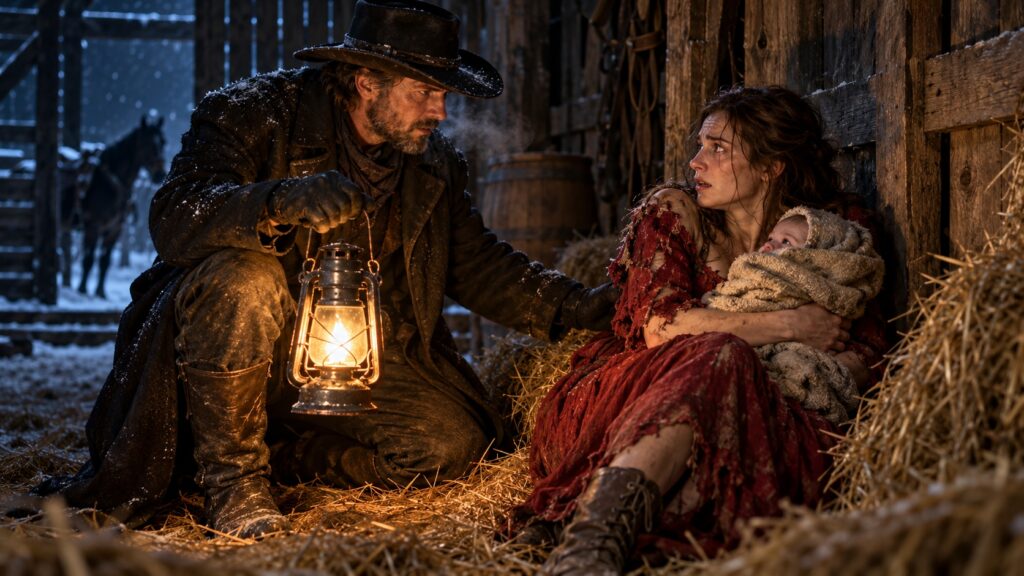
She was sitting in the corner behind a stack of hay bales, her back against the wall.
The first impression was exactly the one his employer had warned him about.
Desperate.
Disordered.
Dangerous.
Clara’s dress had once been elegant enough for a respectable household, but the hem was torn and wet, the sleeves stained from travel. Her brown boots were scraped nearly white at the toes. A loose strand of dark hair had frozen against her cheek.
She held a child against her chest.
Not held.
Shielded.
Her arms formed a cage around the infant.
Her eyes went immediately to Elias’s coat, his gloves, the knife at his belt and finally the revolver beneath the edge of his heavy wool coat.
“You found us.”
Her voice was hoarse.
Elias lowered himself slowly onto one knee.
He placed the lantern on the hay between them.
“Take it easy.”
She tightened her grip on the child.
“You’ve been in here how long?”
Clara said nothing.
“An hour?”
Nothing.
“Two?”
Her lips moved.
“I don’t know.”
“You’re freezing.”
“I know.”
“The baby is freezing too.”
At that, her face changed.
Not much.
But enough.
Fear became hostility.
“Don’t.”
Elias remained still.
“Don’t what?”
“Don’t speak about him.”
He looked at the bundle.
Only a small section of the child’s face was visible. Pale forehead. Closed eyelids. A tiny mouth.
The baby breathed.
That mattered.
“His hands warm?”
Clara looked down automatically.
Elias saw the movement and understood the answer.
“No,” he said. “They aren’t.”
She stared at him.
“You’re trying to frighten me.”
“You’re already frightened.”
“Stay away.”
“I haven’t moved.”
“Don’t take him.”
The words came quickly.
Not screamed.
That made them worse.
“Please.”
Elias watched her for several seconds.
Outside, wind struck the barn wall.
“I’m not touching the child.”
“You were sent for him.”
“Yes.”
Clara’s face emptied.
There it was.
Confirmation.
Until that moment she might still have hoped that he was some traveller, farmer, constable, anyone except the man whose arrival she had been dreading for two days.
Elias did not lie to frightened people unless the lie served some purpose.
There was no purpose in lying now.
She knew who he was.
“The old man said you were clever,” she whispered.
“What old man?”
“The innkeeper.”
Elias almost smiled.
“He also said you were ruthless.”
“That sounds more like him.”
Her eyes moved to the barn door.
Elias noticed.
“There are six kilometres of open field behind this barn,” he said. “Maybe seven. Temperature will fall again before sunrise.”
“I know.”
“You wouldn’t make the road.”
“I made it this far.”
“You had daylight then.”
“You don’t know what I had.”
“No.”
For the first time, he heard anger beneath the terror.
Good.
Anger kept people alive.
He rubbed warmth back into his bare fingers.
The contract lay folded inside his coat.
He could almost feel its weight.
Three thousand francs upon confirmation.
Another seven thousand if he returned the child alive.
An additional payment for the woman if possible.
Possible.
That was the word Lord Adrien Valcourt had used.
Not unharmed.
Not alive.
Possible.
Elias had noticed.
He noticed most things.
It was why men such as Valcourt hired him.
Three weeks earlier, Elias had sat across from the landowner in a library overlooking vineyards buried under winter rain.
Valcourt had been fifty-eight, silver-haired, composed and dressed with the quiet extravagance of men who considered wealth a natural law.
“My son’s child was taken,” he had said.
“By whom?”
“A woman who worked in the household.”
“The mother?”
A silence had followed.
“No.”
Elias had looked up.
Valcourt’s expression had remained perfectly calm.
“She is unstable.”
“That wasn’t my question.”
Valcourt had poured wine.
“My son made mistakes.”
“What sort?”
“The ordinary sort.”
Elias had not touched the wine.
“Ordinary mistakes usually don’t require a tracker.”
The older man smiled.
“I was told you were discreet.”
“I was told you paid well.”
That ended the questions.
Or seemed to.
Now, kneeling in the barn, Elias wondered why the memory had returned with such clarity.
Perhaps because of the way Clara held the child.
Perhaps because he had seen women who had stolen infants.
He had once tracked a woman across the Austrian border after she took her sister’s newborn during a period of grief.
That woman had held the child like evidence of something owed to her.
Clara held this baby as if every bone in her body existed for one purpose.
To place herself between the child and everyone else.
Elias picked up the lantern.
Clara flinched.
“I’m checking his face.”
“No.”
“He needs heat.”
“I said no.”
“He may already be hypothermic.”
The word frightened her more than the gun.
Her eyes filled, but she did not cry.
Instead she looked down at the infant.
Elias saw the decision forming.
She hated him.
She needed him.
There were few positions more dangerous than that.
“Let me see one hand,” he said.
Clara hesitated.
Then slowly adjusted the blanket.
That was when Elias saw the embroidery.
A silver stag beneath a crown.
Small.
Precise.
Sewn into the linen with pale grey thread.
He knew the symbol.
Everyone in western Bretagne knew it.
The Valcourt crest.
Elias had seen it on wine crates, carriage doors, estate documents, even the brass buttons worn by the servants in the manor.
Clara saw him looking.
Her fear sharpened.
“Where did you get that?”
“It was his.”
“Whose?”
“The baby’s.”
“That wasn’t the question.”
Clara pulled the blanket back over the child.
Elias lowered the lantern.
Something inside the story moved.
Not broke.
Moved.
A piece sliding where it should have been from the beginning.
Valcourt had said the child belonged to his son.
He had never said the child’s name.
Never mentioned the mother.
Never shown Elias a birth certificate.
And when Elias had asked whether the authorities had been notified, Valcourt had said the matter was private.
Private.
Rich men used that word when law became inconvenient.
“What is his name?” Elias asked.
Clara stared at him.
“The child.”
She swallowed.
“Luc.”
“Luc what?”
“Just Luc.”
“No child is just anything.”
“He is if someone is looking for the rest.”
Elias said nothing.
Clara drew her knees closer.
“You’ll take him anyway.”
“That depends.”
“On money?”
The insult landed because it was accurate.
Elias leaned back slightly.
“Yes.”
Clara seemed surprised.
He continued.
“Money is why I came.”
She looked almost disgusted.
He had expected that too.
“Ten thousand francs,” he said.
Her eyes widened.
“That is what your son is worth to Adrien Valcourt.”
Clara’s face changed again.
Not fear now.
Recognition.
“You said my son.”
Elias became still.
“You told me he wasn’t yours.”
“I told you nothing.”
“No.”
She looked down at the infant.
“Valcourt told you.”
“Yes.”
“He told you I stole him.”
“Yes.”
“And you believed him.”
“I followed you.”
“That isn’t the same thing.”
“No.”
For several moments neither spoke.
Then Luc made a weak sound beneath the blankets.
Clara reacted instantly.
Elias watched her open the cloth slightly and press her cheek against the child’s forehead.
Her own hands were shaking.
He stood.
She recoiled.
“Stay there.”
“We’re making a fire.”
“No.”
“You want him alive?”
The brutality of the question shocked her.
It was intentional.
“Then we make a fire.”
“There’s smoke.”
“Roof is already broken.”
“They’ll see it.”
“Not in this wind.”
“You don’t know who’s behind you.”
Elias looked at her.
“There are three men.”
Colour left her face.
“So close?”
“Half a day, perhaps less.”
“Valcourt’s?”
“Yes.”
“You led them here.”
“No.”
“They followed you.”
“Probably.”
She gave a short, humourless laugh.
“Then you did.”
Elias accepted that.
He crossed to a stack of dry wood beside an iron brazier.
Clara watched every movement.
“I had a daughter once,” he said.
The words surprised both of them.
He crouched and struck a match.
Clara did not respond.
The fire took slowly.
“They’re not paying you to tell me your life.”
“No.”
“Then why are you?”
Elias fed another piece of wood into the flame.
“Because I want you to understand why I know what cold does to children.”
Silence.
“How old?”
“Six.”
Clara looked at the child.
“What happened?”
“Pneumonia.”
“I’m sorry.”
“You don’t know me.”
“That doesn’t matter.”
Elias watched the fire.
His wife had said something similar twenty years earlier.
A stranger had offered condolences after the funeral, and Elias had gone outside because he could not bear to hear another person say they were sorry.
He had spent most of his life afterward becoming someone to whom nobody offered condolences.
It had seemed simpler.
He moved the brazier closer.
“Come forward.”
Clara hesitated, then shifted across the hay.
Not much.
Enough for Luc to feel warmth.
Elias removed his coat.
She stiffened.
“I’m not coming closer.”
He slid the coat across the floor.
“Put that around both of you.”
She looked at it.
“Why?”
“Because your dress is wet.”
“You expect me to trust you?”
“No.”
“Then why—”
“I expect you to use a coat.”
She stared at him.
Eventually she reached for it.
The fabric was still warm from his body.
That seemed to frighten her almost as much as anything else.
Elias looked away while she settled it around herself.
Trust was sometimes easier when not observed.
He gave her five minutes.
Then he asked, “Who is Luc’s father?”
Clara’s jaw tightened.
“You know.”
“I know what I was told.”
“Henri Valcourt.”
Adrien’s only son.
Thirty-two.
Married.
Elias remembered that.
He had met Henri once in Paris years earlier.
A beautiful, bored young man who laughed too loudly and lost heavily at cards.
“And Luc’s mother?”
Clara’s expression hardened.
“I am.”
Elias did not react.
“Valcourt said you were employed in the household.”
“I was.”
“As governess.”
“To Henri’s daughter.”
“Henri has a daughter?”
“Had.”
The word sat between them.
Elias looked at her.
“What happened?”
“She died.”
“When?”
“Last spring.”
“How?”
Clara said nothing.
The barn seemed suddenly colder.
“Clara.”
“She fell.”
“From where?”
“The west terrace.”
“How old?”
“Five.”
Elias closed his eyes for a moment.
Six.
Five.
Too close.
“Accident?”
“That is what they told people.”
“And what do you say?”
Clara looked toward the fire.
“I say children are often blamed for the things adults refuse to admit.”
Elias waited.
The wind pushed snow through a crack in the wall.
She finally continued.
“Her name was Émilie.”
The way she said it changed the room.
Not the voice of a governess remembering a former charge.
Something closer.
Something intimate.
“She was quiet,” Clara said. “Not shy. Quiet. There is a difference. Shy children want to speak and are afraid. Émilie had learned there was no use speaking.”
Elias said nothing.
“She watched everyone. She knew which footsteps meant her father was drunk. She knew when her grandfather had guests she was expected to disappear. She knew her mother would not defend her.”
“Henri’s wife.”
“Margot.”
“Where is she now?”
“Switzerland.”
“Convenient.”
Clara looked up sharply.
“Do not judge her.”
“I wasn’t.”
“You were.”
Elias accepted the correction.
Clara’s hand rested against Luc’s back.
“Margot was frightened too.”
“Of Henri?”
“Of the house.”
“People aren’t usually frightened of houses.”
“They are when houses belong entirely to one man.”
Adrien Valcourt.
Elias saw the name differently now.
A man at the centre of a system rather than a family.
Clara continued.
“After Émilie died, Henri began drinking more. He blamed Margot. Then he blamed me. Then he blamed the servants. Anyone except himself.”
“Was he responsible?”
Clara looked at Elias.
“He was on the terrace.”
Not enough for an accusation.
Enough for suspicion.
“Did you see it?”
“No.”
“Who did?”
“Margot.”
Elias leaned forward.
“And?”
“She told Adrien.”
“What happened?”
“Adrien sent her away.”
“Why?”
“To recover from grief.”
Clara almost spat the phrase.
“Officially.”
“And unofficially?”
“She had become inconvenient.”
Elias looked toward the barn door.
His mind was working now.
Tracing something other than footprints.
“Then Luc was born.”
Clara nodded.
“Henri came to me after Émilie died. At first I thought he wanted comfort.”
She stopped.
Her face became unreadable.
Elias did not ask for details.
People told more when given room.
“I had loved him once,” she said.
That surprised him.
“Before?”
“Years before. Before he married Margot.”
“And after?”
“I loved the memory.”
That was a sentence Elias understood too well.
“He said everything had changed. He said Émilie’s death had shown him what kind of life he was living. He said he was leaving.”
“For you?”
“For himself, supposedly.”
Her smile was faint and exhausted.
“But men often rename desire as courage.”
Elias glanced at her.
“And you believed him.”
“For a month.”
“What changed?”
“I became pregnant.”
Of course.
The oldest truth.
The most predictable cruelty.
“He denied Luc was his?”
“At first he offered money.”
“And then?”
“His father became interested.”
Elias frowned.
“Why?”
“Henri had no surviving legitimate child.”
Now Elias understood.
“Heir.”
“Yes.”
The word carried no triumph.
Only horror.
“Adrien wanted Luc.”
“Not me.”
“Henri?”
“Henri wanted whatever required least courage.”
Elias looked at the embroidery on the blanket.
“The crest.”
“Adrien ordered it made.”
“When?”
“Before Luc was born.”
The detail was chilling because of how ordinary it sounded.
A piece of linen.
A symbol stitched patiently by someone who probably never knew what it meant.
“He planned to acknowledge him?”
“No.”
Clara’s answer was immediate.
“He planned to take him.”
Elias stared at her.
“How?”
“He had documents prepared.”
“What documents?”
“Adoption. Guardianship. Medical statements.”
“Statements saying what?”
“That I was unstable.”
There it was.
The word Valcourt had used.
Elias felt something settle in his stomach.
“They told the doctor I had become irrational after Émilie’s death. That I was obsessed with Henri. That I had imagined a relationship.”
“Was there proof?”
“Letters.”
“You kept them?”
“Henri did.”
“Why would he?”
“I don’t know.”
She paused.
“Perhaps some part of him wanted to be caught.”
That was possible too.
Cowards sometimes left evidence because confession required strength they did not possess.
“Where are the letters?”
“Gone.”
“Destroyed?”
“I thought so.”
Elias noticed the wording.
“Thought?”
Clara looked at him.
“When Margot left, she gave me a key.”
“To what?”
“A deposit box in Rennes.”
Elias’s attention sharpened.
“What is inside?”
“She said if anything happened to her, I should open it.”
“Did you?”
“Yes.”
“And?”
“Letters. Financial records. Statements from servants.”
“About Émilie?”
“Among other things.”
Elias looked at the fire.
So that was the second hunt.
Not merely the child.
Evidence.
He had wondered why Valcourt had offered so much money.
Ten thousand francs was absurd for a retrieval unless something larger was being recovered.
“He thinks you have them.”
“Yes.”
“Do you?”
Clara studied him.
“No.”
Elias almost laughed.
“Good.”
She blinked.
“You believe me?”
“No.”
For the first time, something passed over her face that was almost amusement.
It disappeared quickly.
“Where are they?”
“Safe.”
“Then keep them safe.”
She stared at him.
That was the first moment the balance between them changed.
Not trust.
Possibility.
Luc stirred again.
Clara looked down.
Elias rose.
“You need to leave before dawn.”
“With you?”
“Yes.”
“Where?”
“South.”
“They’ll expect south.”
“Exactly.”
She frowned.
“That makes no sense.”
“They’ll expect you to believe they expect south. So you’ll go east.”
“And you’ll go south.”
“No.”
“You’re staying?”
“I’m going north.”
Clara stared.
“You’re going back to them.”
“Yes.”
“Why?”
“To tell them you’re dead.”
Silence.
The brazier cracked.
Clara tightened the coat around herself.
“They won’t believe you.”
“They will if I show them something.”
“What?”
Elias looked at her boots.
“The child’s blanket.”
Her arms locked around Luc.
“No.”
“The outer linen.”
“No.”
“Clara.”
“No.”
“The crest is what they’ll recognise.”
“You want me to hand you proof that you found us.”
“I want you to hand me proof that convinces them they don’t need to continue looking.”
She shook her head.
“They will ask for the body.”
“Not immediately.”
“And when they do?”
“I’ll give them a ravine.”
“That sounds like the beginning of a very bad plan.”
“It is.”
“Then why are you calm?”
“Because I’ve had worse ones.”
Clara looked at him for a long moment.
Then she said, “They’ll kill you.”
The statement was almost clinical.
Perhaps she wanted to see if he understood.
“Yes.”
“You say that like it means nothing.”
“It means something.”
“What?”
Elias looked at the flames.
He saw, unexpectedly, his daughter’s red scarf.
Twenty years vanished.
A small body beneath blankets.
His wife beside the bed whispering that the fever was worse.
Him outside in the snow because he could not bear the sound of the child struggling to breathe.
Cowardice came in many forms.
Sometimes it looked like leaving a room.
Sometimes it looked like taking money and refusing to ask questions.
He looked at Clara.
“It means I would prefer they didn’t.”
Her mouth tightened.
“That is not an answer.”
“No.”
He moved toward the door.
Clara panicked.
“Where are you going?”
“To check the road.”
“You’ll leave us here.”
“I’ll come back.”
“You expect me to trust that?”
“No.”
He paused.
“But if I intended to take the child, I could have done it ten minutes ago.”
“That’s supposed to comfort me?”
“No.”
He opened the door.
Cold air rushed in.
Then he stopped.
Footprints.
Not his.
Fresh.
At the edge of the barn.
Elias extinguished the lantern immediately.
“Put out the brazier.”
Clara froze.
“Now.”
She kicked snow over the coals.
Darkness swallowed the barn.
Outside, a horse snorted.
Clara’s breathing became audible.
Elias crossed to her and crouched.
“Three men,” he whispered.
“You said half a day.”
“I was wrong.”
“Valcourt’s?”
“Probably.”
“Probably?”
“One way to find out.”
He removed his revolver.
Clara stared at the weapon.
“No shooting.”
“If possible.”
“I mean it.”
“So do I.”
He looked toward the loft.
“There’s a ladder.”
“It’s broken.”
“Can you climb?”
“With him?”
“Yes.”
She followed his gaze.
“I can try.”
“That isn’t what I asked.”
Clara looked at Luc, then back at him.
“Yes.”
He nodded.
“Good.”
She started toward the ladder.
Then Elias caught her wrist.
She turned sharply.
He released her immediately.
“If I tell you to run, don’t wait.”
“What about you?”
“You don’t know me.”
“You said that already.”
“Then remember it.”
A fist struck the barn door.
“Vane?”
Elias closed his eyes briefly.
He knew the voice.
Gabriel Marchand.
Valcourt’s estate captain.
Not a tracker.
Something worse.
A loyal man.
“Elias?”
Another knock.
“We know you’re inside.”
Elias looked at Clara.
Her face had gone pale.
He motioned toward the loft.
She climbed.
The old ladder creaked beneath her.
Luc began to whimper.
Clara pressed him close.
Elias stepped toward the centre of the barn.
Marchand called again.
“Open the door.”
Elias opened it.
Three riders stood outside.
Marchand in front.
Tall, black-bearded, military posture.
Two estate men behind him.
“Couldn’t sleep?” Elias asked.
Marchand looked past him.
“You found her.”
“Found a barn.”
“Horse tracks lead here.”
“So do mine.”
Marchand smiled slightly.
“You’ve never liked people looking over your shoulder.”
“I don’t.”
“Valcourt doesn’t like wasting money.”
“Then he hired the wrong men to follow me.”
One of the riders shifted.
Marchand ignored the insult.
“Where is she?”
“Gone.”
“Where?”
“River.”
“Which river?”
“The Penfao.”
Marchand looked toward the barn.
“Mind if I check?”
“Yes.”
That changed the air.
Marchand’s smile disappeared.
“You were paid to return the child.”
“I know.”
“Then why are you making this difficult?”
Elias shrugged.
“Because I was almost finished.”
“Finished?”
“She crossed the ice.”
Marchand stared.
“And?”
“It broke.”
Above them, the barn remained silent.
Too silent.
Elias could feel Clara listening.
“The woman?”
“Gone.”
“The child?”
Elias reached slowly inside his coat.
Marchand’s hand moved toward his weapon.
“Easy.”
Elias pulled out the folded contract.
Then, from beneath it, the embroidered linen he had cut from the outer edge of Luc’s wrapping while Clara climbed.
He had done it without asking.
That might cost him later.
If later existed.
He held out the cloth.
The silver stag caught moonlight.
Marchand stared at it.
One of the riders swore.
“Where did you get that?”
“From the ice.”
Marchand took it.
His face changed.
Not grief.
Not disappointment.
Fear.
Tiny.
But Elias saw it.
“Did you recover the body?”
“No.”
“You’re certain the child went under?”
“I watched it happen.”
Marchand looked at him.
“You watched?”
“Yes.”
“And did nothing?”
Elias’s expression remained flat.
“It was ice water in January.”
Marchand continued staring.
Then he looked toward the barn.
“Search it.”
Elias drew his revolver.
No one moved.
The moment widened.
Marchand looked at the gun.
Then at Elias.
“That would be a mistake.”
“Yes.”
“Move.”
“No.”
“Why?”
Elias tilted his head.
“If I’m lying, you already know why.”
Marchand’s jaw tightened.
“If you’re telling the truth?”
“Then you’re wasting my time.”
The two men behind Marchand shifted uneasily.
They were hired men.
Not martyrs.
Marchand knew it.
So did Elias.
“You’ve changed,” Marchand said.
“No.”
“You used to understand arrangements.”
“I still do.”
“Then understand this one. Valcourt wants the child.”
“The child is dead.”
“Valcourt will want proof.”
“You’re holding it.”
Marchand glanced at the linen.
For one second, Elias thought it might work.
Then Marchand looked at the barn again.
And smiled.
“The woman wore red.”
Elias said nothing.
Marchand pointed toward the hay near the entrance.
A small thread of red cloth had caught on a nail.
Damn.
Marchand stepped forward.
Elias lifted the revolver.
Above them, a floorboard creaked.
Everyone heard it.
Marchand looked up.
“Clara?”
Elias fired.
Not at Marchand.
At the lantern hanging from the outside beam.
Glass exploded.
Oil flared across the snow.
The horses reared.
One rider fell.
Marchand shouted.
Elias slammed the barn door and dropped the wooden bar into place.
“Run!”
Clara descended from the loft almost falling.
“There’s another door,” Elias said.
“Where?”
“Back wall.”
They moved through darkness.
Men struck the main entrance.
Wood cracked.
Clara clutched Luc beneath Elias’s coat.
Elias kicked away a rotten panel near the rear stall.
Cold air poured in.
A narrow service door appeared behind stacked timber.
He forced it open.
Snow.
Darkness.
Freedom for perhaps thirty seconds.
“Go east.”
“You said south.”
“I lied.”
“To me?”
“To everyone.”
Behind them, the main door splintered.
Clara stared at him.
“Come with us.”
“I need to slow them.”
“No.”
“Clara.”
“No.”
Her voice changed.
Not fear.
Anger.
“You don’t get to decide to die because it feels cleaner than living with what you’ve done.”
The sentence stopped him.
He stared at her.
She did not know about his daughter.
Not really.
But somehow she had struck the hidden wound exactly.
“Come with us,” she said again.
Footsteps inside the barn.
Elias looked toward the darkness beyond the door.
Then back at Clara.
He made the second treasonous decision of the night.
He followed her.
They crossed the field together.
Not running.
Running would exhaust Clara.
Walking fast.
Measured.
Luc remained silent beneath the coat.
Behind them men shouted.
Elias led her toward the frozen orchard.
“There’s a road beyond the trees.”
“And then?”
“A chapel.”
“A chapel?”
“Priest owes me money.”
Clara looked at him incredulously.
“What sort of life have you lived?”
“The wrong one.”
Despite everything, she laughed.
Once.
Quietly.
It was the strangest sound in the winter night.
They reached the trees.
A gunshot sounded behind them.
The bullet struck a trunk.
Clara ducked.
Elias pushed her forward.
“No stopping.”
Another shot.
Too far.
Poor visibility.
They would not risk many.
Not with the child.
That was when Elias understood something else.
“They won’t shoot at you.”
“What?”
“They can’t.”
“Why?”
“Because Valcourt wants Luc alive.”
Clara looked over her shoulder.
“You sound relieved.”
“I am.”
“And you?”
“I’m considerably less valuable.”
They reached the road.
A horse appeared through the snow.
Elias caught its reins.
One of Marchand’s men had left it tethered near the orchard.
He helped Clara mount.
“You ride?”
“Yes.”
“Good.”
“You?”
“I walk.”
She stared.
“No.”
“Horse can’t carry both of us fast enough.”
“They’ll catch you.”
“Possibly.”
Her eyes hardened.
“You’re doing it again.”
“Doing what?”
“Deciding for everyone.”
He almost answered.
Instead he looked back.
Lights moved through the orchard.
Close.
Clara extended a hand.
“You said you were getting us both out alive.”
Elias looked at her hand.
He had indeed said it.
The promise had seemed simple inside the barn.
Promises always did.
He took her hand.
Mounted behind her.
And for the first time in twenty years, Elias Vane chose survival instead of punishment.
They rode east.
Three days later, Adrien Valcourt received a sealed envelope.
Inside was a strip of embroidered linen.
A report signed by Elias Vane stating that Clara Veyne and the infant Luc Valcourt had been lost beneath river ice during an attempted crossing.
There was also a second envelope.
Unmarked.
That one contained copies of Henri Valcourt’s letters.
Margot’s statement concerning the death of her daughter.
Testimony from two former servants.
Financial ledgers showing payments to a physician for false medical declarations.
And a handwritten note.
You hired me to find what was stolen.
I did.
It was not the child.
The originals were already with a magistrate in Rennes.
By spring, the Valcourt estate had become the centre of an inquiry that the family’s influence could delay but no longer bury.
Henri left France before he could be questioned.
Adrien remained.
Men like Adrien often believed staying was proof of innocence.
It was sometimes only proof that they had spent too long believing consequences were for other people.
Clara never learned exactly where Elias had sent her documents.
He never told her.
Some habits of secrecy survived even moral transformation.
They travelled north under false names.
First to Belgium.
Then the Netherlands.
Eventually a small coastal town outside Haarlem, where Clara found work translating correspondence for a shipping firm.
Luc grew.
For the first year, Elias slept in rented rooms nearby but never in the same house.
He repaired locks.
Carried coal.
Walked Clara home when winter streets became empty.
Never touched her without reason.
Never asked what she felt.
Their closeness developed the way trust often does after betrayal.
Not through declarations.
Through repetition.
He returned when he said he would.
He left money on the table without mentioning it.
She stopped hiding documents when he entered the room.
He stopped sleeping with a pistol beneath his pillow.
One afternoon, almost two years after the barn, Clara found him sitting on the harbour wall watching Luc chase gulls.
The boy had Elias’s old wool hat pulled down over his ears.
Clara stood beside him.
“He calls you Papa when you’re not listening.”
Elias watched the child.
“He shouldn’t.”
“Why?”
“Because I’m not.”
Clara considered this.
“No.”
She sat beside him.
“You aren’t.”
Elias looked at her.
She smiled faintly.
“But perhaps children understand family before adults do.”
He looked away toward the sea.
For several moments neither spoke.
Then Clara said, “Margot wrote.”
Elias turned.
“From Switzerland?”
“Yes.”
“How is she?”
“Alive.”
It was not a full answer.
It was enough.
“She wants to see Luc one day.”
“Will you let her?”
“I think so.”
Elias nodded.
Clara folded her hands.
“She also told me something.”
He waited.
“She was the one who kept Henri’s letters.”
“You knew that.”
“No.”
Elias looked at her.
“She told me she destroyed them.”
“Why lie?”
“To protect me.”
Clara glanced toward Luc.
“She knew Adrien would search anyone who had reason to hate the family. He never imagined she would trust me because he believed we should have hated each other.”
Elias almost smiled.
“Men like him often misunderstand women.”
“Men like him misunderstand everyone.”
Clara turned toward him.
“She said something else.”
“What?”
“That after Émilie died, she almost said nothing.”
Elias understood.
“She was ashamed.”
“Yes.”
“Because she was afraid.”
“Yes.”
Clara’s eyes remained on the water.
“She wrote that silence felt like cowardice until she understood fear does not make a person a coward. Staying silent forever does.”
Elias absorbed that.
The harbour bells rang four.
Luc came running toward them, laughing, the oversized hat slipping over his eyes.
Elias caught him before he collided with the bench.
The child wrapped both arms around his neck without hesitation.
Elias froze.
Even after two years, some forms of affection still startled him.
Clara watched.
“You can put him down,” she said softly.
“I know.”
But he did not.
Luc rested his head against Elias’s shoulder.
Across the harbour, winter sunlight broke through the clouds.
Elias thought of another child.
Another winter.
A room he had left because grief frightened him more than death did.
For years he had believed he had become hard because the world required hardness.
Now he understood something less flattering.
Hardness had simply been easier than attachment.
Attachment demanded the possibility of loss.
Clara stood.
She brushed hay that did not exist from the sleeve of his coat.
An old nervous habit.
He noticed.
He always noticed.
“You still have the lantern?” she asked.
Elias looked at her.
“From the barn?”
“Yes.”
“It survived.”
“Why did you keep it?”
He considered lying.
Then did not.
“To remember.”
“The night you betrayed Adrien Valcourt?”
“The night I finally stopped betraying myself.”
Clara looked at him for a long moment.
There was no dramatic embrace.
No confession.
No promise that suffering had somehow justified what came after.
Some wounds should not be made beautiful simply because people survive them.
She only slipped her hand into his.
Elias looked down at their joined hands.
Then at Luc sleeping against his shoulder.
He thought about the barn, the embroidered crest, Marchand at the door, the contract inside his coat.
Ten thousand francs.
A fortune.
Once, it had seemed like enough money to solve almost anything.
Now he could barely remember what he had planned to do with it.
Clara squeezed his hand once.
Not gratitude.
Not forgiveness.
Something steadier.
A recognition.
That two frightened people had once met in a frozen barn believing the other might destroy what little remained of their lives.
Instead, each had become proof that the other could still choose differently.
And perhaps that was all redemption ever was.
Not erasing what had been done.
Not becoming innocent again.
Only reaching the moment when the old choice presented itself in another form—
and refusing to make it twice.