Chapter 1 – The Bicycle Light
At 8:14 on a cold November evening in Lyon, Malik Benali was cycling home from work.
He was twenty-eight.
Born in France.
Raised twenty minutes from where he now lived.
He worked as a junior architect at a small design firm near Part-Dieu.
That evening, he had stayed late because a client had changed the measurements on a renovation plan for the third time.
By the time he left the office, the rain had stopped but the streets were still wet.
His rear bicycle light had started flickering.
Malik noticed it at a red light.
He tapped the casing twice.
The light came back.
Then went out again.
“Great.”
He stopped near a bakery that was closing and reached into his backpack for the spare battery he thought he had.
He did not.
He checked the side pocket.
Nothing.
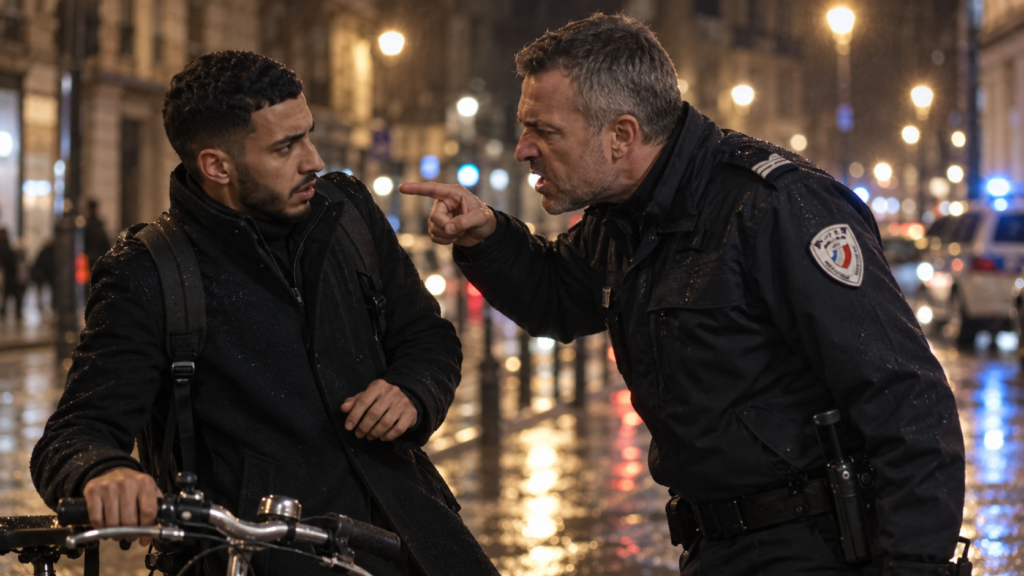
That was when a police car slowed beside him.
The passenger window lowered.
A uniformed officer looked over.
“Your rear light isn’t working.”
Malik nodded.
“I know. It just died.”
“Identification.”
Malik paused.
“Sure.”
He took out his wallet.
The officer stepped from the vehicle.
Mid-forties.
Broad shoulders.
Short grey hair.
His name badge read:
DUPONT.
Malik handed him his ID.
Dupont looked at it.
Then at Malik.
Then back at the card.
“You live here?”
“Yes.”
“Here where?”
Malik pointed down the street.
“Three blocks.”
Dupont looked at the address.
“That’s not three blocks.”
Malik frowned.
“It’s five minutes.”
“You said three blocks.”
Malik looked at him.
“Okay.”
The second officer remained near the car.
Malik assumed the interaction would take thirty seconds.
It did not.
Chapter 2 – The First Question
Dupont held the ID.
“What are you doing out here?”
Malik looked at him.
“Going home.”
“From where?”
“Work.”
“What kind of work?”
Malik hesitated.
“Architecture.”
Dupont gave him a look that Malik could not immediately read.
“Architecture?”
“Yes.”
“Where?”
Malik named the firm.
Dupont looked at the bicycle.
Then at Malik’s coat.
Then at the backpack.
“You have anything in the bag?”
Malik’s expression changed.
“Why?”
“I’m asking.”
“Laptop. Notebook. Charger.”
“Open it.”
Malik stared.
“For a broken light?”
Dupont’s face hardened slightly.
“Do you want to make this difficult?”
Malik exhaled.
“No.”
“Then open the bag.”
The second officer looked over.
Malik slowly unzipped the backpack.
Dupont glanced inside.
Laptop.
Documents.
A rolled printout.
A lunch container.
Nothing else.
He closed it.
Malik held out his hand.
“My ID?”
Dupont did not give it back.
“Where were you born?”
Malik went still.
“In Lyon.”
Dupont looked at him.
“Originally.”
Malik stared.
“I was born here.”
“That isn’t what I asked.”
“Yes, it is.”
The second officer looked up more sharply now.
Malik’s voice stayed calm.
“I was born in Lyon.”
Dupont tilted his head.
“Your family.”
Malik looked at him for several seconds.
“Why?”
“I’m trying to establish who I’m dealing with.”
That sentence changed the entire interaction.
Chapter 3 – “Who You’re Dealing With?”
Malik laughed once.
Not because he found it funny.
“Who you’re dealing with?”
Dupont frowned.
“Yes.”
“My ID literally tells you.”
“Don’t get smart.”
“I answered every question.”
“No. You answered around them.”
Malik stared.
“What am I answering around?”
“Your background.”
“My background isn’t relevant to a bicycle light.”
Dupont took a step closer.
“You don’t decide what’s relevant.”
The second officer finally spoke.
“Jean.”
Dupont looked over.
“What?”
“Maybe just issue the warning.”
Dupont ignored him.
He looked back at Malik.
“You people always do this.”
The words landed quietly.
Malik blinked.
“What?”
Dupont realised what he had said.
But instead of stepping back, he doubled down.
“You heard me.”
Malik’s voice became colder.
“No. Say it again.”
Dupont folded his arms.
“People who get stopped and immediately start arguing.”
Malik nodded slowly.
“That’s not what you meant.”
“Yes, it is.”
“No.”
Dupont’s jaw tightened.
“You want a fine?”
Malik laughed again.
“For what?”
“For the light.”
“Then fine me.”
Dupont stared.
Malik continued.
“Fine me for the light. That’s what this started as.”
People were beginning to look over now.
The bakery worker had come to the doorway.
A woman with a shopping bag slowed down.
Dupont noticed.
“Don’t perform.”
Malik stared.
“I’m standing here.”
“You’re raising your voice.”
“I am not.”
“Lower it.”
Malik looked around.
His voice was barely above conversational level.
That was the moment he understood.
This was not really about the volume.
Chapter 4 – The Phone
Malik reached toward his coat pocket.
Dupont immediately said:
“Hands where I can see them.”
Malik froze.
The second officer stepped forward.
“He’s reaching for his phone.”
Dupont replied:
“I know what he’s reaching for.”
Malik looked at him.
“Then why did you say that?”
“Because I told you to keep your hands visible.”
“I was getting my phone.”
“For what?”
“To record.”
Dupont laughed.
“Of course.”
Malik took the phone out slowly.
“I am allowed to record.”
“Do whatever you want.”
Malik tapped the screen.
Dupont immediately said:
“Don’t put that in my face.”
“It isn’t in your face.”
“Back it up.”
“It is at my chest.”
“Back it up.”
Malik took one step backward.
“There.”
Dupont moved forward.
Malik frowned.
“You told me to back up.”
“I told you not to put the phone in my face.”
“You stepped toward me.”
Dupont pointed.
“See? This attitude.”
Malik’s voice rose for the first time.
“What attitude?”
“Exactly that.”
“What do you want from me?”
“Cooperation.”
“I gave you my ID.”
“You argued.”
“You asked where I was born after reading that I was born here.”
Dupont’s expression hardened.
“That is a legitimate question.”
“No, it isn’t.”
“Don’t tell me how to do my job.”
“Then tell me what this has to do with a bicycle light.”
Dupont said nothing.
Malik held the phone steady.
“What does Algeria have to do with my bicycle light?”
The woman with the shopping bag stopped completely.
Dupont stared.
“I didn’t say Algeria.”
Malik’s face changed.
“No. You didn’t.”
The second officer looked at Dupont.
So did the woman.
Malik continued.
“I never said Algeria.”
Dupont’s jaw clenched.
“It’s on your surname.”
Malik laughed in disbelief.
“There it is.”
“Don’t.”
“There it is.”
“I said don’t.”
“You guessed my family background from my name.”
“So?”
“And then asked where I’m really from.”
“I did not say really.”
“You said originally.”
“That is different.”
“No, it isn’t.”
Dupont’s voice rose.
“STOP TWISTING MY WORDS.”
Several people turned.
Now he was the loud one.
Chapter 5 – The Witness
The woman with the shopping bag stepped closer.
“Officer.”
Dupont turned.
“Please keep moving.”
She did not.
“I’ve been standing here.”
“Then you should keep moving.”
“I heard what you said.”
Dupont’s face changed.
“This doesn’t involve you.”
“It became my business when you started asking him where he’s really from.”
“I did not say really.”
Malik looked at her.
“Thank you.”
Dupont snapped:
“Don’t encourage this.”
The woman stared.
“Encourage what?”
“This situation.”
“What situation?”
Dupont pointed at Malik.
“Noncompliance.”
Malik laughed.
“I am literally standing still holding my phone.”
Dupont turned.
“Put the phone down.”
“No.”
“Put it down.”
“No.”
The second officer said:
“Jean.”
Dupont ignored him.
“I’m giving you a lawful instruction.”
Malik looked at him.
“For what?”
“For officer safety.”
“I’m holding a phone.”
“That can be used as an object.”
Malik stared.
“Are you serious?”
“Put it down.”
The woman said:
“He’s not threatening you.”
Dupont rounded on her.
“Stay out of this.”
“No.”
“You need to move.”
“No.”
“Ma’am.”
“I’m not leaving.”
Dupont looked around.
Three more people had stopped.
Someone across the street was watching.
A delivery cyclist had slowed down.
Dupont looked increasingly embarrassed.
And embarrassment made him angrier.
Chapter 6 – The Search
Dupont looked at Malik.
“Turn around.”
Malik stared.
“For what?”
“I’m conducting a search.”
The second officer immediately said:
“On what basis?”
The question surprised everyone.
Dupont turned.
“What?”
The second officer, Martin, spoke more carefully.
“What are you searching for?”
Dupont stared at him.
“Anything relevant.”
“To the light?”
Dupont’s face reddened.
Malik looked between them.
“Exactly.”
Dupont turned back.
“I don’t need to explain procedure to you.”
Malik’s voice sharpened.
“You absolutely do if you’re putting your hands on me.”
“Turn around.”
“No.”
The air changed.
Not because Malik moved.
Because he didn’t.
Dupont stepped closer.
“I said turn around.”
“And I said why?”
“Because I instructed you.”
“That is not a reason.”
Dupont reached for Malik’s arm.
Malik pulled back.
“Don’t touch me.”
Dupont grabbed his sleeve.
“Stop resisting.”
Malik shouted:
“I AM NOT RESISTING.”
The woman with the shopping bag yelled:
“He didn’t do anything!”
Martin stepped between them.
“Jean, stop.”
Dupont stared at his colleague.
“Move.”
“No.”
“You move.”
“There’s no basis.”
“Move.”
“No.”
Dupont’s face was furious now.
“You’re undermining me in public.”
Martin replied:
“Then stop making it worse.”
Silence.
That sentence hit harder than anything Malik had said.
Chapter 7 – The Explosion
Dupont let go of Malik’s sleeve.
For half a second, everyone thought it was over.
Then Dupont looked at Malik’s phone.
“Delete that recording.”
Malik stared.
“No.”
“Delete it.”
“No.”
“You recorded police operations.”
“Yes.”
“You don’t know the law.”
“I know enough.”
Dupont stepped forward again.
Martin blocked him.
“Jean.”
Dupont shouted:
“HE’S BEEN PROVOKING THIS FROM THE START.”
Malik exploded.
“PROVOKING WHAT?”
His voice echoed off the shopfronts.
“You stopped me for a broken light!”
Dupont pointed.
“And then you argued every single step!”
“Because you asked where I’m from!”
“I ASK EVERYONE QUESTIONS!”
“Would you ask him?”
Malik pointed toward a white man standing near the bakery.
Dupont stared.
“Don’t make this racial.”
Malik laughed in disbelief.
“I didn’t!”
“You are now.”
“No. YOU did!”
Dupont’s face went red.
“You people always want racism whenever you’re told no.”
The entire street went silent.
Not one person moved.
Martin closed his eyes.
The woman with the shopping bag whispered:
“Oh my God.”
Malik stared at Dupont.
For a moment, he looked almost calm.
Then:
“Say it again.”
Dupont said nothing.
Malik stepped closer.
Martin immediately placed a hand out between them.
“Malik, stay there.”
Malik ignored him.
“No. Say it again.”
Dupont looked away.
“That’s what I thought.”
Dupont snapped back:
“No, don’t do that.”
“Do what?”
“Act like you’ve caught me saying something.”
“You just did.”
“I said people like you.”
“No.”
Malik shook his head.
“You said you people.”
“It means argumentative people.”
“Bullshit.”
Dupont shouted:
“WATCH YOUR LANGUAGE.”
Malik shouted back:
“WATCH YOURS.”
That was the peak.
Two men screaming in the middle of a wet street.
One in uniform.
One holding a phone.
Both furious.
But only one had the power to turn the argument into handcuffs.
Everyone watching understood that.
So did Malik.
And that was what made his anger look different from Dupont’s.
He knew he could not afford to lose control in the same way.
Chapter 8 – The Supervisor
Martin called for a supervisor.
Dupont protested immediately.
“That isn’t necessary.”
Martin ignored him.
Malik remained where he was.
The woman with the shopping bag stood beside him now.
Her name was Claire.
She handed Malik her business card.
“I heard the whole thing.”
Dupont looked over.
“This is inappropriate.”
Claire replied:
“No. This is evidence.”
Dupont laughed.
“You people have already decided.”
Malik stared at him.
“There it is again.”
Dupont shook his head.
“No. Don’t twist that too.”
A supervisor arrived twelve minutes later.
Captain Élodie Marchand.
She spoke first to Martin.
Then Dupont.
Then Malik.
Nobody was arrested.
Nobody was handcuffed.
Malik received no fine for the bicycle light.
Instead, the supervisor took statements.
When Dupont explained the interaction, he said Malik had become hostile from the beginning.
Claire interrupted.
“He did not.”
Marchand raised a hand.
“I’ll speak to you separately.”
Claire nodded.
Dupont continued.
“He questioned every instruction.”
Marchand asked:
“Why did you ask where his family was from?”
Dupont paused.
“Context.”
“What context?”
“Identity.”
“You had his ID.”
“Yes.”
“Which showed he was born in Lyon.”
Dupont’s face hardened.
“That doesn’t mean I can’t ask.”
“No. But I’m asking why.”
Dupont looked away.
Malik watched.
For the first time that evening, Dupont had no authority over the question.
He had to answer it.
And he did not like that.
Chapter 9 – The Complaint
Malik filed a formal complaint the next morning.
Claire gave a statement.
Martin did too.
There was body-camera footage.
There was Malik’s phone recording.
There were witnesses.
The process took months.
Long enough for anger to turn into exhaustion.
During the investigation, Dupont insisted he was not racist.
He said the phrase “you people” referred to civilians who became confrontational during routine checks.
He said questions about family origin were standard rapport-building.
He said Malik had misinterpreted the interaction because he was already suspicious of police.
Malik read that sentence twice.
Already suspicious of police.
He laughed when he saw it.
Not because it was funny.
Because even in the written explanation, somehow his reaction had become the problem.
Chapter 10 – The Hearing
At an internal disciplinary hearing, Dupont was asked directly:
“Do you understand why Mr. Benali believed your questions were racially motivated?”
Dupont answered:
“I understand that he chose to see them that way.”
Malik was not in the room.
But when his lawyer later repeated the sentence to him, he stared at the wall.
“Chose?”
“Yes.”
“He said chose?”
“Yes.”
Malik laughed once.
Then stopped.
That single word bothered him more than the shouting.
Because it meant Dupont still believed racism only existed if the person accused agreed that it did.
Chapter 11 – The Result
The department eventually found that Dupont had breached professional conduct standards.
The official wording was careful.
Improper questioning.
Failure to de-escalate.
Unprofessional language.
Disproportionate escalation.
The finding did not use the word Malik had expected most.
Racism.
Dupont received disciplinary sanctions and retraining.
He remained employed.
That result caused another argument online.
Some people said the punishment proved the system worked.
Others said keeping him in uniform proved the opposite.
Some comments focused on Malik’s shouting.
Others asked how calm a person was expected to remain while being repeatedly treated like a suspect during a bicycle-light stop.
One comment read:
He should have just cooperated.
Malik saw it.
He stared at the words.
Then closed the page.
Because he had cooperated.
Until cooperation started meaning accepting every humiliation without reacting.
Chapter 12 – The Second Stop
Six months later, Malik was cycling home again.
Different street.
Different evening.
His lights worked perfectly.
A police car slowed beside him.
Malik’s body reacted before his mind did.
Shoulders tight.
Hands cold.
The window lowered.
A young officer said:
“Evening.”
Malik stopped.
“Yes?”
The officer pointed behind him.
“Your bag strap is hanging near the wheel.”
Malik looked down.
It was.
“Oh.”
“Could get caught.”
Malik pulled it up.
“Thanks.”
The officer nodded.
“Have a good evening.”
The car drove away.
Malik remained still for several seconds.
Nothing had happened.
That was the point.
A normal interaction.
Brief.
Clear.
Respectful.
The kind of interaction he had wanted the first time.
He started cycling again.
Then his phone vibrated.
A message from Claire.
She had sent him a screenshot.
Someone had posted in a local discussion group about the disciplinary case.
The top comment said:
People are too quick to call everything racist now.
Malik stopped at the next red light.
He read it once.
Then locked the screen.
Behind him, a car honked when the light turned green.
Malik started moving.
He did not reply.
Some arguments ended because people understood one another.
Others ended only because one person became too tired to keep explaining what had happened to them.
And somewhere in another part of the city, Dupont was still working.
Still telling people he had never treated Malik differently.
Still certain that the real problem began the moment Malik noticed that he had.