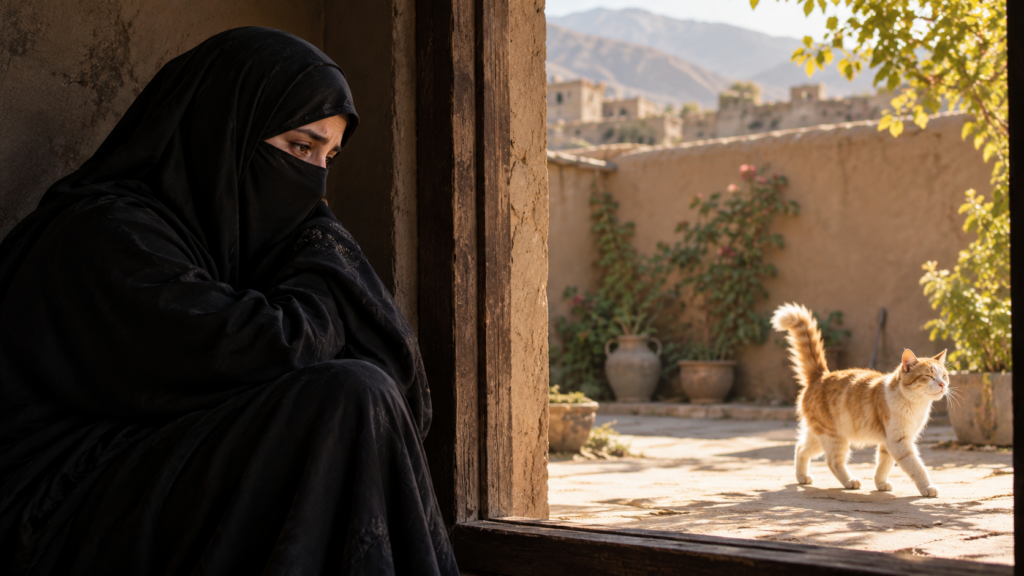
At 7:12 on a cold February morning in Kabul, nineteen-year-old Laila Rahimi was ironing her younger brother’s school shirt.
The electricity had returned twenty minutes earlier.
Nobody knew how long it would stay.
So her mother had plugged in the iron, switched on the small electric heater, and begun charging two mobile phones at the same time.
Outside, the lane was turning grey with morning.
Men pulled metal shutters from shopfronts.
A bread seller stacked warm naan behind a fogged window.
A motorcycle coughed twice before starting.
Somewhere beyond the courtyard wall, schoolboys were shouting at one another.
Laila could hear them.
She could not see them.
She pressed the iron over the sleeve of Farid’s white shirt.
“Hold still.”
“I am holding still.”
“You’re moving.”
“I’m breathing.”
Farid was sixteen and already taller than his sister.
He stood beside the table wearing one sock, trying to eat bread with honey while Laila fixed his collar.
Their mother, Soraya, poured tea.
“You’ll miss the bus.”
Farid looked at the clock.
“I have time.”
Laila smoothed the shirt.
“You always have time.”
He smiled.
“You’re jealous.”
She stopped ironing.
Farid immediately realised he had chosen the wrong word.
“I didn’t mean—”
“I know.”
Laila unplugged the iron.
Three years earlier, she had attended secondary school.
Her books still stood on a shelf in the room she shared with her twelve-year-old sister, Mina.
Biology.
Chemistry.
Dari literature.
An English grammar book with her name written carefully on the inside cover.
Laila had once planned to become a doctor.
Later, when that seemed too ambitious, she decided she might become a nurse.
Then perhaps a midwife.
Eventually, the exact profession stopped mattering.
What mattered was that every version of her future had required a classroom.
Farid put on his coat.
He picked up his backpack.
“Do you need anything from the market?”
Laila thought for a moment.
“Blue thread.”
“For the embroidery?”
“Yes.”
“Which blue?”
She laughed.
“The same one I showed you yesterday.”
“You showed me five blues.”
“They weren’t the same.”
“To me they were.”
Soraya handed him a small piece of paper.
“Take this to the pharmacy too.”
Farid read it.
“Grandmother’s tablets?”
“Yes.”
“I’ll go after school.”
Soraya nodded.
Farid opened the courtyard gate.
Their cat, Mishi, had been sitting beside a bucket in the sun.
The instant the gate opened, she shot between Farid’s legs.
“Mishi!”
Laila dropped the folded shirt.
The cat ran into the alley.
Farid laughed.
“She’ll come back.”
“She was sick last week.”
“She always comes back.”
But Laila was already moving.
She reached the gate.
Stopped.
She was wearing a long house dress.
Her hair was uncovered.
The alley was less than five metres away.
Mishi sat beside a drain, licking one paw.
“Come here.”
The cat looked at her.
Laila crouched behind the half-open gate.
“Mishi.”
The cat walked farther away.
Farid stepped into the street.
“I’ll get her.”
“You’ll miss your bus.”
“So?”
“So go.”
Farid looked at his sister.
Then at the cat.
Then back at her.
For both of them, the absurdity was so ordinary they did not discuss it.
Farid could simply walk into the street.
Laila could not.
Soraya appeared behind her carrying a black outer garment.
“Put this on.”
“Mama, she’s right there.”
“Put it on.”
“It will take longer than catching her.”
“Laila.”
Her mother’s voice changed.
That was enough.
Laila took the garment.
She covered herself.
Adjusted the fabric.
Then covered her hair and face as her mother insisted whenever she went outside.
By the time she opened the gate, Mishi had disappeared around the corner.
Farid sighed.
“I’ll find her.”
“No. Go to school.”
“But—”
“Go.”
Laila stepped outside.
The cold air touched the small exposed area around her eyes.
She had walked perhaps twenty metres when she saw Mishi under a parked car.
“Come on.”
She crouched.
The cat moved deeper beneath it.
A shopkeeper across the road watched without interest.
Two boys passed carrying bread.
Nobody cared about the cat.
Then Laila heard a man’s voice behind her.
“Sister.”
She froze.
Two men were walking along the lane.
One wore the clothing associated locally with the morality authorities.
The other carried a notebook.
Laila stood.
“Where are you going?”
“Home.”
“Where is your mahram?”
She looked toward her house.
“Inside.”
“You are outside.”
“My cat ran away.”
The man looked beneath the car.
Mishi’s yellow eyes reflected from the shadow.
For a moment nobody said anything.
Then the second man smiled faintly.
“You came outside for a cat?”
Laila felt heat rise beneath the fabric covering her face.
“She was sick.”
The first man looked at her clothing.
“Your covering is loose.”
Laila immediately pulled the fabric closer.
“I’m going home.”
“You should know the rules.”
“I do.”
“Then follow them.”
The shopkeeper across the road lowered his eyes.
Farid had not yet reached the end of the street.
He heard the voices and turned back.
“My sister is with me.”
The man looked at him.
“You were walking away.”
“I was getting her cat.”
Laila whispered:
“Farid, go.”
He ignored her.
“She lives there.”
He pointed toward their gate.
“She only came outside for one minute.”
The morality official looked at him.
“Then she can go back.”
Laila stepped away.
At that exact moment, Mishi darted from beneath the car.
She ran between the two men.
Across the lane.
Onto a low wall.
Then jumped into the courtyard of a neighbouring house.
Nobody stopped her.
Nobody asked where she was going.
Nobody asked who accompanied her.
The cat disappeared into the sunlight.
Laila stared after her.
Farid whispered:
“I’ll get her later.”
They went home.
It should have been a minor incident.
A warning.
Nothing more.
But after that morning, Soraya became frightened.
For three days she did not allow Laila or Mina near the front gate.
“If they recognise the house, they may come again.”
“They don’t care about us,” Laila said.
“You don’t know that.”
“I did nothing.”
“That doesn’t matter.”
Laila looked at her mother.
“Then what does?”
Soraya did not answer.
She simply closed the curtain.
Before August 2021, Soraya had worked in an accounting office.
Not an important job.
She had not been powerful.
She had spent most days entering figures into spreadsheets and complaining about a printer that jammed whenever someone tried to print more than twenty pages.
She used to leave home each morning carrying a handbag and a plastic container of rice.
Laila remembered watching her apply lipstick in the hallway mirror.
Not because lipstick was important.
Because leaving the house had once been ordinary.
Now Soraya rarely spoke about that job.
She embroidered children’s clothes at home and occasionally helped a neighbour keep handwritten accounts for a small food business.
The money was irregular.
Farid increasingly became the person who did things outside.
He bought vegetables.
Collected medicines.
Paid bills.
Carried documents.
Asked questions at offices.
Laila wrote lists for him.
That was how February became March.
Then April.
Then May.
Mishi continued escaping whenever somebody forgot to watch the door.
Nobody punished her.
She slept wherever she wanted.
On the roof.
Under a neighbour’s car.
Beside a pile of firewood.
Sometimes she disappeared for half a day.
Laila began noticing it.
Not because she resented the animal.
Because the comparison became impossible not to see.
One afternoon, Mina stood beside the courtyard wall listening to children returning from school.
She was twelve.
Her last year of formal education was ending.
She held an exercise book against her chest.
“What happens next year?”
Laila knew exactly what she meant.
“Nothing.”
Mina frowned.
“What do you mean?”
“You’ll study here.”
“With you?”
“Yes.”
“That isn’t school.”
“No.”
“Will they open again?”
Laila looked away.
“I don’t know.”
Mina became angry.
Not emotional.
Angry.
“Farid says they’ll open.”
“Farid doesn’t know.”
“Papa said the same thing.”
“Papa doesn’t know either.”
Their father, Hamid, heard them from the next room.
He worked repairing mobile phones in a small shop.
He came into the courtyard.
“Why are you frightening her?”
Laila turned.
“I’m not frightening her.”
“You told her school isn’t opening.”
“I said I don’t know.”
“She doesn’t need to think about these things every day.”
“She thinks about them because she’s the one who can’t go.”
Hamid sighed.
“Laila.”
“What?”
“Enough.”
There was no cruelty in his voice.
That made her angrier.
Her father loved his daughters.
He had bought Laila’s textbooks.
He had once driven across Kabul to find a second-hand microscope because she wanted one for school.
He complained about the restrictions when they were alone.
But he had also learned to survive them.
He avoided arguments.
Avoided officials.
Avoided drawing attention.
For Hamid, keeping his daughters safe had slowly become the same thing as keeping them invisible.
“Papa,” Mina asked, “why can Farid go?”
Hamid looked at her.
“Because his school is open.”
“Why?”
He had no answer.
Mina waited.
Then she asked:
“Because he’s a boy?”
Hamid rubbed his forehead.
“Go help your mother.”
Mina stayed.
“Is it?”
“Go.”
She left.
Laila looked at her father.
“You couldn’t even say it.”
“What do you want me to say?”
“The truth.”
“And what would the truth change?”
The question hung between them.
Laila hated it because she had no good response.
Several weeks later, Soraya’s mother became ill.
The old woman lived with relatives on the other side of Kabul.
She had diabetes and had developed a fever.
Soraya wanted to visit.
Hamid could not leave work.
Farid was at school.
“We’ll go when he comes home,” Hamid said on the phone.
Soraya looked at the clock.
“That is four hours.”
“Then four hours.”
“She’s sick now.”
“What do you want me to do?”
Soraya ended the call without saying goodbye.
Laila stood in the kitchen.
“I’ll go with you.”
Soraya looked at her.
“That doesn’t solve anything.”
“We can take a taxi.”
“No.”
“Mama.”
“No.”
“She might need you.”
“I know.”
“So let’s go.”
Soraya remained by the window.
A taxi passed outside.
Then another.
Life continued.
Men went to work.
Boys came out of shops.
A vegetable seller shouted prices from a cart.
Mishi walked along the top of the wall.
She stopped.
Stretched.
Jumped down into the lane.
Soraya watched her.
“So stupid.”
“What?”
“That cat.”
Laila looked outside.
Mishi crossed the road.
Soraya laughed once.
A strange, bitter laugh.
“She doesn’t even know she’s free.”
Neither woman spoke after that.
At 3:35, Farid returned from school.
He still had his backpack on when Soraya said:
“Come.”
“Where?”
“To your grandmother.”
“I have an exam tomorrow.”
“We won’t stay long.”
“Mama—”
“Please.”
Farid stopped.
Soraya almost never said please to her children in that tone.
He put down his books.
Ten minutes later, the three of them left.
Farid walked slightly ahead.
Soraya and Laila followed behind, completely covered.
At one point a bus passed carrying boys roughly Laila’s age.
Some were laughing.
One was asleep against the window.
One held a mathematics textbook.
Laila watched until the bus disappeared.
“Stop looking around,” Soraya said quietly.
“I wasn’t doing anything.”
“I know.”
“Then why did you say that?”
Her mother did not answer.
They reached the relative’s house shortly before five.
Laila’s grandmother was weaker than expected but stable.
A doctor had already visited.
Everyone relaxed.
Tea was made.
Someone brought bread.
For an hour, the room almost felt like the family gatherings Laila remembered from childhood.
Women talked.
Someone laughed too loudly.
An aunt complained about food prices.
Mina sent a voice message asking when they would return.
Then one of Laila’s cousins, twenty-two-year-old Zahra, entered the room.
Laila had not seen her in months.
Zahra used to study journalism.
Now she taught English privately to three girls in her family’s sitting room.
“How many students?” Laila asked.
“Three.”
“Only three?”
“Four if one girl’s father changes his mind.”
“Why wouldn’t he?”
Zahra shrugged.
“He thinks English is unnecessary now.”
Laila understood.
Unnecessary for what?
Neither said it.
Zahra looked toward the older women.
“Come upstairs.”
They climbed to the roof.
Late afternoon light covered Kabul in pale gold.
From there, Laila could see dozens of roofs.
Water tanks.
Satellite dishes.
Laundry moving in the wind.
A flock of pigeons crossed the sky.
Zahra leaned against the wall.
“What would you study if everything opened tomorrow?”
Laila answered instantly.
“Medicine.”
Zahra smiled.
“You didn’t even think.”
“I’ve had years to think.”
“Do you still study?”
“Sometimes.”
“Sometimes means no.”
Laila looked at her.
“Do you?”
“Yes.”
“For what?”
Zahra was quiet.
Then:
“I don’t know.”
They both laughed.
It was not funny.
From the street below came the sound of children playing.
Then a young girl began singing.
Only a few lines.
An older woman immediately called her inside.
The singing stopped.
Laila looked across the roofs.
A bird landed on a television antenna.
It chirped repeatedly.
Zahra followed her gaze.
“Lucky thing.”
Laila smiled.
Then she said:
“Mishi went outside again today.”
“Your cat?”
“Yes.”
“She always does.”
“Nobody stops her.”
Zahra looked at her.
The smile disappeared from both their faces.
A week later, Hamid came home carrying a paper bag.
He handed it to Laila.
Inside was a notebook.
Thick.
Good paper.
Expensive compared with the cheap exercise books they usually bought.
“What is this?”
“For your studying.”
She looked at him.
“I thought you said thinking about it changes nothing.”
Hamid sat down.
“I said the truth changes nothing.”
“That sounds worse.”
“Yes.”
He looked tired.
Then he said:
“But forgetting everything would be worse.”
Laila opened the notebook.
She began writing biology notes again.
At first only at night.
Then every afternoon.
Mina joined her.
Soon two neighbouring girls came as well.
Nobody called it a school.
That word attracted attention.
It was simply “studying.”
Three girls sitting on cushions around a low table.
Then four.
Then five.
Farid occasionally brought home old textbooks.
Hamid pretended not to notice when extra shoes appeared near the door.
Soraya always closed the curtains.
One afternoon, Laila was explaining the human heart when somebody knocked hard on the gate.
Every girl stopped moving.
Soraya entered the room.
“Books away.”
Nobody asked why.
The girls moved quickly.
Not because they knew who was outside.
Because they did not.
That uncertainty had become part of daily life.
Hamid opened the gate.
It was only a neighbour.
Her daughter had forgotten her scarf.
Everyone laughed afterward.
But quietly.
That evening, Laila sat alone in the courtyard.
Mishi was beside her.
The cat stretched in the last patch of sunlight.
Then jumped onto the wall.
“Mishi.”
The cat looked back.
“Don’t.”
She jumped anyway.
Laila stood and watched her walk along the wall toward the street.
For a second, she thought about the morning months earlier.
The warning.
Her mother’s fear.
Farid turning back from school because his sister could not safely take twenty steps alone without worrying whether someone would object.
She thought about Mina.
About Zahra.
About the girls who hid their books whenever someone knocked.
Then Mishi jumped down to the street.
Laila could no longer see her.
She remained behind the gate.
Her father came into the courtyard.
“Cat again?”
“Yes.”
“She’ll come back.”
“I know.”
Hamid stood beside her.
For a while, neither spoke.
Laila finally said:
“Do you know what the worst part is?”
“What?”
“I don’t even want something extraordinary.”
Hamid looked at her.
“I don’t want to become famous.”
She continued.
“I don’t want to leave Afghanistan.”
“I don’t want to fight anyone.”
“I want to go to class.”
“I want to walk to a shop.”
“I want Mina to know what school she will attend next year.”
“I want Mama to visit Grandma without waiting for Farid.”
Her voice began to shake.
“I want ordinary things.”
Hamid lowered his eyes.
Laila pointed toward the gate.
“That cat has ordinary things.”
Her father said nothing.
The next morning, Farid left for school at 7:05.
He complained that his maths teacher gave too much homework.
Mina watched him from the courtyard.
Soraya prepared tea.
Hamid went to work.
Laila opened her biology notebook.
At 7:18, Mishi returned.
She slipped through the gate as a neighbour entered.
Dust covered her paws.
She had apparently spent the night somewhere outside.
She ate.
Drank water.
Then lay down in the sunlight.
Nobody asked where she had been.
Nobody asked who had accompanied her.
Nobody checked how much of her body she had covered.
Nobody told her that the sound she made was inappropriate.
Nobody told her the park was not for her.
Nobody asked whether education would make her disobedient.
She was simply a cat.
Laila sat beside her with a book that no longer led to a classroom.
Outside the wall, Kabul was already awake.
And for another morning, the girl remained inside.

















