The Commander Who Raided His Own Trap
The Voice in His Ear
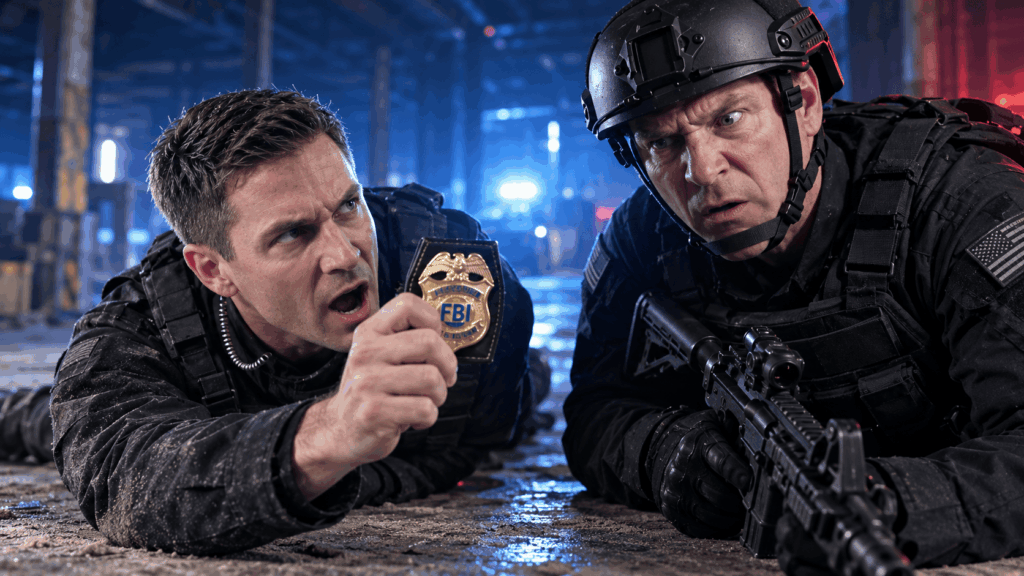
“Freeze! You’re taking the fall for this raid!”
Commander Grant Harlan pressed his boot against Mark’s shoulder, keeping him flat on the warehouse floor.
Dust filled the beam of a tactical flashlight.
Beyond the broken windows, red and blue lights swept across stacks of abandoned machinery. Officers shouted somewhere near the loading bay, their voices distorted by distance and the hollow building.
Mark lay beside an overturned chair.
His hands were visible.
His black tactical jacket had torn at the sleeve when Harlan forced him down.
The commander lowered his rifle.
“You should have taken the money.”
Mark looked up at him.
At thirty-one, he had learned to control his expression through months of undercover work. Fear was something he acknowledged privately and concealed when necessary.
But there was no disguising the danger of a rifle pointed at him by a man who believed he had already arranged the explanation.
Harlan leaned closer.
“Your friends ran. You stayed. That makes you the organizer.”
“You know that isn’t true.”
“I know what my report will say.”
Mark glanced toward the doorway.
Two members of Harlan’s team stood outside it. Neither had a clear view into the room.
That separation was deliberate.
So was the commander’s insistence that his body camera had malfunctioned.
Mark slowly moved one hand toward the inside of his jacket.
“Don’t.”
“My credentials.”
Harlan’s finger tightened against the rifle.
Mark stopped.
Then a tiny voice reached him through the receiver hidden beneath his collar.
“We have it. Identify yourself.”
Mark drew out a leather credential holder.
The gold badge caught the light.
“Check the wire, Commander.”
Harlan stared.
“The entire Justice Department is listening.”
For one second, the warehouse seemed perfectly still.
Then someone behind Harlan said, “Commander. Step away from him.”
The commander turned.
This time, the officers in the doorway were not waiting for his orders.
The Missing Case
The investigation had begun with a missing evidence box.
No dramatic confession.
No secret photograph.
Just a discrepancy noticed by an evidence technician who refused to change a date.
The box contained cash seized during a raid on a gambling operation.
According to the seizure report, it had arrived at the evidence unit before midnight.
According to the access log, the seal was not scanned until the following afternoon.
When the technician, Lydia Shaw, opened the outer packaging for a routine inventory, the amount inside was lower than the figure listed on the original worksheet.
Her supervisor suggested a counting error.
She asked for the first count sheet.
It had disappeared.
A revised sheet appeared two days later.
The new total matched the cash in the box.
Lydia saved the earlier electronic record before anyone could replace it.
Then she reported the discrepancy outside her chain of command.
Other cases began to surface.
Cash that shrank between seizure and storage.
Jewelry described vaguely enough to vanish.
Witnesses who withdrew complaints after late-night visits.
The same tactical unit appeared repeatedly.
And the same commander approved the paperwork.
Grant Harlan had led the unit for nearly a decade. At forty-five, he possessed the confident bearing of a man accustomed to entering rooms where everyone else moved aside.
He knew which prosecutors trusted him.
Which supervisors avoided conflict.
Which officers needed overtime badly enough to stop asking questions.
He also knew how to make an unreliable person look responsible for his own actions.
That skill became the center of the investigation.
The Man Called Mercer
Mark entered the operation under the name Daniel Mercer.
His cover placed him among contractors who cleared properties after foreclosures and commercial disputes.
It gave him access to warehouse owners, storage managers, and people who sometimes preferred transactions without many records.
Harlan noticed him through a middleman.
A former towing operator named Vince Calder approached Mark outside a salvage yard.
“Some people need storage,” Vince said.
“For what?”
“Things they don’t want sitting around at home.”
Mark did not agree immediately.
He asked about payment.
Access.
Insurance.
Questions that made him seem cautious rather than eager.
Over the following weeks, he rented a small commercial storage unit and accepted sealed boxes from Vince.
The contents were not what mattered at first.
The delivery times were.
They matched the nights of several police raids.
Eventually, Vince brought Harlan to meet him.
The commander wore civilian clothes, but his manner gave him away.
He stood where he could see the entrance.
He asked questions as though he already knew the answers.
“You keep records?” Harlan asked.
“Enough to get paid.”
“Keep fewer.”
Mark shrugged.
“That costs more.”
Harlan smiled.
For the first time, he seemed to like him.
The Woman with the Duplicate Key
Lydia met the investigators in a borrowed conference room far from her workplace.
She brought copies of inventory sheets, access records, and emails requesting clarification.
She also brought the answer to a question nobody had thought to ask.
Who could enter the temporary evidence cage before a formal intake?
Harlan’s unit had its own key.
The arrangement had begun years earlier as a convenience.
After-hours seizures could be secured without waiting for the evidence staff.
Nobody had reviewed the practice.
Nobody reconciled the temporary entries consistently.
Lydia pointed to one line on an access record.
“This is where the cash disappeared.”
The investigator looked at the date.
Harlan had signed the handover.
A younger officer had completed the inventory.
His name was Aaron Bell.
Bell’s report mentioned a second cash container that did not appear in the final evidence record.
When questioned internally, he had been told he misremembered.
He later received a poor evaluation describing him as hesitant under pressure.
Then he transferred out of the unit.
Mark read the summary that evening.
Harlan did more than steal.
He made people doubt what they had seen.
If they refused, he gave them something else to worry about.
The First Offer
Harlan invited Mark to a diner near the industrial district.
He arrived alone.
A folder rested beneath his arm.
Inside were photographs of a warehouse and a handwritten list of items.
“You have a loading crew?”
“Sometimes.”
“I need something moved.”
Mark studied the photographs.
“What kind of something?”
“Equipment. A few cases.”
“From where?”
Harlan tapped the warehouse image.
Mark looked up.
“That place belongs to someone.”
“Not for much longer.”
The commander explained that a raid was being planned.
Certain items would not be entered into evidence.
Mark would remove them before the property was formally secured.
“And if someone sees me?”
“You’re working under instruction.”
“Whose?”
Harlan’s smile faded.
“Mine.”
Mark let the silence sit.
Then he named a price high enough to sound greedy and low enough to remain plausible.
Harlan agreed.
The recording captured the conversation clearly.
But the investigators still needed to establish how the scheme connected to earlier seizures and who else knowingly participated.
They could not treat every officer in the unit as an accomplice.
Some might be.
Others might be doing exactly what Harlan had taught them to do: follow orders, avoid questions, trust the paperwork.
The Warehouse
The building stood near a disused rail spur.
Its windows were broken.
The main floor held old printing machinery, empty shelves, and stacks of wooden pallets.
The owner had leased portions of it to several businesses, one of which was under investigation for receiving stolen electronics.
Harlan intended to use that investigation as cover.
The legitimate purpose of the raid would make his presence ordinary.
The confusion would make missing property difficult to trace.
Mark would arrive early.
He would inspect the loading area and prepare to move selected cases.
Then Harlan would claim a suspect had alerted the occupants.
The tactical team would enter.
In the disorder that followed, the commander’s chosen items would disappear.
That was the plan Harlan described.
The federal team prepared for something worse.
Harlan had begun asking whether Mark kept copies of messages.
He had questioned Vince about who introduced him.
The questions suggested suspicion.
They also suggested that Mark was becoming useful in a different way.
A man inside the warehouse could be blamed for whatever Harlan needed explained.
The investigators adjusted the operation.
A monitoring team stayed nearby.
A separate command channel linked the cooperating officers who knew what was happening.
Mark received one final instruction.
“If he isolates you, don’t argue to preserve the recording. Your safety comes first.”
Mark nodded.
He understood.
He also knew Harlan would not announce the moment at which suspicion became a decision.
The Officer Who Looked Back
Aaron Bell was no longer assigned to Harlan’s unit.
But he had been asked to assist with perimeter security for the warehouse raid.
The request puzzled him.
Harlan usually chose people who did not ask questions.
Bell had asked too many.
Before the operation, a federal investigator contacted him through his attorney.
They explained enough for him to understand the stakes without asking him to improvise.
He would perform his assigned role.
He would keep his recording equipment active.
He would follow the separate instructions given if the operation changed.
Bell agreed.
At the briefing, Harlan barely acknowledged him.
The commander described the warehouse as dangerous.
Possible armed suspects.
Unreliable intelligence.
A civilian contractor whose role remained unclear.
Bell looked at the photograph attached to the briefing sheet.
Mark’s cover identity.
Harlan tapped it.
“This one may try to talk his way out. Don’t let him confuse you.”
Bell felt a familiar pressure behind his ribs.
He had heard versions of that warning before.
It made listening seem like weakness.
He kept his expression neutral.
And he checked his camera.
The Door That Closed
Mark entered the warehouse shortly before the tactical team arrived.
He wore the black jacket Harlan had told him to use.
His boots scraped over broken glass near the loading bay.
Vince was supposed to meet him there.
Instead, Mark found a message.
Wait in the office.
The office was a concrete room off the main floor.
One door.
A cracked interior window.
A metal desk with no drawers.
Mark paused outside it.
His receiver remained silent.
He entered.
Minutes later, the raid began.
Shouts echoed through the warehouse.
A door struck the wall.
Flashlights swept past the office window.
Then Harlan appeared.
He ordered Mark to the floor.
Mark complied, identifying himself by his cover name.
Harlan pushed him down anyway.
The commander told the officers behind him to check the loading bay.
He stayed in the room.
The door swung nearly closed.
Mark could still see a narrow strip of warehouse light.
Harlan’s rifle filled the space above him.
“Where are the copies?”
Mark kept his hands visible.
“What copies?”
“The messages. The delivery dates.”
“I keep what I need to get paid.”
Harlan pressed his boot against Mark’s shoulder.
“You should have deleted them.”
Then came the threat.
And the words that made the plan unmistakable.
“You’re taking the fall for this raid.”
The Men in the Doorway
When Mark revealed his badge, Harlan’s first reaction was disbelief.
His second was calculation.
His eyes moved from the credentials to the door.
He began turning the rifle.
“Don’t move it,” a voice said.
Bell stood in the doorway beside a federal agent.
Their weapons remained controlled.
Their instructions were clear.
Harlan looked at Bell.
“Aaron. This man’s lying.”
Bell did not answer the accusation.
“Step away from him, Commander.”
“I gave you an order.”
The federal agent repeated the instruction.
Harlan’s face changed.
The old certainty was gone.
He lowered the rifle awkwardly.
An agent took control of it before it could strike the floor.
Another moved to Mark.
“Are you hurt?”
Mark rolled onto his side and sat up.
“My shoulder.”
The agent helped him stand.
Across the room, Harlan was restrained.
He watched the hands working around his wrists as if the process were unfamiliar.
Outside, officers from his unit waited for instructions.
Some looked confused.
One asked whether the raid was continuing.
The cooperating supervisor told them to hold their positions while the scene was secured.
Nobody cheered.
Nobody needed to.
The Paperwork Already Written
Among the records recovered during the operation was a draft incident narrative.
It existed before the raid.
The document described Mark’s cover identity as an organizer involved in stolen property and missing proceeds.
It claimed he had resisted officers.
It referred to a weapon supposedly recovered near him.
Investigators had not found that weapon where the draft said it would be.
They did find a separate case in a vehicle linked to Vince.
The discovery became part of the broader inquiry.
The draft itself was disturbing enough.
Harlan had prepared the explanation before the event.
Mark read it after receiving medical attention.
His shoulder was bruised.
His hands shook slightly when he reached the final paragraph.
For months, he had listened to Harlan describe other people as unreliable.
Now he could see the mechanism in writing.
A report did not merely record what happened.
In the wrong hands, it could replace it.
Mark put the pages down.
His supervisor asked whether he wanted a few days away.
“Yes,” he said.
He had been prepared to admit fear during the operation.
He would not start pretending it disappeared afterward.
The People Behind the Case Numbers
The public announcement came later.
By then, additional searches and interviews had expanded the investigation.
Harlan’s arrest was the most visible part.
The people affected by earlier cases were less easy to fit into a headline.
A restaurant owner whose seized cash had included payroll money.
A woman whose late mother’s bracelet never reached the evidence inventory.
A man pressured to accept an inaccurate statement because contesting it would delay the return of his work equipment.
Lydia helped the review team trace the records.
She did not promise every missing item would be recovered.
Some would not be.
Some accounts could not be reconstructed fully.
But people were contacted.
Their complaints were reopened.
Their descriptions were read without the assumption that they must be mistaken.
One afternoon, the restaurant owner came to collect a formal notice about his case.
He stood at the counter holding it.
“I kept telling them there was more.”
Lydia nodded.
“I know.”
He swallowed.
“Someone finally checked.”
She waited until he was ready before explaining the next steps.
The Interviews
Harlan tried to portray the case as a misunderstanding between agencies.
That account did not survive the records.
The diner conversation.
The delivery messages.
The financial trail.
The warehouse recording.
The report drafted before the raid.
Each piece supported the others.
Vince initially denied knowing anything about diverted property.
Then investigators showed him payments, storage records, and his own communications.
He obtained counsel and began cooperating.
Several officers admitted they had noticed irregularities but accepted Harlan’s explanations.
One had knowingly signed an inaccurate inventory.
Another had refused.
Those distinctions mattered.
The investigation did not turn an entire team into a single villain.
It identified choices.
What each person knew.
What each person did.
What each person concealed afterward.
Bell gave his statement carefully.
He described his earlier complaint and the evaluation that followed.
At the end, the investigator asked why he had remained silent so long.
Bell looked at the table.
“I thought speaking again would just give him another way to punish me.”
The investigator recorded the answer.
This time, it did not disappear into a note marked personality conflict.
The Courtroom
Months later, Mark testified.
He wore a plain suit.
Harlan sat across the courtroom, no helmet, no body armor, no team waiting for his commands.
His attorney questioned Mark about the cover identity.
The payments.
The conversations in which Mark had agreed to move property.
Mark answered directly.
Undercover work depended on deception.
The jury would need to understand its purpose and limits.
He did not evade that.
Then the warehouse recording played.
Harlan’s voice filled the room.
“You’re taking the fall for this raid.”
Mark kept his eyes on the microphone in front of him.
He had heard the recording before.
It still tightened his breathing.
The prosecution followed it with the draft narrative.
The timing was established through the recovered records.
The threat and the prepared explanation sat beside each other.
Neither could be dismissed as an isolated outburst.
When the verdicts came, Harlan was convicted on charges arising from the corruption scheme and his actions during the operation.
The sentence imposed later included a substantial prison term.
His authority ended permanently.
There would be no quiet transfer.
No new unit.
No uniform in which to resume the same habits somewhere else.
The Locker
After the case, Bell returned to the tactical building to collect equipment from his old locker.
His transfer had become permanent.
He had chosen a position with a training team that worked across the department.
Inside the locker, beneath a pair of gloves, he found an old copy of his evaluation.
Hesitant under pressure.
He looked at the words for a long time.
Then he folded the page.
His corrected personnel record was already on file.
He kept the old copy anyway.
Not as a grudge.
As a reminder of how easily a label could replace a person if nobody demanded the facts behind it.
At his first training session, a young officer asked whether questioning a supervisor during an operation could create confusion.
“Yes,” Bell said. “So learn how to raise a concern clearly. And learn how to listen when someone raises one with you.”
He did not mention Harlan by name.
He did not need to.
The Badge on the Table
Mark met Lydia for coffee shortly after sentencing.
They had spent months passing through the same investigation without ever having an ordinary conversation.
She asked about his shoulder.
“Fine now.”
“Really?”
He smiled.
“Mostly.”
She nodded, accepting the better answer.
He asked whether she was still working in evidence.
“Yes. New procedures. More people checking the handovers.”
“Does it help?”
“It helps when they actually do it.”
Mark laughed quietly.
On the table between them sat the receipt for their coffees.
Lydia turned it toward him.
“Your turn.”
He paid.
Outside, they parted beneath a pale afternoon sky.
Mark walked to his car and sat for a moment before starting it.
The operation was over.
The threat was over.
The memory would take longer.
He opened the small case holding his credentials.
The badge had changed Harlan’s expression in an instant.
But the case had been built by Lydia saving a record, Bell agreeing to speak, investigators checking dates, and people who kept insisting that their missing money and unanswered complaints mattered.
Mark closed the case.
Then he drove home.
For the first time in a long while, he had no cover name to remember when someone called him.

















