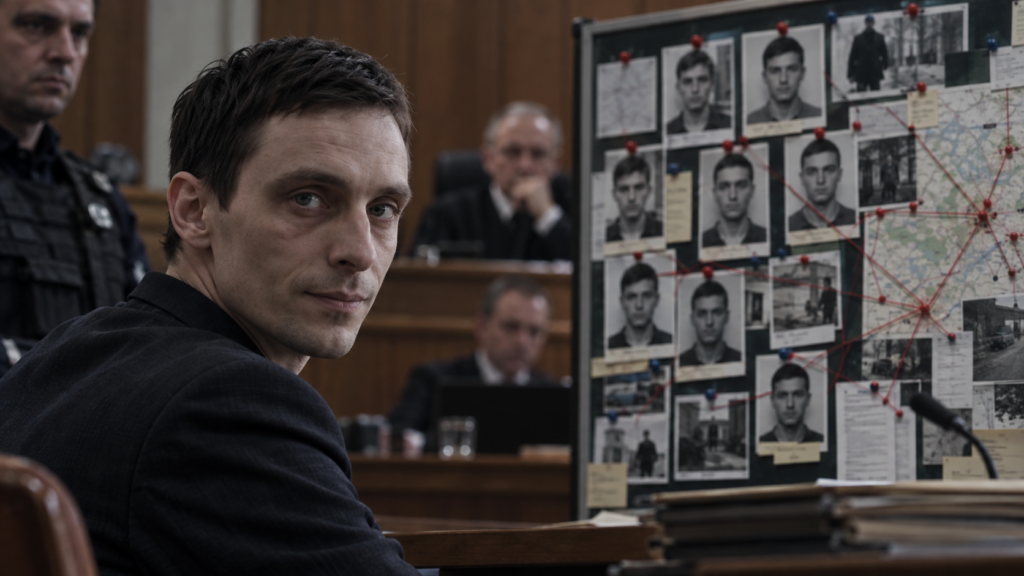
Chapter 1 – The Girls Who Vanished
For eighteen months, the city of Ghent stopped allowing its daughters to walk home alone.
It began with seventeen-year-old Elise Van Dam.
She disappeared after leaving a late cinema screening.
Her bicycle was found chained properly outside the tram stop.
Her phone was discovered two days later beneath a bench, battery dead.
Elise was found the following week.
Then came nineteen-year-old Noor De Wilde.
Twenty-two-year-old Ana Martins.
Eighteen-year-old Chloé Bernard.
Five young women in fourteen months.
The newspapers eventually gave the killer a name:
The Lantern Man.
Detective Mara Verhoeven hated it.
Killers did not deserve names.
Names turned them into myths.
And myths were harder to arrest than men.
Mara was forty-three and had spent twenty years in criminal investigations.
She was known for being quiet.
Not cold.
Quiet.
People mistook the two.
Her partner, Tomas De Smet, once said Mara did not enter rooms.
She absorbed them.
A cup moved two centimetres.
A coat button missing.
A witness using the word “probably” instead of “definitely.”
Mara noticed.
That was how they eventually found him.
Adrian Keller.
Thirty-nine.
Electrical technician.
Divorced.
No significant criminal record.
No dramatic childhood anyone could sell to a documentary.
He lived alone in a clean apartment above a pharmacy.
He drove a grey van.
Inside a locked storage unit registered under another name, investigators found personal objects belonging to four of the missing girls.
Not trophies displayed on walls.
Not shrines.
Just labelled plastic boxes.
Names.
Dates.
Nothing from Elise.
But enough.
Adrian was arrested at 6:12 on a Tuesday morning.
He did not run.
He did not resist.
He simply looked at Mara and said:
“You took longer than I expected.”
That sentence made every newspaper in Belgium.
Mara never forgot the next one.
During interrogation, she placed photographs of the five girls on the table.
Adrian studied them carefully.
Then said:
“You still don’t understand what you’re looking at.”
Mara replied:
“I understand enough.”
For nine months, she believed that.
So did everyone else.
Chapter 2 – The City Breathes Again
Adrian Keller was convicted.
The evidence was overwhelming.
DNA.
Vehicle records.
Digital traces.
Victims’ belongings.
His movements.
His own partial admissions.
He never confessed in the way prosecutors wanted.
He admitted to “taking” four girls.
He refused to use the word murder.
He denied Elise.
Completely.
Mara thought Elise was simply the one crime he wanted to keep for himself.
Some offenders confessed selectively.
Some protected one secret because secrecy itself felt like possession.
The trial ended.
Adrian received life imprisonment.
People stopped checking behind themselves at tram stops.
Parents relaxed curfews.
Girls started walking home with headphones again.
The Lantern Man became yesterday’s nightmare.
Mara received a commendation.
She hated the ceremony.
Tomas loved watching her hate it.
“You could smile.”
“I am smiling.”
“No, you’re threatening the photographer.”
Mara glanced toward the camera.
“I hate photographs.”
“I know.”
“You invited my mother.”
“She threatened me.”
“That sounds more accurate.”
For the first time in nearly two years, Mara took a week off.
She spent four days doing almost nothing.
On the fifth, she reorganised the kitchen.
On the sixth, she went back to work.
Tomas looked at her.
“You’re terrible at resting.”
“I rested.”
“You alphabetised tea.”
“That was unrelated.”
It was almost normal.
Then a sixteen-year-old boy named Lucas Maes failed to come home.
Chapter 3 – Lucas
Nobody initially connected Lucas to Adrian Keller.
Why would they?
Lucas was male.
Sixteen.
A football academy student.
He disappeared after evening practice.
His backpack was found beside a canal footpath.
Wallet still inside.
Nothing suggested robbery.
His mother insisted he would never disappear voluntarily.
Police treated it seriously.
But missing teenagers existed before Adrian Keller.
Mara did not join the case.
Not until Lucas was found four days later.
She stood twenty metres from the recovery scene while forensic officers worked.
Tomas walked toward her.
His face had changed.
Mara knew immediately.
“What?”
Tomas held out a clear evidence bag.
Inside was a small brass key.
Ordinary-looking.
Cheap.
A red thread had been tied through its circular head.
Mara stared.
“No.”
Tomas said nothing.
The girls had each been found with a similar key concealed somewhere among their belongings.
That detail had never been released publicly.
Not once.
Mara took the evidence bag.
“How many people knew?”
“Investigation team.”
“Prosecutors.”
“Yes.”
“Forensics.”
“Yes.”
“Families?”
“Not all of them.”
“Court?”
“It came up in sealed evidentiary submissions.”
Mara looked toward Lucas.
Then at the key.
Adrian Keller had been inside a maximum-security prison for eleven months.
He had no unsupervised internet access.
No visitors except his lawyer and older sister.
Mara whispered:
“Copycat.”
Tomas replied:
“Maybe.”
She looked at him.
“You don’t believe that.”
“I didn’t say that.”
“You made the face.”
“What face?”
“The face you make before saying something annoying.”
Tomas exhaled.
“Copycats copy what they know.”
Mara looked back at the key.
This one contained a detail the public did not know.
Someone else did.
Chapter 4 – The Second Boy
Three weeks later, eighteen-year-old Simon Arendt disappeared.
Mara was already waiting for it.
That frightened her.
Simon worked evenings in a supermarket.
He finished at 10:04.
He never reached the bus stop.
His phone moved for another eleven minutes.
Then stopped.
Two days later, he was found outside the city.
No public details were released.
Mara stood beside the forensic pathologist.
“Key?”
The pathologist nodded.
“Blue thread this time.”
Mara frowned.
“What?”
“Blue.”
The girls’ keys had used red thread.
Lucas had red.
Simon had blue.
Tomas stood behind her.
“Maybe variation.”
Mara stared at the evidence.
“No.”
“What?”
“Not variation.”
She walked away.
Tomas followed.
“Mara.”
“It’s correction.”
He frowned.
“Correction of what?”
She stopped.
“With the girls, Adrian used red.”
“Yes.”
“Lucas gets red.”
“Yes.”
“Then Simon gets blue.”
Tomas understood.
“The first boy was still following Adrian.”
“And the second isn’t.”
“So?”
Mara looked at him.
“So whoever is doing this wants us to notice the difference.”
Chapter 5 – Adrian Smiles
Adrian Keller had lost weight in prison.
That was the first thing Mara noticed.
The second was that he seemed happy to see her.
“Mara.”
“Don’t call me that.”
“You came back.”
She sat opposite him.
Tomas remained behind the glass with prison security.
Mara placed photographs of Lucas and Simon on the table.
Adrian looked down.
Nothing in his expression changed.
“Boys.”
“Yes.”
“Interesting.”
Mara watched him.
“Do you recognise them?”
“No.”
“Do the keys mean anything?”
Adrian looked at her.
“You already know they do.”
“How would you know about the keys?”
“You wouldn’t be here otherwise.”
Mara leaned forward.
“The second key used blue thread.”
His eyes moved.
Barely.
But Mara caught it.
“You know why.”
Adrian smiled.
“There she is.”
“Why blue?”
“You arrested me nearly a year ago.”
“Why blue?”
“And you’re still asking the wrong questions.”
Mara’s voice hardened.
“Two boys are dead.”
Adrian shrugged.
“And five girls.”
“Four.”
He looked at her.
Mara froze.
He had always denied Elise.
He smiled again.
“Still counting her?”
“She fits.”
“No.”
“You had belongings from the others.”
“Yes.”
“You followed the same pattern.”
“Yes.”
“Elise disappeared first.”
“Yes.”
“So why isn’t she yours?”
Adrian leaned closer to the glass.
“Because she wasn’t a girl I chose.”
Mara stared.
“What does that mean?”
Adrian leaned back.
“You built your case in a straight line.”
“You murdered four women.”
“Yes.”
The directness still unsettled her.
“You copied Elise.”
Adrian said nothing.
Mara’s pulse changed.
“What?”
He smiled.
She understood the implication before he said it.
“You copied Elise.”
Adrian’s expression remained calm.
Mara whispered:
“She wasn’t your first victim.”
“No.”
“She wasn’t yours at all.”
“No.”
“Then whose was she?”
Adrian laughed softly.
“Now you’re finally looking backward.”
Chapter 6 – The First Murder Wasn’t His
Mara returned to Elise Van Dam’s file at 2:10 that morning.
The murder that had started everything.
Seventeen.
Student.
Cinema.
Bicycle at the tram stop.
Body found six days later.
A brass key with red thread.
The newspapers had believed Elise was Adrian Keller’s first victim.
Police had believed it too.
But what if she wasn’t?
Mara spread the five files across the conference table.
Elise first.
Then Adrian’s four confirmed victims.
She compared details nobody had compared in years because once a pattern becomes accepted, differences begin looking like noise.
Elise’s shoes were clean.
The others’ were not.
Elise’s phone was deliberately left behind.
Adrian kept phones until shortly before discovery.
Elise’s key had been placed inside her coat pocket.
Adrian’s keys were hidden inside personal bags.
Small differences.
Possibly meaningless.
Possibly everything.
Tomas entered carrying two coffees.
“You went home?”
“No.”
“I knew that.”
Mara pointed.
“He copied her.”
Tomas looked at the files.
“Adrian?”
“He saw Elise’s case.”
“How?”
“News.”
“The key wasn’t public.”
Mara stopped.
Exactly.
The key.
Tomas slowly lowered the coffee.
“If Adrian copied Elise…”
“He had to know about the key.”
“How?”
Neither spoke.
The answer was ugly.
Either Adrian had information from someone connected to the original investigation.
Or someone connected to Elise had told him.
Mara whispered:
“We assumed there was one killer because the key connected them.”
Tomas nodded.
“But if the key connected Adrian to Elise only because somebody gave him that detail…”
“Then we used the wrong thing as proof of continuity.”
Tomas looked at the boys’ files.
“And now someone is doing it again.”
Chapter 7 – The Third Boy
The third disappearance changed the city.
His name was Felix De Clercq.
Seventeen.
He vanished after leaving his girlfriend’s house.
By then parents were frightened again.
Only now they watched their sons.
Schools sent warnings.
Football practices ended earlier.
Teenage boys who had once mocked their sisters for sharing live locations began doing exactly the same thing.
Felix was found after five days.
Blue-thread key.
Mara stood silently at the scene.
Tomas said:
“We have a second series.”
Mara shook her head.
“No.”
“What?”
“One series.”
He stared.
“Elise.”
Mara nodded.
“Elise wasn’t the beginning of Adrian.”
“She was the beginning of this person.”
“And Adrian?”
“A parasite.”
Tomas frowned.
“You think he saw an unsolved murder and copied it?”
“Yes.”
“Why?”
“Because he liked the idea.”
“That simple?”
Mara looked at him.
“People keep wanting murderers to be complicated because simple evil feels insulting.”
Tomas looked away.
“And now?”
“Now the original killer is active again.”
“After almost three years?”
Mara looked at Felix.
“Or never stopped.”
Chapter 8 – The Boy Who Survived
The break came from someone who was not dead.
Nineteen-year-old Jonas Verbeek walked into a police station at 11:40 on a Friday night.
He was shaking.
He said someone had followed him from the train station.
A dark car.
Driver unknown.
He changed streets twice.
The car followed.
Then a man approached him outside an apartment block.
Not aggressively.
Calmly.
The man said:
“Your father asked me to bring you home.”
Jonas’s father had died four years earlier.
Jonas ran.
The man did not chase him.
Mara interviewed Jonas personally.
“What did he look like?”
“Normal.”
“Normal isn’t useful.”
“I know.”
“Age?”
“Forties. Maybe fifty.”
“Hair?”
“Dark. Grey at the sides.”
“Accent?”
“Local.”
“Height?”
“About yours.”
Mara almost smiled.
“I’m not a man.”
Jonas looked embarrassed.
“I mean…”
“I know.”
She slid photographs across the table.
Adrian.
Former suspects.
People connected to Elise.
Jonas stopped at one.
Mara noticed.
“Who?”
He pointed.
A man named Peter Van Dam.
Elise’s father.
Mara said nothing.
Jonas frowned.
“Is that him?”
“I’m asking you.”
“I don’t know.”
“You stopped.”
“He looks similar.”
“How similar?”
Jonas stared.
Then shook his head.
“No.”
“No?”
“No. Older maybe.”
Mara gathered the photographs.
But inside, something had moved.
Elise’s father had access to parts of the original investigation through family liaison.
He knew about the key.
He had spent years publicly criticising police for failing to find his daughter’s killer.
And after Adrian was arrested, he had disappeared from media completely.
Too obvious.
Mara hated obvious.
Chapter 9 – Peter Van Dam
Peter lived outside Bruges.
He answered the door wearing gardening gloves.
Mara showed her badge.
His expression barely changed.
“I wondered when you’d come.”
That sentence immediately irritated her.
“You expected us?”
“Three boys are dead.”
“Why would that bring us here?”
Peter removed the gloves.
“Because eventually you would realise Adrian didn’t kill Elise.”
Mara stared.
“You knew?”
“I suspected.”
“Since when?”
“His trial.”
“You never said anything.”
“I did.”
“No.”
“I told your department his story didn’t fit my daughter.”
“You said every parent believes their child is different.”
Peter’s face hardened.
“That isn’t what I said.”
Mara remembered.
Three years earlier, Peter had repeatedly argued that Elise’s case felt different.
Police had interpreted it as grief.
Maybe arrogance.
Maybe denial.
Mara asked:
“Who knew about the key?”
Peter smiled without humour.
“You.”
“Besides police.”
“My wife.”
“Anyone else?”
“Our son.”
Mara paused.
“Elise had a brother?”
Peter’s face changed.
“You don’t remember?”
Mara did not.
Thousands of pages.
Hundreds of interviews.
One younger brother.
Twelve years old at the time.
“Where is he?”
Peter looked toward the garden.
“Dead.”
Mara’s breath caught.
“When?”
“Two years after Elise.”
“How?”
“Suicide.”
Silence.
Peter looked at her.
“You arrested Adrian three weeks later.”
Mara felt cold.
“What was his name?”
“Mathis.”
Chapter 10 – Mathis
Mathis Van Dam had been fifteen when he died.
Not twelve.
Mara had remembered incorrectly.
That bothered her more than it should have.
She opened his file.
Depression.
School absence.
Behavioural problems following Elise’s death.
Therapy.
A fight.
Another fight.
Then suicide.
His room had been cleared within months.
His phone destroyed.
His computer sold.
No criminal investigation.
No reason for one.
Tomas read beside her.
“So Mathis isn’t killing boys.”
“I know.”
“Then why does he matter?”
“Because somebody connected to the family knew the key.”
“Peter?”
“Maybe.”
“Mother?”
“Maybe.”
“Someone Mathis told?”
Mara stared at a photograph.
Elise and Mathis at a Christmas dinner.
Elise smiling.
Mathis making an obscene gesture toward the camera.
Normal siblings.
Then she noticed another figure reflected in a mirror behind them.
A teenage boy.
Barely visible.
“Who’s that?”
Tomas leaned closer.
“No idea.”
Mara called Peter.
He answered immediately.
“The Christmas photograph.”
Silence.
“What about it?”
“There’s another boy.”
Another pause.
Peter said:
“Thomas.”
“Thomas who?”
“Thomas Vercauteren.”
“Friend?”
“Mathis’s best friend.”
“Where is he now?”
Peter’s voice changed.
“I don’t know.”
Mara leaned forward.
“When did you last see him?”
“The funeral.”
“Mathis’s?”
“Yes.”
“Not Elise’s?”
“He was at both.”
Mara looked at Tomas.
“Age?”
“Same as Mathis.”
So twenty-one now.
Too young for Jonas’s description.
Unless Jonas was wrong.
Or unless Thomas wasn’t the man he saw.
Chapter 11 – The Pattern Inside the Pattern
Mara built a new timeline.
Elise dies.
Adrian copies Elise’s staging and begins killing girls.
Mathis deteriorates.
Mathis dies.
Adrian is arrested.
Months later, boys begin disappearing.
Why boys?
Tomas stood in front of the board.
“Revenge?”
“Against whom?”
“Boys Mathis’s age.”
“Why?”
“I don’t know.”
Mara stared at the photographs.
The girls Adrian selected resembled Elise only superficially.
Age.
Build.
Dark hair in three cases.
He had copied the ritual, not the person.
But the boys were different.
Lucas played football.
Simon stocked shelves.
Felix was preparing for engineering school.
Nothing connected them.
Then Mara examined dates.
Lucas disappeared on March 4.
Simon, April 17.
Felix, June 2.
She overlaid another timeline.
Elise’s missing date.
Mathis’s hospital admissions.
Mathis’s therapy appointments.
School disciplinary incidents.
Tomas noticed first.
“June 2.”
“Yes.”
“What happened June 2?”
Mara opened Mathis’s school record.
June 2, three years earlier.
Mathis had been suspended after fighting another student.
Tomas looked at the others.
March 4.
April 17.
Each date corresponded to documented events from Mathis’s final year.
Not major anniversaries.
Private dates.
Someone knew Mathis’s life intimately.
Mara whispered:
“This isn’t about Elise.”
Tomas frowned.
“Then what?”
“It’s about her brother.”
Chapter 12 – Thomas Vercauteren
Thomas lived in Antwerp.
Mara and Tomas reached his apartment just after dawn.
No answer.
Landlord opened the door.
Empty.
Not recently abandoned.
Deliberately emptied.
No clothes.
No computer.
No photographs.
Nothing in the bathroom.
The refrigerator unplugged.
Tomas walked into the bedroom.
“Mara.”
On the wall were small pinholes.
Many.
Something had hung there.
They obtained access to building security footage.
Thomas had left nine days earlier carrying two suitcases.
Alone.
Mara watched repeatedly.
“That’s not our man.”
Tomas nodded.
Thomas was tall and thin.
Jonas described someone older, broader.
Mara looked closer at the footage.
Thomas walked toward a dark car.
Passenger door opened before he reached it.
Someone was driving.
Image quality poor.
No face.
Only an arm.
Male.
Older.
Mara froze the frame.
Tomas whispered:
“Two people.”
Mara said nothing.
The entire case shifted again.
Chapter 13 – Adrian’s Last Interview
Mara returned to Adrian Keller.
This time he looked tired.
“No photographs?”
“No.”
“No keys?”
“No.”
He smiled.
“Progress.”
Mara sat.
“You knew Elise wasn’t yours.”
“Yes.”
“You knew there was another killer.”
“I knew there was another person.”
“How?”
Adrian looked at her.
“You really want the answer?”
“Yes.”
“I met him.”
Mara went still.
“When?”
“Before my second girl.”
“Where?”
Adrian smiled.
“No.”
“Who?”
“No.”
“Thomas Vercauteren?”
Nothing.
“Peter Van Dam?”
Adrian’s eyes remained still.
“Someone connected to Mathis?”
A flicker.
Mara leaned forward.
“Mathis knew the person who killed Elise.”
Adrian said:
“You’re close.”
“Did Mathis kill Elise?”
Adrian laughed.
“No.”
“Did Thomas?”
Silence.
“Did Peter?”
“No.”
That answer came too quickly.
Mara noticed.
“Why are you protecting someone?”
Adrian looked genuinely amused.
“Protecting?”
“Yes.”
“You still think killers care about one another.”
“Then why not tell me?”
Adrian leaned forward.
“Because if I tell you, you get to close the file again.”
Mara stared.
He continued:
“You like closed files.”
“People deserve answers.”
“No.”
“You do.”
She said nothing.
Adrian smiled.
“You arrested me and called the story finished.”
“You killed four girls.”
“Yes.”
“And someone else killed Elise.”
“Yes.”
“And boys are dying now.”
“Yes.”
“Same person?”
Adrian’s expression changed.
For the first time, uncertainty.
“I don’t know.”
Mara stopped.
That was not the answer she expected.
“You don’t know?”
“No.”
“Then what do you know?”
Adrian looked at her.
“The person who showed me the key hated girls.”
Mara’s breath slowed.
“And whoever is killing now?”
Adrian smiled faintly.
“Hates boys.”
Chapter 14 – Two Killers
The theory became unbearable.
Elise’s killer.
Adrian the copycat.
A third person killing boys.
Three people linked by one symbol.
Or two.
Or one network.
Nothing clean.
Nothing cinematic.
Tomas hated it.
“This is too many coincidences.”
Mara agreed.
“So find the thing making them not coincidental.”
They returned to Mathis.
His therapy records were protected.
A court order took time.
When they finally obtained limited access, one name appeared repeatedly.
Dr. Stefan Vercauteren.
Thomas’s father.
Psychologist.
He had treated Mathis briefly after Elise’s murder.
Mara stared at the name.
Thomas Vercauteren was Mathis’s best friend.
Thomas’s father was Mathis’s therapist.
Stefan had access to the family.
To Mathis’s grief.
Possibly to details of Elise’s case Mathis knew.
And Stefan was fifty-two.
Broad build.
Dark hair greying at the sides.
Mara showed Jonas a photograph.
His face drained.
“That’s him.”
“Certain?”
Jonas stared.
“Yes.”
Mara felt the case lock into place.
Too easily.
She hated that feeling now.
Chapter 15 – The House
Stefan Vercauteren was not home.
Neither was Thomas.
Police searched the property.
They found no victims.
No obvious trophy collection.
No bloody basement.
Nothing television would have liked.
Instead, they found notebooks.
Hundreds of pages.
Clinical notes.
Personal notes.
Observations about Mathis.
About grief.
About blame.
About gender.
Mara read one sentence twice:
A daughter is mourned as innocence. A son is mourned as failure.
Another:
Girls are protected from danger. Boys are taught they should survive it.
Another:
Nobody asked what Mathis became after Elise died.
Tomas stood behind her.
“This isn’t evidence of murder.”
“No.”
“It’s creepy.”
“Creepy isn’t illegal.”
Then a forensic technician called from upstairs.
Inside a locked cabinet was a small box.
Keys.
Dozens.
Some brass.
Some steel.
None tied with thread.
Mara stared.
Tomas whispered:
“Oh, hell.”
They photographed everything.
Then Mara noticed one empty space inside the foam lining.
A rectangular indentation.
Something had been removed.
Recently.
Chapter 16 – Thomas Comes Back
Thomas Vercauteren returned voluntarily three days later.
No lawyer.
No luggage.
He walked into police headquarters and asked for Mara by name.
She sat opposite him.
Twenty-one.
Thin.
Exhausted.
He looked nothing like a serial killer.
Mara no longer trusted that thought.
“Where is your father?”
Thomas shook his head.
“I don’t know.”
“You left with him.”
“No.”
“We have footage.”
“I got into his car.”
“Then?”
“He drove me to Lille.”
“Why?”
“He said we needed to leave.”
“Because?”
Thomas rubbed both hands together.
“He knew you’d find the notes.”
“What notes?”
Thomas looked up.
“You found them.”
Mara said nothing.
Thomas continued.
“My father didn’t kill Elise.”
“Who did?”
“I don’t know.”
“You expect me to believe that?”
“Yes.”
“Why?”
“Because I don’t know.”
“Did Mathis?”
“No.”
“Did you?”
Thomas stared.
“No.”
“Who gave Adrian the key detail?”
Thomas stopped breathing for a second.
There.
Mara saw it.
“You.”
“No.”
“You knew.”
Thomas looked away.
“How?”
He remained silent.
Mara leaned forward.
“Thomas.”
His eyes filled.
“Mathis told me.”
“Told you what?”
“That Elise’s key was tied with red thread.”
“Why?”
“He saw the police return it in an evidence photograph shown to the family.”
“And you told Adrian.”
Thomas shook his head violently.
“No.”
“Then who?”
“My father.”
Mara went still.
“Your father knew?”
Thomas whispered:
“I told him.”
The room became very quiet.
“Why?”
“I was fifteen.”
“Why?”
“I was angry.”
“At who?”
“Everyone.”
Mara waited.
Thomas looked at her.
“Mathis was disappearing right in front of everyone and all anybody talked about was Elise.”
There it was.
Not murder.
Not yet.
Resentment.
Grief.
A boy standing beside a dead girl’s shadow.
Thomas whispered:
“My father kept saying people only care when the victim looks innocent.”
Mara felt cold.
“And now boys are dying.”
Thomas shook his head.
“No.”
“You expect me to believe your father isn’t responsible?”
“I think he is.”
Mara stared.
“Think?”
Thomas began crying.
“I think he wants people to look at boys the way they looked at Elise.”
Chapter 17 – The Last Boy
While Thomas was being interviewed, another boy disappeared.
Seventeen-year-old Elias Martens.
Mara received the call without leaving the room.
Her face changed.
Thomas saw.
“No.”
Mara said nothing.
“No.”
He stood.
The officer by the door moved forward.
Thomas shouted:
“He doesn’t have him.”
Mara stared.
“How do you know?”
“Because my father isn’t here.”
“What does that mean?”
Thomas looked terrified now.
“He said he wasn’t doing it alone.”
Silence.
Mara stepped closer.
“Who?”
“I don’t know.”
“WHO?”
“He never told me!”
Mara slammed one hand onto the table.
“You’ve been sitting here for two hours!”
“I DIDN’T KNOW!”
“You knew there was someone else!”
“I thought he meant Adrian!”
“ADRIAN IS IN PRISON!”
“I KNOW!”
Mara stopped.
Thomas was shaking.
He whispered:
“My father said Adrian was proof.”
“Proof of what?”
“That once people see a pattern, they’ll keep seeing it even when the person changes.”
Mara stared.
Thomas whispered:
“He said that’s the safest place to hide.”
Chapter 18 – The Farmhouse
Elias Martens was found alive.
Barely twenty-four hours after disappearing.
He had escaped from an empty farmhouse outside Kortrijk.
He could not identify the person who took him.
He remembered two voices.
One older.
One younger.
Police surrounded Stefan Vercauteren’s known properties.
Nothing.
Then Elias described hearing a train every seventeen minutes.
Tomas used rail maps.
They narrowed the area.
Another farmhouse.
Abandoned.
Inside, they found evidence connecting the location to Lucas, Simon and Felix.
No Stefan.
No accomplice.
But on one wall were photographs.
Girls on the left.
Boys on the right.
Mara recognised every victim.
Elise.
Adrian’s four girls.
Lucas.
Simon.
Felix.
Elias.
Under Elise’s photograph:
BEGINNING.
Under Adrian’s victims:
IMITATION.
Under the boys:
CORRECTION.
Tomas stood beside Mara.
“What does correction mean?”
She stared.
“I don’t know.”
Then she noticed something.
An empty space beneath the girls.
Not one empty space.
Four.
Photograph-sized rectangles.
Prepared.
Waiting.
Tomas saw them too.
“So there were supposed to be more girls?”
Mara shook her head.
“I don’t know.”
On the boys’ side were also four empty spaces.
Symmetry.
The entire wall seemed unfinished.
Or ongoing.
Chapter 19 – Stefan
They found Stefan’s car two days later near the Belgian-French border.
Empty.
No sign of him.
Thomas remained under investigation but was released pending further evidence.
Publicly, police said Stefan Vercauteren was wanted for questioning in connection with the disappearances.
Privately, Mara believed he was the centre of it.
But belief had already betrayed her once.
Three weeks passed.
No new victim.
Four.
Five.
The city began breathing again.
Mara did not.
She visited Adrian Keller one final time.
He sat down.
“You look worse.”
“Stefan Vercauteren.”
Adrian’s face gave her nothing.
“You know him.”
“Maybe.”
“He showed you Elise’s case.”
No answer.
“He gave you the key detail.”
Silence.
“You copied his crime.”
Adrian smiled.
“You still think Elise was his.”
Mara stopped.
“What?”
Adrian leaned back.
“I never said Stefan killed Elise.”
“You said you met the person who showed you the key.”
“Yes.”
“Stefan.”
“I didn’t say that either.”
Mara stared.
Then understood.
Maybe Adrian had let her fill in every blank.
Again.
“Who killed Elise?”
Adrian looked at her.
Then smiled.
“That’s the right question.”
“Answer it.”
“No.”
“Why?”
“Because now you’re finally afraid of the answer.”
Chapter 20 – The Photograph
Two months later, police recovered an old memory card from a damaged camera belonging to a tourist who had been near the tram stop the night Elise disappeared.
Most photographs were useless.
Buildings.
Rain.
Blurred lights.
One image showed Elise in the background.
Alive.
Walking toward the tram shelter.
Mara stared at it for almost a minute.
Tomas leaned over her shoulder.
“There.”
A man stood approximately ten metres behind Elise.
Face obscured.
Dark coat.
Could have been anyone.
Then Tomas zoomed out.
Another figure stood across the street.
Younger.
Watching both Elise and the man.
Mara’s breathing slowed.
“What?”
Tomas pointed.
The younger figure wore a school backpack.
Mara already knew before facial enhancement returned.
Mathis Van Dam.
Elise’s brother.
Fifteen at the time.
Watching.
Not walking with her.
Not calling out.
Watching.
Mara opened Mathis’s old statements.
He had told police he was home that night.
His parents confirmed it.
Both had been wrong.
Or lying.
Mara whispered:
“He saw something.”
Tomas nodded.
“And never told us.”
“Or told someone else.”
“Thomas?”
“Maybe.”
“Stefan?”
“Maybe.”
Mara looked again at the photograph.
Elise.
Unknown man behind her.
Mathis watching from across the street.
Three people frozen seconds before the case began.
Then her phone rang.
Unknown number.
She answered.
No voice.
Only breathing.
“Mara?”
Silence.
“Tomas, trace it.”
He was already moving.
Then a man’s voice came through.
Quiet.
Almost amused.
“You found the photograph.”
Mara stood.
“Stefan?”
The man laughed softly.
Wrong voice?
Maybe.
She could not tell.
“Who is this?”
“You keep arresting the middle of the story.”
Mara’s blood went cold.
“What does that mean?”
The line remained silent.
Then:
“Ask why Mathis was watching his sister.”
The call ended.
Tomas stared at the trace screen.
“Gone.”
Mara looked at Elise’s photograph again.
Not at the man following her.
At Mathis.
For three years everyone had believed the mystery was:
Who killed Elise?
Now Mara wondered whether the more dangerous question had always been:
What did Mathis know before she died?
And somewhere, Adrian Keller was still behind bars.
Stefan Vercauteren was still missing.
Thomas insisted he knew nothing else.
The boys had stopped disappearing.
For now.
On Mara’s evidence board, she removed the line connecting Elise directly to Adrian.
Then she removed the line connecting Elise directly to Stefan.
She stood there holding the two loose pieces of red string.
For the first time in her career, she understood something she had spent twenty years resisting.
Sometimes solving one murder did not close a story.
Sometimes it only revealed that you had entered it halfway through.
And somewhere outside the station, someone already knew what the first chapter had been.

















