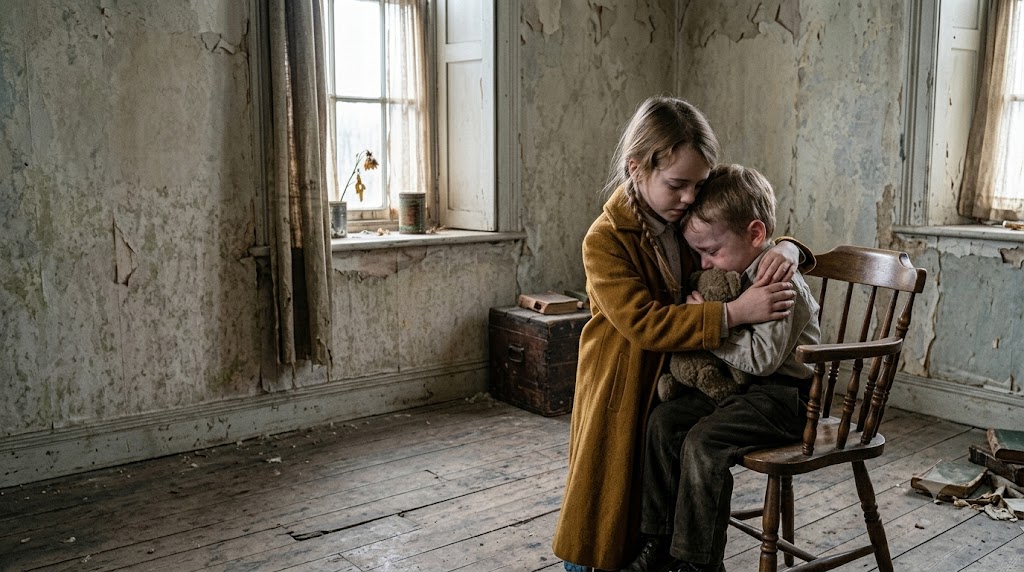
PART 1 – THE EMPTY HOUSE
When five-year-old Anna Mercer came home from kindergarten, the first thing she noticed was that the house sounded wrong.
Usually, the radio was playing in the kitchen.
Usually, her mother was moving between rooms.
Cupboards opening.
Water running.
Someone telling one of the boys to stop touching something.
That afternoon, there was nothing.
Anna stood inside the front door with her little school bag still hanging from one shoulder.
“Mom?”
No answer.
She walked into the kitchen.
The table was bare.
Not cleaned.
Bare.
The blue ceramic bowl that normally held fruit was gone.
The coffee tin was gone.
Two drawers were hanging open.
Anna stared at them without understanding.
Then she heard crying.
It came from the living room.
Her three-year-old brother, Jamie, was sitting in his little wooden rocking chair.
His knees were pulled up.
A brown teddy bear was crushed against his chest.
He was rocking forward and backward.
Not quickly.
Almost mechanically.
And he kept repeating the same sentence.
“Mommy doesn’t love me anymore.”
Anna stopped in the doorway.
Jamie didn’t look at her.
“Mommy doesn’t love me anymore.”
“Jamie?”
He kept rocking.
“Mommy doesn’t love me anymore.”
Anna walked toward him.
“Where’s Mom?”
That finally made him look up.
His face was wet.
“She left.”
Anna frowned.
“Where?”
Jamie squeezed the bear.
“She took her stuff.”
Anna did not understand what that meant.
Adults left the house all the time.
They went shopping.
They went to work.
They visited people.
Then they came back.
“When?”
Jamie only began repeating it again.
“Mommy doesn’t love me anymore.”
Anna looked around the room.
Then she noticed the photograph missing from the mantel.
Her mother had taken that too.
That was the first moment Anna felt afraid.
Not because she understood abandonment.
She didn’t.
Because even at five years old, she understood something simpler.
People who planned to come back did not usually take the photographs.
PART 2 – TWO DAYS
There were four children in the house.
Anna.
Her older brother Michael, seven.
Jamie, three.
And the youngest, Peter, who was still small enough to ask for their mother every time someone opened the front door.
Their father, Robert, came home later that evening.
Anna remembered his face when he looked around.
She remembered him opening the bedroom wardrobe.
Standing there.
Then shutting it again.
He did not explain much.
Adults rarely explained disasters properly to children.
He only said:
“Your mother’s gone.”
Michael asked:
“When is she coming back?”
Robert didn’t answer.
For approximately two days, he tried to manage.
Breakfast was wrong.
Nobody had clean socks.
Peter cried at night.
Jamie carried the teddy bear everywhere.
Then Robert told them to pack some clothes.
“Where are we going?” Anna asked.
“To Aunt Margaret’s.”
“For how long?”
“A few days.”
That sounded manageable.
A few days was something a five-year-old could understand.
At Margaret’s house, Robert carried their small bags inside.
Margaret looked surprised to see all four children.
Then worried.
Robert spoke to her quietly in the kitchen.
Anna stood near the hallway trying to hear.
She caught fragments.
“She’s gone.”
“I can’t…”
“Just until…”
“I need to sort things out.”
Then Robert came back into the room.
He crouched in front of Anna.
“I’ll come back and get you in a couple of days.”
Anna nodded.
She believed him immediately.
Children believed timelines adults gave them because they had no reason not to.
Two days.
Maybe three.
Anna watched from the window as Robert walked toward his car.
Jamie stood beside her holding his bear.
“Daddy coming back?”
“Yes.”
Anna answered before Margaret could.
“Couple days.”
Robert drove away.
Two days passed.
Then four.
Then a week.
Then another.
He did not come back.
PART 3 – THE CHILDREN WHO STAYED
Margaret never sat the children down and announced that they lived with her now.
It simply became true.
Their clothes moved from suitcases into drawers.
School forms began carrying Margaret’s address.
Birthday cakes appeared in her kitchen.
Christmas presents collected beneath her tree.
The children gradually stopped asking when their father was coming.
Not all at once.
Questions disappeared one by one.
Peter stopped first because he had been too young to remember much.
Michael stopped because anger replaced hope.
Jamie stopped saying “Mommy doesn’t love me anymore,” but kept the teddy bear.
Anna stopped because she learned something that would shape the rest of her childhood.
Asking a question did not make adults answer it.
Margaret did her best.
She was not their mother.
She never pretended to be.
That mattered.
When Anna cried, Margaret did not say:
“Forget about her.”
She said:
“I don’t know why she left.”
When Michael became angry, Margaret did not say:
“Your father doesn’t care.”
She said:
“Your father has problems I cannot fix.”
When Jamie once asked whether they had been bad children, Margaret became furious.
Not with Jamie.
With the idea.
“No.”
She put both hands on his shoulders.
“Never think that.”
Jamie looked down.
“Then why’d they go?”
Margaret opened her mouth.
Then closed it.
Because there was no answer a child could understand that would make the abandonment hurt less.
PART 4 – THEIR FATHER
Anna saw Robert again when she was fourteen.
She did not recognize him.
That was the part she would remember most.
Not the smell of alcohol.
Not the dirty jacket.
Not the unsteady way he stood.
The fact that she looked directly at her own father and saw a stranger.
Margaret had received a phone call.
Robert was nearby.
He wanted to see the children.
By then Michael refused.
Jamie said nothing.
Anna agreed.
Maybe because she was curious.
Maybe because some part of the five-year-old girl was still standing at Margaret’s window waiting for the car to return.
Robert arrived almost an hour late.
A thin man stepped through the doorway.
His face looked older than it should have.
His hands shook slightly.
He smiled at Anna.
“Look at you.”
She stared.
Margaret said quietly:
“Anna.”
Only then did she understand.
Her stomach dropped.
“Dad?”
His smile widened.
“Of course.”
She immediately felt guilty.
As though failing to recognize him were somehow her mistake.
Robert tried to hug her.
Anna let him.
He smelled like stale cigarettes, alcohol and rain.
He stayed perhaps forty minutes.
He spoke too loudly.
Repeated himself.
Promised things.
“I’m getting myself straight.”
“You’ll see.”
“I’m going to get a place.”
“We’ll do something together.”
Anna listened.
At fourteen, she was old enough to understand promises differently.
When he left, she turned to Margaret.
“What happened to him?”
Margaret looked toward the door.
“Life.”
Anna shook her head.
“No.”
Margaret looked at her.
Anna repeated:
“What happened?”
Margaret finally said:
“He drinks.”
That was the softened version.
Over the following years, Anna learned the rest.
Robert drank constantly.
He lost jobs.
Then rooms.
Then places to stay.
Sometimes relatives knew where he was.
Sometimes nobody did.
He drifted between couches, shelters, temporary rooms and the street.
Anna saw him only a handful of times afterward.
Each meeting was shorter.
Each promise smaller.
Eventually, even he stopped saying everything would change.
Then one day, years later, someone called to say Robert had died.
Anna waited for a feeling she could identify.
Grief.
Anger.
Relief.
Anything.
What came instead was exhaustion.
Her father had abandoned them once when they were children.
Alcohol had spent the rest of his life making sure he never really returned.
PART 5 – THE OTHER BROTHER
At fifteen, Anna learned the family had one more secret.
Margaret told her because she believed Anna was old enough.
They were sitting in the kitchen.
Nothing dramatic.
Tea.
Toast.
A rainy afternoon.
Margaret said:
“There is something about your mother you should know.”
Anna immediately stiffened.
At fifteen, any sentence beginning with your mother felt dangerous.
“What?”
“You have another brother.”
Anna stared.
“What?”
“Older than Michael.”
Anna laughed once.
Not because it was funny.
Because sometimes disbelief sounds like laughter.
“No, I don’t.”
Margaret said nothing.
Anna’s face changed.
“Do I?”
“Yes.”
“Where?”
“I don’t know.”
“What do you mean you don’t know?”
Margaret folded her hands.
“Your mother had him before you children.”
“And?”
“She left him too.”
Anna stopped breathing for a moment.
The anger arrived slowly.
“She did this before?”
Margaret looked at her.
“Yes.”
Anna pushed her chair backward.
“So she knew.”
“Knew what?”
“What leaving a child feels like.”
“Anna -”
“She already had a child.”
“Yes.”
“And she left him.”
“Yes.”
“Then she had us.”
Margaret’s eyes filled.
“Yes.”
“And left again.”
There was nothing else to say.
For years, Anna had imagined some impossible emergency.
Maybe their mother had panicked.
Maybe something had happened.
Maybe she had been trapped.
Maybe she had believed the children would be better without her.
Every explanation was painful.
But this new fact destroyed one of the gentler possibilities.
Their mother had disappeared from a child once before.
And then she had done it again.
PART 6 – FORTY YEARS
The strangest part was that their mother had not disappeared only from her children.
She disappeared from almost everyone.
Her brothers did not know where she was.
Her sisters did not know.
Old friends knew nothing.
There were rumors.
Different cities.
Another relationship.
Maybe abroad.
Nothing solid.
Their grandmother kept waiting for information.
Anna called her Gram.
Gram grew older.
Every few years, someone would say:
“Maybe we’ll find her.”
They never did.
Gram died without knowing where her daughter had gone.
Anna had complicated feelings about that.
Part of her thought her mother deserved to know that her own mother had waited.
Another part thought Gram had already suffered enough.
By the time Anna was middle-aged, she had mostly stopped imagining a reunion.
Her life existed without one.
She had work.
Relationships.
Family.
Scars that had become ordinary.
Jamie still had the teddy bear somewhere.
Michael almost never spoke about their mother.
Peter dealt with the past differently.
And one of the brothers did not survive long enough to see what happened next.
Then Margaret hired a private investigator.
She did not tell Anna immediately.
Margaret had grown old herself.
Perhaps the mystery bothered her more with age.
Perhaps she wanted one answer before there were no relatives left to ask the question.
Weeks passed.
Then months.
One afternoon Margaret called Anna.
Her voice sounded strange.
“I found her.”
Anna thought she had misheard.
“Who?”
Margaret was silent.
Then:
“Your mother.”
Forty years after walking out of the house, their mother had been found.
Alive.
PART 7 – THE PHONE NUMBER
Her name was still the same.
That surprised Anna.
She had imagined aliases.
New surnames.
Something dramatic.
Instead there was an address.
A telephone number.
A life.
Anna stared at the information Margaret had written down.
“This is her?”
“Yes.”
“You’re sure?”
“The investigator is sure.”
Anna sat quietly.
Margaret waited.
“Do you want to call?”
Anna looked at the number.
For forty years, she had imagined what she would say if this moment ever happened.
Why?
How could you?
Did you think about us?
Did you know Dad left too?
Did you know Jamie sat in that rocking chair saying you didn’t love him?
Did you know Gram died waiting?
Did you know one of your sons died before anyone found you?
Forty years of questions.
Anna picked up the phone.
Then put it back down.
“No.”
Margaret looked surprised.
“Not yet.”
That yet lasted several weeks.
Eventually, one of Anna’s brothers agreed to go with her.
Not because either expected reconciliation.
They wanted to see her.
That was all.
Or at least that was what they told each other.
PART 8 – THE WOMAN AT THE TABLE
Their mother was an old woman now.
Anna had expected that.
Of course she had.
Time had not stopped simply because Anna’s memories had.
But seeing her was different.
The woman who opened the door had white hair.
Thin hands.
A cardigan buttoned almost to her neck.
Anna’s first thought was absurd.
She looks ordinary.
Her mother looked at both of them.
There was no dramatic gasp.
No collapse.
No immediate tears.
She said:
“You found me.”
Anna’s brother answered:
“Yes.”
Their mother stepped aside.
“Come in.”
They sat around a small table.
Anna could hear a clock ticking.
For the first several minutes, conversation was painfully polite.
Weather.
The journey.
Where they lived.
Anna felt something rising inside her.
She had not waited forty years to discuss traffic.
Finally she said:
“Do you know what I remember about the day you left?”
Her mother looked at her.
“No.”
Anna stared.
Not I’m sorry.
Not I think about that day all the time.
Just:
No.
“Jamie was three.”
Her mother’s expression remained neutral.
“He was sitting in his rocking chair.”
Silence.
“He had his teddy bear.”
Anna’s brother shifted beside her.
Their mother looked toward the window.
Anna continued.
“He kept saying, ‘Mommy doesn’t love me anymore.’”
The old woman finally looked back.
Anna waited.
Nothing.
No visible shock.
No tears.
No hand over the mouth.
No question about Jamie.
Anna felt something inside her go cold.
“Do you remember leaving us?”
“Yes.”
“Why?”
Her mother sighed.
Not heavily.
Almost impatiently.
“It was a difficult time.”
Anna stared.
“A difficult time?”
“You were children. You wouldn’t understand.”
“I’m not five anymore.”
“No.”
“Then explain it.”
Her mother looked at her.
“I had to leave.”
“You had to?”
“Yes.”
“Why?”
Another pause.
“Things were bad.”
“With Dad?”
“With everything.”
“That isn’t an answer.”
Her mother’s face tightened slightly.
Anna recognized the expression immediately.
Irritation.
That hurt more than anger would have.
PART 9 – THE BROTHER WHO WASN’T THERE
Anna’s brother finally spoke.
“You know one of us is gone.”
Their mother looked at him.
“What?”
“One of your sons.”
The old woman remained still.
“He died.”
A pause.
“How?”
Anna turned sharply toward her mother.
Not because the question itself was wrong.
Because of the tone.
Clinical.
Curious.
Almost the way someone might ask how an old neighbor had died.
Her brother answered.
Their mother nodded.
“I see.”
Anna stared at her.
“That’s it?”
Their mother frowned.
“What do you want me to say?”
The room became very quiet.
Anna could hear the clock again.
Her brother looked down.
Anna leaned forward.
“He was your son.”
“I know.”
“You left him when he was a child.”
Her mother’s expression hardened.
“I left all of you.”
Anna nearly laughed.
The sentence was so extraordinary in its bluntness that for a second she did not know what to do with it.
Her mother continued.
“What happened afterward wasn’t something I controlled.”
Anna stared.
“You could have called.”
Silence.
“You could have written.”
Nothing.
“Gram died not knowing where you were.”
That finally produced something.
Their mother looked away.
Anna waited.
“Did you know that?”
“No.”
“She waited for you.”
No response.
“Your brothers and sisters didn’t know where you were.”
Still nothing.
Anna felt her voice rise.
“Did you ever wonder what happened to us?”
Her mother looked directly at her.
And hesitated.
Only briefly.
But long enough.
Anna understood the answer before the woman gave one.
“I assumed you managed.”
Anna sat back.
Her brother whispered:
“Managed?”
Their mother looked between them.
“You’re here.”
That was the moment the reunion ended.
Not when Anna stood up.
Not when her brother opened the door.
Not when their mother refused to apologize.
It ended with two words.
You’re here.
As though survival had erased responsibility.
PART 10 – THE SECOND ABANDONMENT
Anna had imagined that meeting her mother would change something.
Perhaps not forgiveness.
Perhaps not love.
But something.
Maybe anger would finally have a face.
Maybe questions would become answers.
Instead, she left with a strange clarity.
The woman who disappeared when Anna was five had always existed largely inside Anna’s imagination.
Sometimes cruel.
Sometimes desperate.
Sometimes frightened.
Sometimes secretly remorseful.
The woman at the table was real.
And reality was simpler.
She had left.
She had stayed away.
She had built decades of distance and apparently learned to live comfortably inside it.
Outside the house, Anna’s brother stopped beside the car.
“Well?”
Anna knew what he meant.
Would they come back?
Would they call?
Would there be another meeting?
She looked toward the window.
Their mother had already disappeared from it.
“No.”
Her brother nodded.
Neither argued.
Forty years earlier, their mother had made the decision to leave them.
This time, Anna made the decision herself.
And somehow that difference mattered.
PART 11 – MARGARET STILL CALLS
Margaret did not cut contact completely.
Every few months, she called Anna’s mother.
The conversations were brief.
Sometimes five minutes.
Sometimes less.
Anna once asked why.
Margaret shrugged.
“I suppose I’m checking whether she’s still alive.”
“Does she ask about us?”
Margaret hesitated.
That was enough.
Anna looked away.
“She doesn’t.”
“Not really.”
Anna nodded.
By then, she no longer expected anything different.
Her mother was approaching ninety.
Anna knew there might eventually be another phone call.
This one saying she had died.
She wondered sometimes what she would feel.
Perhaps sadness.
Not for the mother she knew.
For the one she never had.
For the five-year-old who came home expecting someone to be in the kitchen.
For Jamie rocking with his teddy bear.
For Michael learning anger before he understood why.
For Peter growing up with almost no memory of either parent.
For the older brother Anna did not even know existed until she was fifteen.
For Gram, waiting until there was no more time left to wait.
Those were the people Anna grieved for.
Not the woman who had left.
PART 12 – THE TEDDY BEAR
Years after the reunion, Anna visited Jamie.
They were talking about something unrelated when she noticed an old cardboard box in a cupboard.
On top of several photographs sat a worn brown teddy bear.
Anna stopped.
“Is that…”
Jamie looked.
Then smiled slightly.
“Yeah.”
“You kept it?”
He picked it up.
One ear had been repaired.
The fur was almost flat in places.
Anna touched one of its arms.
For a moment, neither spoke.
Then Jamie said:
“I don’t really remember saying it.”
Anna did.
Every word.
Every repetition.
Mommy doesn’t love me anymore.
Anna looked at her brother.
“You were three.”
“I know.”
Another silence.
Jamie placed the bear back inside the box.
“Do you think she ever loved us?”
Anna had spent most of her life asking some version of that question.
At five, she wanted an answer.
At fifteen, she wanted an explanation.
At forty-five, she wanted accountability.
Now she wanted none of those things.
She closed the box.
“I don’t know.”
Jamie nodded.
Strangely, it was enough.
Because their mother had spent forty years refusing to give them answers.
Anna had finally learned she did not need one to keep living.
The woman who left them was almost ninety now.
Margaret still called occasionally to see whether she was alive.
Anna did not.
She had already watched her mother disappear twice.
Once when she was five.
And once more, forty years later, while sitting directly across from her at a table.
The second time, Anna finally understood what the first had meant. Markdown đã dán (1)

















