Chapter One – The Sound Beneath the Painting
The second blow sounded different.
It was not louder, yet everyone in the library heard the change at once.
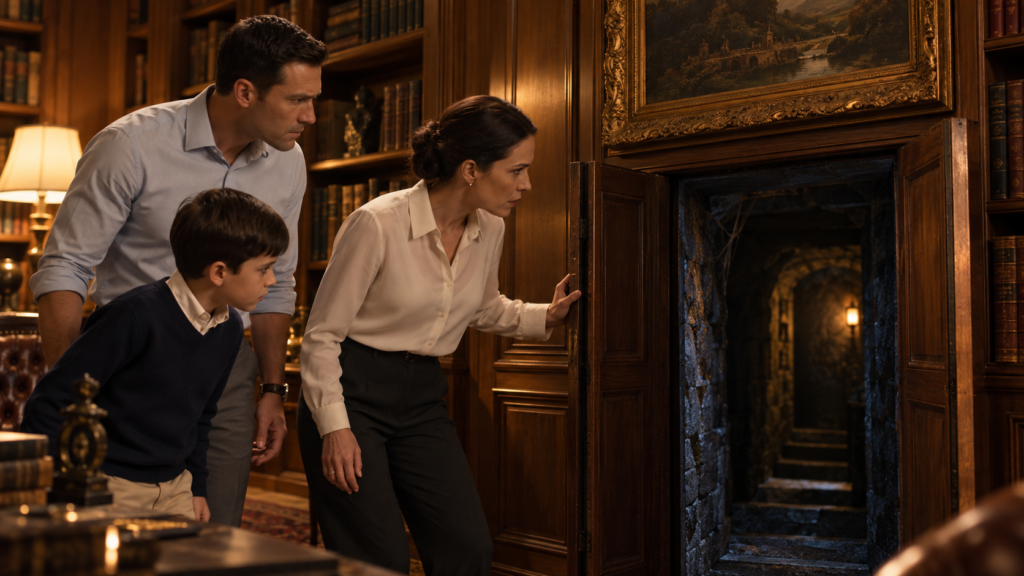
The boy’s fist struck the wooden paneling beneath the old painting, and instead of producing the dull, stubborn knock they had heard before, the wall answered with a dry crack from somewhere deep inside it.
For one suspended moment, nobody moved.
The boy stood close to the wall, breathing hard. His navy sweater had pulled slightly away from the white collar beneath it, while one sleeve had slipped halfway over his wrist. At eight or perhaps nine years old, he looked too small to have caused such a sound.
His father stood several steps behind him.
Only seconds earlier, he had moved forward as if to pull the boy away. However, the mother had stopped him with one hand against his arm.
She had not spoken.
That silence now seemed more important than the impact itself.
Across the room, the older man in the dark business suit remained perfectly upright. His face revealed almost nothing, yet his eyes stayed fixed on the damaged panel.
The boy looked down.
A thin line had appeared in the wood.
At first, it resembled an ordinary crack caused by age. Then the line widened.
Dust slipped from the seam.
The father whispered, “What did you do?”
The boy did not answer.
Instead, he touched the broken edge with his fingertips.
Something moved behind it.
Not the wall.
A mechanism.
The mother noticed.
So did the older man.
The father was the last to understand that his son had not broken the house.
He had found something inside it.
And suddenly the question was no longer why the boy had struck the wall.
It was why someone had built a door behind it.
Chapter Two – A House Full of Silence
The library had always been the quietest room in the house.
Even during family gatherings, when voices filled the hall and glasses touched across the dining table, people entered the library differently. They lowered their voices without thinking, as though the room demanded a certain respect.
Dark wood covered every wall.
Books rose from floor to ceiling.
A large painting hung above a narrow writing table, showing a grey countryside beneath winter clouds. The boy had never liked it.
He once told his mother that the landscape looked lonely.
She had answered too quickly.
“It is only a painting.”
At the time, he believed her.
Now the cracked panel beneath that same painting made the memory feel less innocent.
His father stepped closer.
“Move away from it.”
The boy turned.
“Why?”
“Because I said so.”
The words came out sharper than intended.
His mother looked at him.
Immediately, something in the father’s expression changed.
Regret, perhaps.
Or fear.
The older man remained near the shelves, watching the family with the patience of someone who had already lived through the scene in his imagination.
The boy noticed that.
Children often noticed what adults believed they had hidden.
“Did you know?” he asked.
The question was simple.
Yet none of them answered.
That frightened him more than anger would have.
He looked from his father to his mother.
Then he turned toward the older man.
The grey-haired man lowered his eyes.
That small gesture changed the room.
The boy understood that the adults did know something.
Perhaps not everything.
But enough.
Therefore, when he faced the wall again, he no longer felt like a child being disobedient.
He felt like the only person in the room willing to continue.
Chapter Three – The Mother’s Hand
The father moved again.
This time, he did not reach for the boy.
He merely took one step.
The mother stopped him once more.
Her fingers closed around his forearm.
Not tightly.
She did not need strength.
The look she gave him was enough.
“Let him,” she said.
Her voice was low.
The father stared at her.
“You don’t know what’s behind there.”
A pause followed.
Then she answered, “Neither do you.”
The older man looked away.
That was the first true crack in the room.
Not in the wall.
Between the adults.
The boy remained still, listening.
His father glanced toward the older man.
“Is that true?”
The older man’s face remained controlled.
“I know what was once there.”
The mother’s hand slowly left her husband’s arm.
“And now?”
“I don’t know.”
The father gave a small, bitter laugh.
“Of course you don’t.”
The boy turned toward them.
There were sentences being spoken around him, but they belonged to a history he had never been given.
The older man took a breath.
“For years, that wall was not meant to be opened.”
The boy asked, “Why?”
Again, silence.
However, this silence felt different.
The adults were no longer protecting him from an answer.
They were protecting themselves.
The mother looked at her son.
Something almost painful appeared in her face.
“Because some things were hidden before you were born.”
The boy frowned.
“Then why are they still hidden?”
Nobody had a good answer.
So he turned back to the wall.
Chapter Four – The Second Strike
The damaged panel had already begun to separate.
A narrow seam ran vertically beneath the painting.
The boy placed his hand against it.
His father inhaled sharply.
The mother said nothing.
Meanwhile, the older man took one slow step forward.
“Careful.”
The boy looked over his shoulder.
That word mattered.
Not stop.
Not leave it.
Careful.
He understood permission when he heard it.
So he drew back his arm.
His father’s face tightened.
The mother watched her son with an expression that mixed fear and resolve.
Then the boy struck the wall again.
The impact traveled through the room.
Wood split with a sudden, clean sound.
One narrow panel cracked downward.
Another shifted beside it.
The painting above trembled slightly in its frame.
Dust fell across the floor.
For a heartbeat, nothing else happened.
Then the hidden seam opened.
A dark vertical line appeared where solid wood had seemed to exist for decades.
The boy stepped back.
His father stared.
The mother brought one hand slowly to her mouth.
The older man closed his eyes.
Only for a second.
Yet the boy saw it.
That reaction told him more than words could.
The hidden space behind the wall was not a surprise to the older man.
It was a memory.
Chapter Five – The Doors
The boy reached toward the split panel.
His fingers found an edge.
At first, the wood resisted.
Then something released from inside the wall with a soft mechanical click.
He pushed.
One side moved inward.
His father whispered, “Wait.”
But the boy was already moving.
A second panel shifted.
Together, the pieces separated into two narrow wooden doors hidden so carefully within the library wall that nobody unfamiliar with the house would ever have noticed them.
The opening widened.
Warm light from the library spilled through.
Beyond it lay darkness.
Not a room.
A passage.
Narrow walls disappeared into shadow.
The air that came from inside felt colder than the library.
Older too.
The boy stood before the opening.
His expression changed.
Until that moment, curiosity had carried him forward.
Now he understood that finding something and entering it were different decisions.
His father came closer.
This time, the mother did not stop him.
Instead, both parents stood behind their son.
The older man remained farther back.
He looked at the passage as though it had opened not into another part of the house, but into a part of his life he had hoped would remain closed.
The boy glanced at him.
“You knew.”
The older man answered after a pause.
“Yes.”
The father turned sharply.
“You told me there was nothing behind this wall.”
“I told you there was nothing you needed to find.”
“That is not the same thing.”
“No,” the older man said quietly.
“It is not.”
Chapter Six – What Parents Choose Not to Tell
The father stepped toward the hidden entrance.
His body remained tense, but his anger had changed direction.
It was no longer aimed at the boy.
“Who built this?”
The older man looked toward the floor.
“The house was altered long before you inherited it.”
“That wasn’t my question.”
The mother watched them both.
Her face had grown pale.
The older man lifted his eyes.
“Your father knew about it.”
The father went still.
The boy looked at him.
Grandfather.
The word was never spoken, but it seemed to enter the room anyway.
The father’s voice dropped.
“My father?”
“Yes.”
“And you?”
“I knew because he asked me to.”
The father took another step.
“To do what?”
“Keep it closed.”
The mother finally spoke.
“For how long?”
The older man looked at the boy.
Perhaps that was the wrong choice.
Because everyone noticed.
“Until he was old enough,” he said.
The father followed his gaze.
“My son?”
The older man did not answer.
He did not need to.
The boy felt the adults’ attention move toward him.
Suddenly, the passage behind the wall seemed less like an architectural secret.
It was connected to him.
That realization changed everything.
He had believed he was opening something that belonged to the house.
Now he wondered whether the house had been waiting for him.
Chapter Seven – The Painting
The mother looked upward.
Her eyes settled on the painting.
Grey countryside.
Bare trees.
A distant house beneath a white winter sky.
She walked closer.
Her husband noticed.
“What?”
She studied the lower corner of the frame.
“I’ve seen this place.”
The older man’s posture changed.
It was subtle.
Nevertheless, she caught it.
“Where?” the father asked.
She hesitated.
“In a photograph.”
The boy turned.
“What photograph?”
His mother remained quiet for several seconds.
Then she looked toward the older man.
“You had it.”
The older man’s face tightened.
“That was years ago.”
“You told me it was somewhere in France.”
“It is.”
The father looked between them.
“What does that have to do with this passage?”
The mother pointed toward the painting.
“There was another person in the photograph.”
The older man closed his eyes again.
This time, nobody missed it.
The father’s voice became colder.
“Who?”
The older man answered carefully.
“Someone your father wanted forgotten.”
The boy stared at the passage.
A new question formed.
“If they wanted that person forgotten, why keep the painting?”
No one replied.
However, the mother’s expression changed as if the child had touched the heart of the matter.
Because adults destroyed what they truly wished to forget.
They did not frame it.
They did not hang it above a secret door.
They did not keep it for decades.
The painting was not decoration.
It was a marker.
Chapter Eight – The Older Man’s Secret
The older man finally walked toward the opening.
His polished shoes stopped just before the broken wood.
He did not enter.
Instead, he ran one hand along the edge of the hidden door.
The gesture was unexpectedly gentle.
The father noticed.
“You’ve been through there.”
“Yes.”
“When?”
“A long time ago.”
“How long?”
The older man looked toward the dark passage.
“Before you were married.”
The father laughed once, without humour.
“So everyone knew except me?”
“No.”
“Then who?”
The older man hesitated.
That hesitation was enough.
The mother spoke before her husband could.
“My father?”
The room changed.
The older man looked at her.
For the first time, real emotion broke through his composure.
Regret.
The mother understood immediately.
“My father knew about this place.”
“Yes.”
Her eyes hardened.
“And you both agreed never to tell us.”
“It was more complicated.”
“That is what people say when the truth makes them look cruel.”
The older man accepted the words without defending himself.
The boy watched.
Adults often told children that secrets existed to protect them.
Yet as he looked around the room, he began to suspect secrets mostly protected the people who created them.
Chapter Nine – The Passage Was Never Empty
Warm library light reached only a few feet into the hidden corridor.
Beyond that, darkness swallowed the details.
Still, the boy could see enough.
Wooden walls.
A narrow floor.
Dust.
Then something pale farther inside.
He leaned forward.
His father immediately placed a hand on his shoulder.
Not to stop him.
To keep him close.
“What is that?” the boy asked.
The older man did not answer.
The mother narrowed her eyes.
Something hung on the wall inside the passage.
A small rectangular shape.
Perhaps a frame.
Perhaps a photograph.
The boy took one step closer.
His father went with him.
Then the mother followed.
Only the older man remained outside the doorway.
The boy looked back.
“Are you coming?”
The older man’s face seemed older now than when the evening began.
“No.”
“Why?”
He looked into the darkness.
“Because I already know what is at the beginning.”
The father frowned.
“And the end?”
The older man’s gaze moved toward him.
“That is what your father never told me.”
The father stared.
For years, he had believed the older man possessed the answers.
Now he understood that the man had only been guarding the questions.
That was worse.
Because it meant someone else had designed this silence.
Someone who was no longer there to explain it.
Chapter Ten – The First Step Inside
The boy stood at the threshold.
Behind him waited the library he knew.
Warm lights.
Books.
His parents.
A painting he had disliked since childhood.
Ahead waited a passage hidden inside the wall.
Dark.
Cold.
Silent.
Yet strangely deliberate.
His father rested a hand lightly on his shoulder.
The boy looked up.
“Should we go?”
The father glanced at his wife.
For the first time since the wall had opened, the two adults seemed to agree without words.
The mother nodded.
The father looked back at his son.
“Yes.”
The boy stepped forward.
Warm light stretched behind him as he entered the passage.
His parents followed.
The older man remained in the library.
However, just before disappearing into the darkness, the boy turned once more.
The older man was not watching him.
He was staring at the painting.
More precisely, he was staring at the small house painted in the distance.
The boy remembered his mother’s words.
She had seen that place before.
In a photograph.
With someone the family had been told to forget.
That thought followed him into the passage.
Then his father noticed something on the wall ahead.
A photograph.
Its glass was covered in dust.
The boy moved closer.
The mother stopped breathing.
The father said nothing.
None of them touched it.
They did not need to.
Even beneath years of dust, one detail was visible.
The photograph showed the same house as the painting.
And standing in front of it was a man whose face looked disturbingly familiar.
Not because the boy had met him before.
Because the man had the same eyes as his father.
Behind them, the older man finally spoke from the library.
His voice was quiet.
Almost tired.
“There is something you should know before you go any farther.”
The father slowly turned.
The boy did not.
He kept staring at the photograph.
The hidden doors had revealed a passageway.
However, he now understood that the real secret was not behind the wall.
It was inside his family.
And somebody had spent decades waiting for the right person to open it.

















