Chapter One – The Hour When Houses Stop Pretending
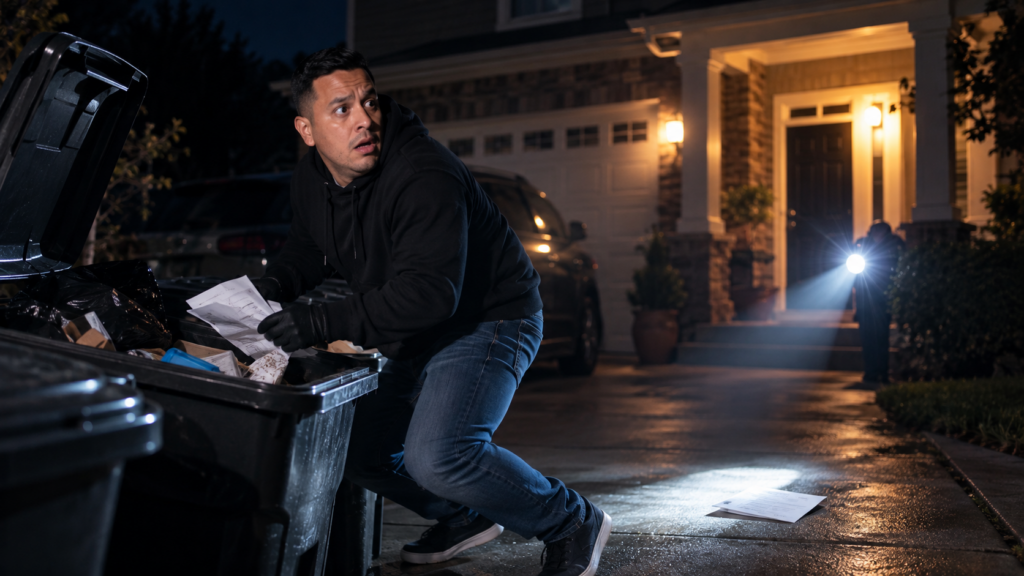
By half past eleven, the street had become so quiet that every ordinary sound seemed guilty of something. The detached houses stood behind clipped hedges and narrow driveways, their windows dark except for the occasional blue pulse of a television or the small amber lamp that someone had forgotten to switch off before bed. A parked car cooled beneath the weak garage light, and two black rubbish bins waited near the curb with their lids half closed, appearing no more remarkable than any other household objects abandoned to the night.
The man in the black hoodie had been watching the house for seventeen minutes before he crossed the pavement.
He was in his late twenties, with short dark hair, a medium build, and the kind of face people rarely remembered correctly afterward. Nothing about him suggested panic at first. His blue jeans were clean enough to belong to someone returning from an ordinary evening out, and his dark trainers with white soles made little sound against the concrete driveway. Only his hands betrayed him. They remained too close to his body, fingers tightening and loosening as though they had forgotten what to do when they were not holding something.
He stopped beside the bins and listened.
Nothing.
No curtain moved.
No door opened.
No dog barked from a neighbouring garden.
That silence should have reassured him, but instead it made the blood beat harder in his ears.
He lifted the first lid.
A smell of coffee grounds, cardboard and damp food rose into the cold air, painfully domestic and almost insulting in its normality. For a moment he merely stared down into the darkness, his face caught between the distant garage lamp and the harder white beam of the flashlight behind him.
Then he began to search.
He did not move like a thief looking for something valuable.
He moved like a man trying to recover something that should never have been thrown away.
Plastic rustled beneath his hands. Newspapers shifted. An empty envelope slid against the side of the bin. He pushed past packaging, a torn shopping bag and a bundle of discarded mail until his fingers touched paper.
His breathing stopped.
There it was.
Folded once.
Creased down the middle.
A small object among rubbish, yet he looked at it as though the whole street had narrowed around it.
For three nights he had told himself that he would not come here.
For three nights he had failed to believe himself.
He drew the paper out.
And somewhere behind him, from the darkness beyond the flashlight beam, a voice shouted.
“Hey!”
The word cracked through the night.
The man flinched as though struck.
The paper slipped from his fingers.
It floated once, pale beneath the light, then landed on the concrete beside the open bin.
He turned sharply.
And ran.
Chapter Two – The Thing He Had Come Back For
Three years earlier, he had believed that the worst kind of loss was losing someone.
Later he learned that there was something quieter and perhaps more cruel: losing the version of yourself that had existed before you understood why that person had gone.
There had been a time when he was welcomed through the front door of this house without knocking. He remembered winter evenings when rain silvered the driveway and warm light spread from the porch across the paving stones. He remembered leaving his shoes near the radiator because someone inside disliked mud on the carpet. He remembered the smell of coffee, old books and washing powder.
He remembered believing he belonged there.
That memory was why approaching the house through its rubbish bins felt obscene.
He had not returned for money.
He had not returned for jewellery.
He had not even returned for revenge, although for a long time he had confused revenge with wanting an answer badly enough.
He had returned because, that afternoon, he had received a photograph on his telephone from an unknown number.
The photograph showed a sheet of paper.
Only the top half was visible, but it was enough.
His surname had been typed across the first line.
Beneath it was a date he knew too well.
And at the edge of the photograph, almost cropped from view, was a handwritten sentence in blue ink.
A sentence he had seen once before.
Then the image disappeared from the messaging account before he could reply.
No explanation followed.
No second photograph came.
For six hours he sat in his flat telling himself it might be fabricated, that someone might simply be cruel, that three years of silence should not be destroyed because of half a page glimpsed on a screen.
At nine, he drove past the house.
At ten, he parked two streets away.
At eleven thirteen, he saw someone carry the black bins to the curb.
That was when he understood what frightened him.
Not that the paper existed.
That someone inside the house had decided it should disappear.
Now, as he ran across the driveway toward the porch, he could still see it lying behind him in the beam of light.
The paper he had waited three years to find.
The paper he had just dropped.
Every instinct told him to turn back.
Every memory told him not to.
He kept running.
Chapter Three – A Voice in the Dark
The shout had not sounded frightened.
That unsettled him more than anger would have.
Fear was predictable. Fear made people retreat, close doors, call for help.
The voice behind him had carried recognition.
Not his name.
Something worse.
Certainty.
As though whoever had spoken had been expecting someone to come for that particular piece of paper.
His trainers struck the driveway in quick, muted blows. The parked car flashed beside him, its windows black mirrors reflecting a distorted figure in a hood. The garage light threw his shadow ahead of him until it stretched almost to the porch.
He did not look back.
The front of the house grew larger.
Warm light burned above the entryway.
From a distance, the porch had always looked welcoming. Up close, it appeared almost theatrical, the brass handle catching the light, the pale door perfectly painted, the small potted plant beside the step arranged with the kind of care that suggested nothing chaotic had ever happened inside.
He knew better.
His lungs tightened.
The house had not changed enough.
That was its cruelty.
The same narrow window stood beside the front door. The same small chip remained on the third paving stone. Even the garage exterior lamp still flickered faintly every few seconds, a fault nobody had repaired since the winter before everything ended.
The world had moved on.
This house had preserved details like evidence.
Behind him, the rubbish bin remained open.
The paper remained on the ground.
And the light began to move.
The flashlight beam left his back and travelled across the driveway, as though the person holding it had stopped chasing him with their eyes.
The man reached the first porch step.
Then he heard no footsteps.
That frightened him enough to slow.
For one suspended second, he almost turned around.
He imagined seeing no one.
Or seeing someone he recognised.
He could not decide which possibility was worse.
So he did the only thing his body seemed capable of doing.
He moved toward the front door.
Chapter Four – Before the Silence
There had once been a woman who told him that truth was overrated.
Not because she believed in lying, but because she believed people often asked for truth when what they really wanted was permission to stop doubting themselves.
He had laughed when she said it.
He had been twenty-five then.
At twenty-five, he believed honesty was simple.
A person either told you what happened or they did not.
A person either stayed or they left.
A person either loved you or they did not.
The years afterward taught him how childish those categories were.
People left while loving.
People stayed while betraying.
And sometimes the truth arrived so late that it resembled cruelty more than kindness.
The paper in the rubbish bin belonged to that part of his life.
He had known of its existence without ever seeing it.
Three years ago, after weeks of unanswered calls and careful evasions, someone had mentioned a document during an argument. Not shown him. Not explained it. Merely said that there were things he did not understand and that perhaps it was better that way.
He had hated that sentence ever since.
Better for whom?
That question had followed him into a new flat, a new job, other relationships, other cities and long train journeys where he would suddenly remember the exact tone in which the words had been spoken.
He eventually learned to live without an answer.
Not peacefully.
But functionally.
Then came the photograph.
The paper.
The handwriting.
And one detail that made sleep impossible.
The handwritten sentence in the photograph was not addressed to the house.
It was addressed to him.
That was why, when he reached the porch, he did not simply keep running down the street.
He had spent three years believing he had been kept outside a secret.
Now he suspected the secret had always been meant to find him.
Chapter Five – The Paper on the Concrete
Behind him, the camera of the night seemed to change its mind.
The man became less important.
The flashlight beam drifted away from his retreating body and returned toward the curb.
The open bin waited beneath it.
Loose refuse moved slightly in the cold breeze.
Then the circle of white light found the paper.
It rested face down on the concrete.
Nothing about it announced what it contained.
No blood.
No photograph taped to its surface.
No dramatic seal.
Only ordinary white paper marked by a crease and one darkened corner where it had touched something damp inside the bin.
That ordinariness was almost unbearable.
Most things that destroy lives arrive without ceremony.
A letter.
A signature.
A hospital form.
A bank statement.
A message read at the wrong hour.
The person behind the flashlight took no visible step into frame.
The beam simply remained there.
Still.
Intent.
The man near the house could no longer see what the light was doing, but he knew.
He could feel the attention leaving him.
That was when another thought entered his mind.
Perhaps the shout had not been intended to stop him.
Perhaps it had been intended to make him drop the paper.
His pace faltered.
The possibility was absurd enough to sound intelligent.
If someone wanted him gone, they could have continued shouting.
They could have approached.
They could have called authorities.
Instead there was silence.
And behind him, the single piece of paper he had searched for lay illuminated in the dark.
Almost displayed.
The realization passed through him slowly.
He had assumed he was the intruder.
For the first time, he wondered whether someone inside this story had wanted him to come.
Chapter Six – The Door He Could Not Touch
He reached the porch.
His hand rose toward the handle.
Then stopped.
A few centimetres separated his fingers from the brass.
He stood like that, frozen beneath the warm light, breath shallow, one shoulder slightly raised from the tension of running.
The door had once opened for him hundreds of times.
He had carried groceries through it.
He had stood beneath its frame while shaking rain from his jacket.
He had leaned against it during arguments, unwilling to leave and too proud to stay.
Now touching it felt like crossing a border.
He lowered his hand.
The house was silent.
No voices reached him from within.
No footsteps crossed the floor.
Yet a faint lamp burned deeper inside, visible through the slim window beside the door.
He looked at that rectangle of light and thought of the paper behind him.
The document could answer the question that had consumed years of his life.
It could also destroy whatever explanation he had built in its absence.
People often imagined that uncertainty was unbearable.
He had discovered the opposite.
Uncertainty could become a shelter.
It allowed hope and resentment to survive together.
Truth chose one.
He turned his head slightly.
From the porch he could see only part of the driveway.
The bins stood beyond the parked car.
The flashlight remained aimed toward the ground.
Whoever held it had still not followed.
His throat tightened.
He understood then that returning to the paper would require a second decision.
Coming to the house had been desperation.
Going back would be choice.
And choice was harder.
Chapter Seven – What Guilt Looks Like from a Distance
For three years, he had told himself he was innocent.
Not innocent of mistakes.
No adult had that luxury.
But innocent of the thing that ended everything.
There had been accusations he did not understand, conversations stopped when he entered rooms, and eventually a departure delivered with such cold restraint that anger would have been easier to survive.
He remembered asking what he had done.
The answer had been silence.
Later, he became angry enough to create answers of his own.
Someone had lied about him.
Someone had used him.
Someone had wanted him gone.
Those explanations hardened into certainty because certainty was easier to live with than the possibility that he had forgotten something essential.
Then came the photograph.
His name.
That date.
The handwriting.
The paper now lying beside the bin.
For the first time, another possibility had emerged.
What if the document did not prove someone else had betrayed him?
What if it proved someone had protected him?
The thought struck with almost physical force.
He leaned against the porch rail.
From there, the man in the black hoodie no longer looked like a suspect fleeing a property.
He looked tired.
Young in a way that only exhausted adults sometimes do.
The hood shadowed his face, but his posture had lost its urgency.
He had reached safety and discovered he did not know what safety meant.
Behind him, the paper waited.
Ahead of him, the house contained whatever remained of the life from which he had been excluded.
The space between those two points was only a driveway.
Emotionally, it was three years long.
Chapter Eight – The Meaning of Being Seen
He finally looked back.
The movement was small.
Not dramatic enough for anyone watching from far away to understand.
His head turned.
His shoulders followed.
The driveway stretched behind him beneath pools of weak artificial light.
The parked car.
The garage.
The black bins.
The paper.
And the flashlight beam.
He still could not clearly see the person holding it.
That seemed deliberate.
His pulse slowed rather than accelerated.
A strange idea settled over him.
Perhaps he knew that posture.
Perhaps he knew the rhythm of that silence.
He searched the darkness beyond the light, but the beam itself prevented him from seeing properly. Whoever stood behind it existed only as absence.
The voice from earlier returned to him.
One word.
“Hey!”
At first he had heard accusation.
Now, replaying it in memory, he heard something else.
Warning.
Not “Stop.”
Not “Get away.”
Not his name.
Only a sound sharp enough to startle him.
Sharp enough to make him release what he was holding.
He looked down at his empty hands.
The paper had never been safely in his possession.
He had touched it for perhaps two seconds.
Yet those two seconds had altered everything.
Because he had seen the top line more clearly than in the photograph.
He had seen the date.
He had seen his own surname.
And beneath it, before the paper fell, he had seen one additional word.
Consent.
That single word now echoed louder than the shout.
Consent to what?
Given by whom?
For whom?
He suddenly knew that the document was not a private letter.
It was a record.
And records had witnesses.
Chapter Nine – The First Betrayal Was Silence
The revelation did not come as an answer.
It came as a rearrangement of suspicion.
For years, he had believed someone had hidden the truth because they feared what he would do with it.
Now he wondered whether they had hidden it because the truth had endangered someone else.
That possibility changed the emotional geometry of everything he remembered.
The cold conversations.
The insistence that he stay away.
The unexplained document.
The sentence that things were better if he did not understand.
Perhaps those words had not been contempt.
Perhaps they had been protection expressed badly.
And protection, he knew, could wound almost as deeply as betrayal when the person being protected was never allowed to choose.
He closed his eyes.
A memory surfaced.
A winter afternoon.
Someone standing in this very driveway with folded arms.
A sentence spoken softly enough that he had dismissed it at the time.
“If you ever discover what happened, promise me you won’t decide who to hate until you know why.”
He had forgotten the exact wording until now.
Or perhaps he had chosen to forget it.
The emotional force of the memory made him open his eyes.
The paper remained illuminated.
The person holding the flashlight remained unseen.
Suddenly, the entire scene felt less like discovery and more like invitation.
Not a kind one.
Not a safe one.
But an invitation nonetheless.
Someone had photographed the document.
Someone had sent the image.
Someone had thrown the original into a bin where he could find it.
And someone had been present at the exact moment he arrived.
Too many details aligned for coincidence.
He had not uncovered the secret.
The secret had been placed in his path.
The real question was no longer what the paper said.
It was why someone had decided tonight was the night he was finally allowed to read it.
Chapter Ten – The Distance Back
He stood beneath the porch light for several more seconds.
The night seemed to hold its breath with him.
Then his gaze shifted from the house to the paper.
Nothing moved.
The physical facts remained unchanged.
A suburban driveway.
A parked car.
A garage.
Two black rubbish bins.
One open lid.
One sheet of paper resting on the concrete.
A young man in a black hoodie who had arrived secretly, searched through rubbish, been startled by a voice, dropped what he found and run toward the house.
From the outside, it was simple.
Almost suspiciously simple.
But lives rarely resemble themselves when viewed from a distance.
The man knew that now.
What looked like trespassing might be grief.
What looked like flight might be fear of discovering the truth.
What looked like guilt might merely be the posture of someone who had spent too long believing a lie.
He stepped away from the door.
Not toward the street.
Toward the driveway.
One slow step.
Then another.
His breathing had steadied.
The flashlight beam did not move.
Whoever held it was waiting.
He walked as far as the edge of the porch and stopped there, still separated from the paper by the length of the parked car.
That was enough.
Not every decision had to be completed in the same moment it began.
His eyes stayed fixed on the white rectangle near the rubbish bin.
For the first time that night, he no longer feared being caught.
He feared reading the page and understanding why someone had spent three years making sure he never saw it.
The colder possibility was that the secret did not concern what had been done to him at all.
It concerned what someone had done for him.
And sacrifices hidden too long had a cruel way of resembling betrayals.
Behind the flashlight, the unseen figure remained perfectly still.
The man on the porch stared toward the paper.
Between them lay barely twenty metres of concrete.
Yet both seemed to understand that crossing that distance would divide his life into two parts.
Before he read it.
And after.
The night offered no explanation.
Only the open bin, the abandoned page and the quiet house that had kept its secret for three years.
Somewhere beyond the narrow circle of light, the person holding the flashlight finally lowered it by a fraction.
Not enough to reveal a face.
Only enough to illuminate the first line of the document.
The man could not read it from the porch.
But he recognised the shape of his own name.
And for the first time since he had run, he stopped thinking about escape.

















