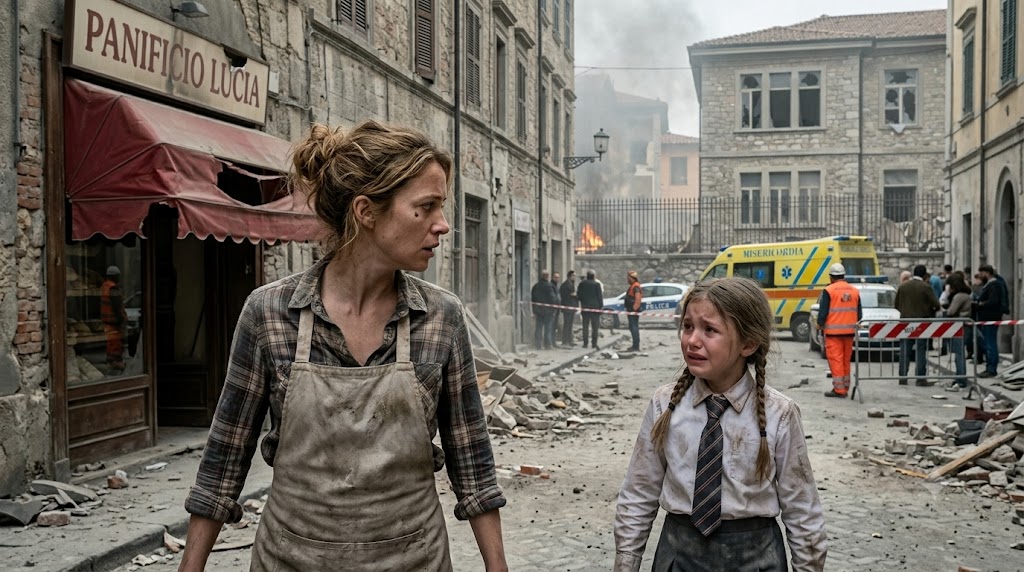
When Sofia Bellini was five years old, she believed all mothers smelled faintly of flour.
Her own mother did because Lucia worked six mornings a week at Bellafonte, a bakery on a narrow street behind the tram depot. By the time Lucia collected Sofia from school, white dust had settled into the lines of her hands and sometimes along the dark hair near her temples. Sofia liked to press her nose into her mother’s coat and breathe in sugar, yeast and the sharp lemon cleaner used on the bakery counters.
People often said they looked alike.
Not in the vague way adults compared mothers and daughters for conversation. Lucia and Sofia shared the same black hair, the same narrow chin, and, most noticeably, the same small brown mole near the outer corner of the left eye.
When Sofia was younger, Lucia used to tap her own mole and then Sofia’s.
“Proof,” she would say.
“Proof of what?”
“That they didn’t give me the wrong baby.”
Sofia would laugh every time.
Those were the good years, though Lucia would later remember them as exhausted ones.
Paolo, Sofia’s father, had once operated a small flooring business with two employees and an old white van. The business failed slowly, then all at once. A contractor delayed payment, interest accumulated, and Paolo began borrowing money to cover previous loans. He hid letters in drawers. He stopped answering unknown numbers. He started leaving the apartment late at night and returning after Sofia was asleep.
Lucia knew things were bad.
She did not know how bad until Paolo stopped coming home.
They found him two days later.
Sofia was too young to understand the details. Lucia made sure she remained that way.
She told her only that her father had been sick in a way people sometimes could not see.
Afterwards, creditors came.
Lucia sold their car.
Then Paolo’s tools.
Then her wedding jewellery, except for a small silver necklace with a round blue pendant that Sofia liked to hold while falling asleep.
They moved into a two-room apartment above a laundromat.
For almost a year, Lucia and Sofia slept in the same bed.
The poverty embarrassed Lucia more than it embarrassed Sofia.
Sofia thought eating soup three nights in a row was normal. She thought lights were switched off because her mother preferred darkness. She believed all children knew never to open the door when unfamiliar men knocked.
What she did understand was that Lucia never left her.
Until the morning the city broke.
The earthquake began at 10:17 on a Tuesday.
Sofia’s class was drawing houses.
She remembered this later because she had colored her roof blue and her teacher had told her roofs were not usually blue.
Then the pencils began rolling.
Someone laughed.
The windows rattled violently.
The laugh stopped.
A sound came from beneath the school that no child in the room had heard before, a deep mechanical groan that seemed too large to belong to any building.
The floor moved.
Children screamed.
The teacher shouted for everyone to get beneath their desks.
Sofia dropped beside hers and covered her head.
A cabinet fell against the wall.
Glass broke.
The lights went out.
Across the city, Bellafonte’s front windows exploded into the street.
Lucia had been carrying a tray from the kitchen when the building shifted sideways. The oven doors opened. Metal racks overturned.
Someone grabbed Lucia’s arm.
Then the ceiling came down.
She remembered none of it afterwards.
Rescue workers pulled her from beneath a collapsed storage area nearly four hours later. She had a fractured wrist, three cracked ribs and a head injury. There were no identification papers in her apron. Her handbag remained somewhere beneath the bakery.
At the hospital, she was registered temporarily as an unidentified woman in her thirties.
She woke two days later knowing how to speak, how to read, how to use a spoon, and nothing useful about her own life.
A nurse asked her name.
Lucia stared at her.
The nurse tried again.
“Do you know where you live?”
Lucia began to cry.
Not because she remembered something.
Because she didn’t.
Sofia’s school survived better than most buildings in that district.
The rear wing collapsed, but the classroom block remained standing.
Parents gathered outside for hours.
Some arrived barefoot.
Some arrived bleeding.
Some never came.
Sofia waited until evening.
Then night.
A teacher tried to keep her with a group of children whose families were still missing.
Sofia slipped away.
She knew how to reach the bakery.
Normally it was twelve minutes by bus.
That night she walked.
Whole streets had changed shape.
Cars sat beneath slabs of concrete. Water ran from ruptured pipes. Sirens came from every direction.
Sofia reached the block where Bellafonte had been and stopped.
She knew the red awning.
It lay in the street beneath rubble.
Everything behind it was gone.
“Mama?”
Nobody answered.
She climbed toward the wreckage.
A firefighter caught her around the waist.
“No, sweetheart.”
“My mama works there.”
“I know. You can’t go in.”
“She’s inside.”
“They’re searching.”
Sofia kicked him.
He held her anyway.
“They’re searching.”
Sofia returned the next morning with another group.
Then again.
For days she sat behind barricades while crews removed concrete.
Nobody told her Lucia had been rescued.
Nobody connected the unidentified hospital patient with the missing bakery worker whose documents had been destroyed.
The city was overwhelmed with hundreds of injured people, displaced families and incomplete records.
Three weeks later, Sofia was still unclaimed.
Father Matteo from the parish of San Girolamo began visiting the emergency shelter where she slept.
At first Sofia refused to speak to him.
Then she asked if the church had a telephone.
For months, she called hospitals from a handwritten list.
Lucia Bellini.
Thirty-two years old.
Black hair.
Brown eyes.
Mole beside left eye.
No one found her.
Eventually San Girolamo became her home.
Not officially at first.
Then legally.
The parish operated a small residential program with two nuns and several foster families. Sofia moved between them until she was old enough to insist she preferred the rooms above the parish school.
She kept Lucia’s blue pendant.
It was the only thing she had left.
Lucia spent seven months in neurological rehabilitation.
Her memory returned unevenly.
She remembered songs but not who taught them to her.
She remembered how to knead bread before she remembered ever working in a bakery.
She knew she disliked fennel.
She could not explain why.
The hospital eventually identified her through municipal records, but the earthquake had destroyed her apartment building and scattered nearly everyone who knew her. Her husband was listed as deceased.
No dependent child appeared in the first records the social worker located because Sofia had been registered under Paolo’s surname in one outdated database and Lucia’s in another.
It was the sort of clerical error that should have been corrected in a week.
In a city still operating from temporary offices, it wasn’t.
Alessandro Vieri met Lucia in a hospital corridor.
He was forty-six, the executive chairman of Vieri Holdings, and had been visiting his mother after hip surgery.
Their first conversation lasted less than a minute.
Lucia dropped a folder.
Alessandro helped gather the papers.
One of them contained exercises for memory rehabilitation.
He handed it back without reading further.
“Thank you,” Lucia said.
“You dropped this too.”
He gave her a pencil.
That was all.
They met again three days later in the same cafeteria.
Then again.
Alessandro was not charming in the obvious way. He spoke quietly, dressed too formally even on Sundays and had the habit of checking his phone without actually opening it.
Lucia liked that he did not ask what she could not remember.
Other people did.
“What does it feel like?”
“Do you remember your wedding?”
“Do you recognise yourself in photographs?”
Alessandro asked whether the coffee was always that bad.
Months passed.
His mother was discharged.
He kept returning.
Lucia noticed.
“You don’t have anyone here anymore.”
“No.”
“Then why do you keep buying terrible coffee?”
Alessandro looked at the cup.
“I suppose I developed a taste for disappointment.”
She laughed.
It was the first time he had heard her laugh.
They married almost three years after the earthquake.
By then Lucia remembered pieces of her old life.
Paolo.
The apartment.
The bakery.
But the years surrounding those memories remained damaged and unreliable.
Whenever she tried too hard, migraines came.
Doctors advised her not to force reconstruction.
She followed the advice because remembering had begun to frighten her.
Two years into the marriage, Lucia gave birth to another daughter.
They named her Bianca.
Alessandro adored the child.
Lucia adored her more.
Perhaps because some part of Lucia’s mind sensed an absence it could not name, she held Bianca too tightly from the beginning.
If Bianca cried at school, Lucia arrived.
If another child excluded her, Lucia called the teacher.
If Bianca wanted something reasonable, Alessandro bought it.
If she wanted something unreasonable, Lucia usually found a way to redefine it as reasonable.
Bianca grew up beautiful, confident of her place in the world.
She inherited Alessandro’s pale grey eyes.
But not Lucia’s mole.
Sofia was nineteen when she saw her mother again.
Not in person.
On a laptop.
Her roommate Giulia was scrolling through photographs from a charity gala while complaining about the dresses.
“You’d look better in this one.”
Sofia was reading.
“I’m studying.”
“You’re always studying.”
“I enjoy not failing.”
Giulia turned the laptop.
A photograph filled the screen.
A woman in a dark green dress stood beside Alessandro Vieri.
Between them was a teenage girl in silver.
Sofia looked up.
Then stopped breathing normally.
The woman had darker hair now.
Better teeth.
Expensive earrings.
Fine lines near her mouth.
But beside her left eye was the mole.
Sofia stood so quickly her chair struck the wall.
Giulia jumped.
“What?”
Sofia took the laptop.
Her hands shook as she enlarged the photograph.
Lucia Vieri.
Chair of the Vieri Foundation.
Wife of Alessandro Vieri.
Sofia read the caption twice.
Then again.
Giulia looked at her.
“Sofia?”
“That’s my mother.”
“What?”
“That’s her.”
“But you said she’s-”
“I said she disappeared.”
Giulia stared at the photograph.
“Are you sure?”
Sofia looked at the mole.
Then at the woman’s hands.
Lucia had always bent the little finger of her right hand inward when posing for photographs. Sofia had forgotten that until she saw it.
“I’m sure.”
Three days later, she stood outside the Vieri estate.
The gates were taller than the entire ground floor of the parish where she had grown up.
Security asked her name.
“Sofia Bellini.”
“Appointment?”
“No.”
“Then I’m afraid-”
“Tell Lucia Vieri that Sofia is here.”
The guard frowned.
“Mrs Vieri receives visitors by appointment.”
“Tell her I’m her daughter.”
That changed his expression.
Not to belief.
To caution.
Twenty minutes later, a woman named Celeste came out of the house.
She was Alessandro’s sister.
Elegant.
Controlled.
Already irritated.
“You need to leave.”
“I need to see Lucia.”
“You cannot arrive here making claims like this.”
“I’m not making a claim.”
“You just told security you’re her daughter.”
“I am.”
Celeste looked at Sofia’s cheap coat, worn boots and backpack.
“Mrs Vieri has one daughter.”
Sofia’s face went hot.
“She had one before.”
Celeste’s mouth tightened.
“I don’t know what you’re trying to accomplish.”
“I don’t want money.”
“I didn’t mention money.”
“You didn’t have to.”
The front door opened behind her.
Bianca appeared.
Seventeen years old.
Perfect hair.
Cream sweater.
Phone in her hand.
“What’s happening?”
Celeste turned.
“Go inside.”
Bianca ignored her and looked at Sofia.
“Who is she?”
Sofia saw Lucia in the shape of Bianca’s mouth.
That hurt in a way she had not anticipated.
“I’m Sofia.”
Bianca waited.
Sofia said, “Lucia is my mother.”
Bianca laughed.
It came out automatically.
Then she realised Sofia was serious.
“No, she isn’t.”
“Bianca.”
Celeste reached for her.
But Bianca kept looking at Sofia.
“My mother doesn’t have another daughter.”
“She does.”
“Then where have you been for seventeen years?”
The question landed because Sofia had spent most of her life asking its opposite.
Where had Lucia been?
Sofia swallowed.
“Looking for her.”
Bianca’s expression changed.
Not sympathy.
Unease.
Then voices came from inside.
Lucia.
Sofia moved toward the door.
Celeste blocked her.
“Don’t.”
Sofia could hear Lucia speaking to Alessandro.
Bianca turned toward the house.
Alessandro’s voice came first.
“You can’t keep protecting her from everything.”
Then Lucia:
“She is my daughter.”
Sofia froze.
Alessandro said something she could not hear.
Lucia’s voice rose.
“I don’t care what anyone says. I have one daughter. One. Bianca is my only daughter.”
Sofia’s face went empty.
She did not hear what came next.
Had she stayed another ten seconds, she would have.
Lucia was talking about Alessandro’s family pressuring them to take guardianship of a niece after a scandal involving the girl’s parents.
She was not talking about Sofia.
But Sofia had already turned away.
Bianca watched her walk toward the gate.
For a moment she looked as though she might call after her.
She didn’t.
Sofia returned to university the next morning.
Giulia asked what happened.
Sofia unpacked her bag.
“Wrong woman.”
Giulia stared.
“What?”
“I was wrong.”
“You said you were sure.”
“I wasn’t.”
That was the only explanation she gave.
She removed Lucia’s photograph from the folder beneath her mattress.
She did not throw it away.
She simply stopped looking at it.
Over the next six years, Sofia constructed a life that required very little hope from other people.
She studied structural engineering because, as Father Matteo once observed, she had spent her childhood obsessed with buildings that stayed standing.
She graduated near the top of her class.
She found work with a mid-sized engineering firm.
She rented a small apartment.
She sent money to San Girolamo when she could.
Her life was not glamorous.
It was reliable.
She preferred reliable.
Lucia’s life continued on the other side of the city.
Bianca entered university and left after a year.
Then she started a fashion label funded largely by Alessandro.
It failed.
She tried event planning.
That lasted longer.
Lucia continued rescuing her from each consequence before it fully arrived.
Alessandro worried.
“You make it impossible for her to fail.”
Lucia looked at him across the breakfast table.
“Why would I want my daughter to fail?”
“Because sometimes failing teaches you something.”
“That’s something successful people say after they’ve survived it.”
He smiled faintly.
“Perhaps.”
Lucia reached for her coffee.
The construction accident happened eight months later.
Vieri Holdings was developing a new office complex outside the city. Lucia attended the site because the foundation planned to occupy several floors.
A crane operator misjudged a suspended facade panel.
The stone section dropped.
It struck scaffolding, shattered and landed several meters from Lucia.
She was not physically hurt.
But the sound of concrete breaking against metal did something the doctors had never managed to do.
Lucia fell to her knees.
Dust.
Sirens.
A red awning beneath rubble.
A little girl’s hand inside hers.
A blue pendant.
Then a voice.
“Mama, look. We match.”
Lucia touched the mole beside her eye.
By the time Alessandro reached her, she was sobbing so violently he thought she had been injured.
“Sofia.”
“What?”
Lucia grabbed his coat.
“I have a daughter.”
The search began within forty-eight hours.
Records were reopened.
Schools contacted.
Church shelters.
Hospitals.
Municipal registries.
The Vieri family hired investigators.
Lucia appeared on television once and regretted it immediately.
The interview was edited into clips and spread online.
A digital age-progressed reconstruction of Sofia’s face appeared beside her childhood photograph.
Lucia kept staring at it.
Bianca did too.
For the first time in her life, Bianca had to consider the possibility that her mother’s most important grief existed before she did.
She hated herself for the jealousy.
She hated Sofia more for causing it.
“Do you remember her?” Bianca asked one night.
Lucia sat at the dining table surrounded by old documents.
“Yes.”
“Everything?”
“No.”
“Do you love her?”
Lucia looked up.
Bianca immediately regretted asking.
“She’s my daughter.”
“That isn’t what I asked.”
Lucia removed her glasses.
“Bianca.”
“Do you?”
“Yes.”
The answer came without hesitation.
Bianca stood.
“Right.”
“Where are you going?”
“Out.”
“Don’t do this.”
Bianca turned.
“Do what? I’m trying not to make this about me.”
“Then don’t.”
Bianca laughed bitterly.
“That’s easy for you to say.”
Lucia stared.
Bianca’s eyes filled.
“I’ve been your whole life since I was born.”
Lucia stood.
“You are my daughter.”
“One of them now.”
The cruelty of the sentence surprised both of them.
Lucia’s face tightened.
“Love isn’t divided like property.”
“You don’t know that.”
Lucia stared at her.
Bianca left before she could answer.
Sofia knew Lucia was searching.
Everyone knew.
Giulia sent her the video.
Father Matteo called.
Three colleagues quietly asked whether the resemblance meant anything.
Sofia denied it each time.
Then deleted the search article from her phone.
She did not believe Lucia’s memory loss story at first.
It sounded too convenient.
Even when hospital records became public enough to confirm the injury, Sofia could not make the facts overwrite what she remembered from the estate.
One daughter.
Bianca is my only daughter.
Six years later, those words still sounded the same.
So Sofia did nothing.
Until her twenty-fifth birthday.
She left work early and stopped at a bakery near Via Monteverde to buy a small cake for the dinner Giulia insisted on hosting.
The bell above the bakery door rang as she entered.
Another woman stepped aside to let her pass.
Sofia smelled orange zest and warm sugar.
She looked up.
Lucia was standing three feet away holding a white cake box.
For several seconds, neither moved.
Lucia’s eyes went immediately to the mole.
Then to the blue pendant around Sofia’s neck.
The cake slipped from her hands.
The box hit the floor.
“Sofia?”
The name sounded wrong coming from her.
Too familiar.
Sofia stepped backwards.
Lucia reached for her phone with shaking hands.
“No. No, wait.”
People turned.
Lucia opened the search page.
There was Sofia’s childhood photograph.
The reconstruction.
Articles.
Months of appeals.
Lucia’s eyes filled.
“You knew.”
Sofia stared at her.
“You knew I was searching for you.”
Her voice broke and then rose.
“Why didn’t you contact us? Do you have any idea how worried I’ve been? How long I’ve been looking?”
Sofia’s expression did not change.
Lucia took a step closer.
“Sofia, please.”
Sofia looked directly at her.
“I don’t know who you are.”
Lucia stopped.
The sentence hit harder than shouting would have.
“You know exactly who I am.”
“No.”
“I’m your mother.”
“No.”
“Sofia-”
“My mother disappeared when I was five.”
Lucia’s face crumpled.
“I didn’t leave you.”
“I know.”
Lucia blinked.
Sofia continued.
“You left me twice.”
Lucia followed Sofia outside.
“Sofia, wait.”
Sofia kept walking.
“I said wait!”
That made Sofia turn.
People moved around them on the pavement.
Lucia stood several meters away, crying openly now.
“I lost my memory.”
“I know.”
“You know?”
“I read everything.”
“Then why-”
“Because I came to your house.”
Lucia stopped.
“What?”
“When I was nineteen.”
“No.”
“Yes.”
Lucia shook her head.
“You never-”
“I stood at your gate.”
Lucia stared.
“Celeste came out.”
Lucia’s face changed.
Sofia continued.
“Bianca was there.”
Lucia whispered, “Oh God.”
“And then I heard you.”
“What did you hear?”
Sofia laughed softly.
It was not amusement.
“I have one daughter. Bianca is my only daughter.”
Lucia closed her eyes.
“No.”
“You said it.”
“I know what you’re talking about.”
“Good.”
“It wasn’t about you.”
Sofia turned away.
Lucia grabbed her sleeve.
Sofia pulled free immediately.
“Don’t touch me.”
Lucia recoiled.
“It was about my niece. Alessandro’s family wanted us to take her in. He said I was overprotecting Bian, ca and I said-”
“You said exactly what I heard.”
“But I didn’t know you existed!”
Sofia’s voice finally rose.
“I DID.”
People turned.
Sofia’s eyes filled, but she did not wipe them.
“I knew you existed. I knew where you lived. I knew the name of your husband. I knew what your daughter wore to charity dinners. I knew you had another life.”
Lucia covered her mouth.
Sofia continued.
“And I stood outside your house looking like someone security needed to remove.”
“Sofia-”
“Do you know what I did afterwards?”
Lucia could not answer.
“I went home.”
Her voice dropped.
“I went back to my dorm and decided I had imagined having a mother.”
Lucia began crying harder.
Sofia watched her.
“You don’t get to be angry that I didn’t come running when you finally remembered.”
Lucia whispered, “You’re right.”
That answer disarmed Sofia more than an argument would have.
Lucia picked up her phone from where she had nearly dropped it.
“I don’t know what to do.”
Sofia looked at her.
“For once, neither do I.”
Then she walked away.
Lucia did not follow.
Bianca learned about the encounter that evening.
She found Lucia sitting alone in the dining room.
The cake box from the bakery was still on the table.
Crushed at one corner.
“Did you find her?”
Lucia looked up.
Bianca knew.
“What happened?”
“She doesn’t want me.”
Bianca sat.
Lucia told her everything.
The estate.
The gate.
Celeste.
The overheard conversation.
Bianca became very still.
“I remember her.”
Lucia stared.
“What?”
“Not clearly.”
“Bianca.”
“She came to the house.”
“You knew?”
“I didn’t know she was telling the truth.”
Lucia stood.
“What did you say to her?”
Bianca’s face tightened.
“I told her you didn’t have another daughter.”
Lucia stared at her.
“I was seventeen.”
“Did you tell me?”
“No.”
“Why?”
“I thought she was lying!”
“Why didn’t you tell me?”
Bianca stood too.
“Because I was scared!”
“Of what?”
“HER!”
Lucia recoiled.
Bianca’s voice cracked.
“She looked like you.”
Silence.
“She had your face. That stupid little mole. She stood there saying she was your daughter, and I thought if she was telling the truth, then what did that make me?”
Lucia stared.
“My daughter.”
“I know that now.”
“You knew it then.”
“No, I didn’t!”
Bianca was crying now.
“You made me your whole life, Mom. Every problem I had, you fixed. Every stupid thing I wanted, you made it important. And then suddenly there was some girl at the gate who looked more like you than I ever could.”
Lucia sat slowly.
Bianca wiped her face angrily.
“I wanted her gone.”
Lucia looked at her daughter.
For the first time, she saw not malice but fear.
That did not make the choice harmless.
It made it understandable.
Which was sometimes worse.
“Call her.”
Bianca shook her head.
“No.”
“Bianca.”
“She hates me.”
“Probably.”
“Thanks.”
“You owe her the truth.”
Bianca laughed bitterly.
“You’re one to talk.”
Lucia looked at her.
Bianca immediately regretted it.
But neither apologised.
Not yet.
Bianca contacted Sofia through Giulia.
The first message received no answer.
The second did not either.
The third was shorter.
I remember you at the gate. I should have told her. I didn’t. I’m sorry.
Sofia read it at lunch.
Then put her phone away.
Bianca sent nothing else.
That restraint mattered.
Three weeks later, Sofia answered.
Why didn’t you?
Bianca stared at the message for nearly an hour before replying.
Because I thought if you were her daughter, I would become less of one.
Sofia read that several times.
Then:
Did you know she had amnesia?
Yes. But I didn’t understand what that actually meant. I thought she had forgotten random things. I didn’t understand she could have forgotten a person.
Sofia did not respond.
A week later, Bianca asked if she could meet.
Sofia almost said no.
Then agreed.
They met in a cafe where neither had history.
Bianca arrived without makeup, which annoyed Sofia because it seemed calculated.
Then Sofia realised she was being unfair and became irritated with herself instead.
They ordered coffee.
Bianca said, “You look like her.”
Sofia laughed once.
“Fantastic opening.”
“Sorry.”
“You’re bad at this.”
“I know.”
Silence.
Bianca rubbed her palms together.
“I hated you before I knew you.”
Sofia looked at her.
Bianca continued.
“I think I still hate parts of what you represent.”
“That’s comforting.”
“I’m trying to be honest.”
“So am I.”
Bianca nodded.
Sofia leaned back.
“You got everything.”
Bianca’s expression changed.
“I know.”
“No, you don’t.”
“I know I had money.”
“Not money.”
Sofia looked at her.
“You had her.”
Bianca went quiet.
That was the first moment she stopped defending herself.
Sofia continued.
“When you were sick, she came. When you had birthdays, she was there. When you graduated, she knew where you were.”
Bianca’s eyes lowered.
“I had to teach myself how to stop looking for her.”
Bianca swallowed.
“I can’t give that back.”
“No.”
“I wish I could.”
Sofia stared through the window.
Then said, “I don’t want your inheritance.”
Bianca blinked.
“I didn’t-”
“You thought it.”
Bianca looked embarrassed.
“Yes.”
“Keep it.”
“It’s not mine to give.”
“I don’t care.”
Sofia looked at her again.
“I want nothing from your family.”
Bianca flinched at the word your.
She deserved it.
Lucia did not meet Sofia again for almost four months.
She sent letters instead.
One every few weeks.
No requests.
No accusations.
No phrases like please forgive me.
She wrote about memory.
About Paolo.
About the bakery.
About the night Sofia was born.
She admitted what she did not remember.
Sometimes she wrote only one page.
Sometimes six.
Sofia kept all of them in a kitchen drawer.
She answered none.
Then Father Matteo died.
The call came early in the morning.
Sofia sat on her bed holding the phone long after the conversation ended.
At the funeral, San Girolamo was full.
Lucia came.
She sat in the back.
Alessandro sat beside her.
Bianca farther down the pew.
Nobody approached Sofia.
That mattered too.
After the service, Sofia walked outside and found Lucia waiting near the stone wall.
Lucia did not move toward her.
Sofia looked at her.
“You came.”
“He raised you.”
“Yes.”
Lucia’s eyes reddened.
“I wanted to thank him.”
“You can’t.”
“I know.”
Sofia looked toward the cemetery.
For years she had imagined what it would feel like if Lucia returned.
Anger had been easier when return was impossible.
Now Lucia was standing ten feet away, older than Sofia remembered and younger than the woman Sofia had invented in her mind.
“Do you still bake?” Sofia asked.
Lucia seemed startled.
“Sometimes.”
“What?”
“Bread mostly.”
“Do you remember teaching me?”
Lucia’s mouth trembled.
“Now I do.”
Sofia nodded.
Lucia waited.
Sofia stepped closer.
Not close enough to hug.
Close enough that their matching moles could be seen without effort.
“Coffee,” Sofia said.
Lucia stared.
“What?”
“We can have coffee.”
Lucia covered her mouth.
Sofia frowned.
“Don’t make it weird.”
Lucia laughed through tears.
“I’m trying.”
“Try harder.”
That was how they began.
Reconciliation did not happen cleanly.
Lucia asked too many questions.
Sofia sometimes disappeared for weeks afterwards.
Bianca and Sofia argued frequently.
The worst fight came when Alessandro suggested setting up a trust for Sofia.
Sofia stood from the dinner table.
“No.”
Alessandro frowned.
“It’s not charity.”
“It feels like it.”
Lucia said, “It’s only fair.”
Sofia turned.
“Fair?”
Lucia realised immediately.
“Sofia, that’s not what I meant.”
“What amount of money makes five years old to twenty-five fair?”
Bianca said, “She didn’t say that.”
Sofia looked at her.
“Stay out of it.”
“No.”
“Bianca.”
“No, I’m tired of everyone acting like Mom has to spend the rest of her life being punished for getting hit in the head.”
Sofia stared.
Lucia said sharply, “Enough.”
But Sofia was already standing.
“You think that’s what I’m doing?”
“I think sometimes you come here just to remind everyone you suffered more.”
Sofia went pale.
Alessandro said, “Bianca.”
Bianca knew she had crossed the line.
She could have stopped.
Instead, she said, “You don’t want money, you don’t want help, you barely want Mom, so what exactly do you want?”
Sofia’s chair scraped backwards.
“I wanted her when I was five.”
Silence.
Bianca’s anger disappeared.
Sofia picked up her coat.
Lucia stood.
“Sofia.”
“No.”
Bianca whispered, “I’m sorry.”
Sofia looked at her.
“You’re always sorry after you get what you wanted.”
“What did I want?”
“For me to leave.”
Then she did.
Bianca stood in the dining room afterwards, rd staring at the empty doorway.
Alessandro said nothing.
Lucia sat down.
Bianca looked at her mother.
“Say something.”
Lucia’s face was exhausted.
“You were cruel.”
“I know.”
“No.”
Lucia looked at her.
“You know you said something cruel. That’s not the same as understanding why you said it.”
Bianca began crying.
“I don’t know how to share you.”
Lucia’s expression softened.
There it was.
The truth beneath years of hostility.
She reached for Bianca’s hand.
“You don’t share me.”
Bianca looked up.
“You both have me.”
Sofia stayed away for two months.
Then Bianca appeared at her apartment carrying no gifts.
No flowers.
No expensive apology.
Only Lucia’s old blue pendant chain, repaired.
Sofia stared.
“Where did you get that?”
“Mom had the matching one.”
Sofia touched the pendant at her throat.
Bianca held out the repaired chain.
“She found hers in storage.”
Sofia did not take it.
Bianca lowered her hand.
“I was jealous of you.”
“I know.”
“I still am sometimes.”
Sofia looked at her.
Bianca continued.
“You had a version of Mom I never knew. Poor. Young. Working in a bakery. I know that sounds insane because you lost her, but when she talks about you, there’s this whole person she was before me.”
Sofia leaned against the doorframe.
Bianca smiled sadly.
“And you’re jealous of me because I got the version after.”
“Yes.”
“So we both resent each other for having the mother neither of us got completely.”
Sofia considered that.
“That’s annoyingly accurate.”
“I’ve been in therapy.”
“It shows.”
“Rude.”
Sofia almost smiled.
Bianca noticed but wisely said nothing.
She held the chain out again.
This time Sofia took it.
Two years later, Lucia returned to Bellafonte.
The bakery had been rebuilt after the earthquake and changed owners twice.
The current owner let Lucia into the kitchen before opening.
Sofia came with her.
Bianca arrived late.
Of course.
She entered wearing sunglasses and carrying three coffees.
“I brought peace offerings.”
Sofia took one.
“This doesn’t excuse being twenty minutes late.”
“I’m rich. We operate on a different clock.”
Lucia gave her a look.
Bianca immediately added, “That was a joke.”
Sofia laughed.
It surprised all three of them.
Lucia stood at the old worktable.
The room no longer looked exactly right.
But the smell did.
Flour.
Sugar.
Yeast.
Lucia placed her hands on the counter.
Sofia watched.
“Do you remember where you were?”
“Near the ovens.”
“And me?”
Lucia nodded.
“At school.”
Sofia looked down.
Lucia said, “I tried to get to you.”
“I know.”
That sentence had taken years.
Lucia’s eyes filled.
Sofia stepped closer.
For once, she did not wait for her mother to decide whether touching was allowed.
She hugged her.
Lucia held her carefully at first.
Then tightly.
Bianca stood beside the coffee cups, crying.
Sofia looked over Lucia’s shoulder.
“Oh, don’t start.”
Bianca wiped her face.
“I’m not doing anything.”
“You are visibly doing something.”
Lucia laughed.
Bianca joined them.
It was awkward.
Three adults trying to fit into a shape that had never existed before.
Nobody cared.
Later, Lucia baked the bread she used to make before the earthquake.
Sofia claimed it tasted different.
Lucia told her she was remembering childhood badly.
Bianca said both versions were probably terrible because neither of them had any objectivity.
They argued.
They ate.
The city outside had rebuilt itself long ago.
Its newer buildings stood beside old walls with cracks still visible beneath paint. Some structures had been restored so carefully no one could tell where they had broken. Others carried repairs openly.
Lucia once believed recovery meant making life look as though nothing had happened.
Sofia had spent years believing the opposite – that keeping every wound visible was the only honest thing.
Eventually both learned there was another possibility.
Something could remain altered and still become whole.
When they left the bakery, Lucia walked between her daughters.
A shop window caught their reflections.
Three women.
Two generations.
Two identical moles near the left eye.
Bianca noticed first.
She pointed at the glass.
“This is unfair.”
Sofia looked at her.
“What?”
“You two have matching faces.”
Sofia smiled.
“You have Dad’s eyebrows.”
Bianca looked horrified.
“Take that back.”
Lucia laughed so hard she had to stop walking.
And this time, when Sofia heard her mother’s laugh, it did not sound like something recovered from another life.
It belonged to this one.

















