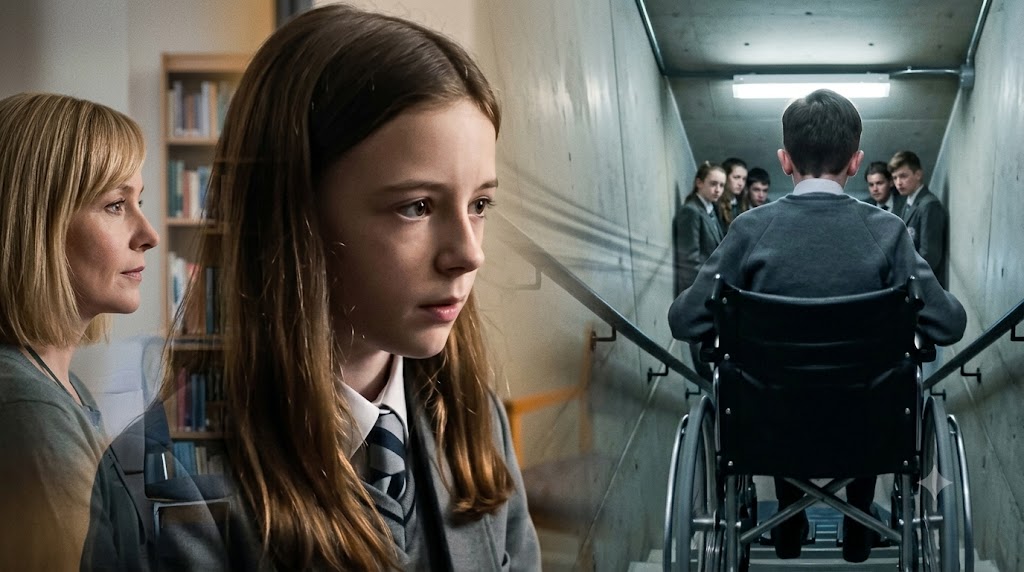
Chapter 1
By the time Hannah Reed was nine, she had already learned that adults liked simple stories.
A child who cried was hurt.
A child who stayed quiet was hiding something.
A sick child was innocent.
And if one child looked fragile enough, the other one did not have to do very much to become dangerous.
Ben Carter had bones that broke too easily.
Every teacher in the school knew it.
Children knew it too, although nobody quite understood what his condition meant. They only understood the rules surrounding him.
No rough games near Ben.
No pushing.
No running through the corridor if Ben was there.
No grabbing his arm.
No touching his wheelchair on the days he used one.
If he fell, fetch an adult.
If he said he was hurt, believe him.
Especially that last one.
Ben was small for his age but had a head that seemed slightly too large for his narrow shoulders. His hair was almost white in summer. He had the habit of watching people longer than was comfortable, as though he were studying what expression they expected from him.
Most children were kind to him.
Some were frightened of him.
Hannah was neither.
For a while, that seemed to interest him.
He began sitting beside her during lunch.
Then beside her during reading.
Then waiting for her near the gate.
Hannah did not object at first.
She did not particularly enjoy his company, but at nine she did not particularly enjoy anyone’s company for very long. Other children exhausted her. They changed rules without warning. They said things they did not mean and expected everyone else to understand.
Hannah preferred books.
Books rarely punished you for taking words literally.
One afternoon Ben followed her into the playground.
“I like you,” he said.
Hannah looked at him.
“I know.”
He frowned.
“You’re supposed to say something.”
“What?”
“Do you like me?”
“Not like that.”
Ben’s face changed.
Hannah noticed it because Hannah noticed changes.
“You don’t even know what I mean.”
“I think I do.”
“Do you want to be my girlfriend?”
“No.”
There was no cruelty in the answer.
That was simply the answer.
Ben stared at her.
“Why?”
“I don’t want a boyfriend.”
“What if it was someone else?”
“I don’t want anyone.”
This was not entirely true, though Hannah did not yet possess the language for what was true.
Sometimes she looked at the older girls waiting outside school and felt something she could not name.
Sometimes she imagined holding hands with one of them.
Never boys.
But at nine, this seemed less like an identity than another private detail, like disliking peas or sleeping with one foot outside the blanket.
Ben kicked the gravel.
“You think you’re better than me.”
Hannah frowned.
“No.”
“Because I’m disabled.”
“No.”
“That’s why.”
“No, it isn’t.”
He walked away before she finished.
Hannah assumed the conversation was over.
It was not.
The first accusation came three days later.
Ben told a teacher Hannah had threatened to knock him over.
Hannah was removed from class.
She sat outside the headteacher’s office for twenty-seven minutes.
She counted.
Twenty-seven minutes.
Inside, adults discussed whether she understood “the seriousness of what she’d done.”
When Hannah was finally allowed inside, the headteacher folded her hands on the desk.
“Ben says you told him you’d push him down.”
“I didn’t.”
“Hannah.”
“I didn’t.”
“You understand what could happen to Ben if he fell?”
“Yes.”
“So why would you say something like that?”
“I didn’t.”
The headteacher sighed.
That sigh would become familiar.
Not angry.
Worse.
Disappointed.
As though Hannah’s refusal to confess were an additional offence.
“I didn’t say it.”
“Ben has no reason to make something like this up.”
Hannah did not know how to answer that.
Because she did not know his reason either.
Not yet.
So she was punished.
Missed break.
A note home.
A lecture about empathy.
The next accusation came two weeks later.
Ben said Hannah had tried to trip him.
Three children said she had been on the opposite side of the playground.
Hannah was still punished.
Another time, he claimed she had whispered that she wished he would break his leg.
Hannah had been in the library.
It did not matter.
Adults had developed a strange arithmetic around Ben.
His vulnerability counted as evidence.
Hannah’s denials counted as defensiveness.
Witnesses counted only if they supported him.
The fact that Hannah had never been in trouble before somehow counted against her too.
“You know the rules very well,” one teacher told her.
The implication was that perhaps she had simply learned how to break them invisibly.
Hannah went home furious without knowing how to express fury.
She lined up the pencils on her desk.
Red.
Orange.
Yellow.
Green.
Blue.
Purple.
Then again.
Red.
Orange.
Yellow.
Green.
Blue.
Purple.
Her mother asked what was wrong.
“Nothing.”
It was easier.
Adults seemed to prefer that answer.
Chapter 2
The person who finally believed Hannah was a man named Mr Mercer.
He taught Year Six.
He was not especially warm.
He did not kneel beside children and speak softly.
He did not call the class “my little stars.”
He expected homework on time, hated glitter, and once confiscated a plastic recorder because a boy had played the same three notes for fifteen minutes.
Hannah liked him immediately.
His rules remained the same from Monday to Friday.
In October, Ben told MMrMercer that Hannah had cornered him beside the gym doors.
MrMrercer looked at Hannah.
Then at Ben.
“When?”
“Before lunch.”
“What time?”
Ben hesitated.
“Like twelve.”
Mr Mercer looked at the wall clock.
Then back at Ben.
“Hannah was with me.”
Silence.
Ben blinked.
Mr Mercer continued.
“She was helping sort the reading folders from eleven forty-five until twelve ten.”
Ben’s cheeks turned red.
“Maybe it was earlier.”
“How much earlier?”
“I don’t know.”
Mr Mrr leaned back against his desk.
“Then think.”
Ben said nothing.
That afternoon Mr Mrr asked Hannah to remain after class.
She stood beside her desk expecting punishment.
Instead, he said:
“How long has this been happening?”
Hannah looked at him.
“What?”
“Ben.”
Her fingers tightened around the strap of her schoolbag.
“A while.”
“How long?”
“Since Year Four.”
Mr Mer’s face changed very slightly.
“And you’ve told people?”
“Yes.”
“What did they say?”
“That he wouldn’t lie.”
Mr Mer was quiet.
Then:
“Do you know why he’s doing it?”
“No.”
That part was still true.
Mr Mer did not promise to fix everything.
Hannah would remember that.
Adults who wanted children to trust them often made promises before they had facts.
Mr MerceMrnly said:
“From now on, when something is reported, I’ll check first.”
It sounded almost insultingly small.
It changed Hannah’s life.
Mr Mercer noticed.
Where Hannah sat.
When she left class.
Who was around her.
Once, Ben reported that Hannah had threatened him in the corridor.
Mr Mercer knew Hannah had spent the entire break helping another teacher laminate worksheets.
Another time Ben claimed Hannah had shoved his chair.
Two teaching assistants had seen Hannah leave the room five minutes earlier.
Then came the afternoon when Ben accused her of whispering something cruel during assembly.
MMrMercer looked at him for a long moment.
“Ben.”
Ben shifted.
“Yes?”
“Hannah wasn’t in assembly.”
A pause.
“She was at the dentist.”
Ben’s mouth opened.
Nothing came out.
After that, the accusations stopped.
Not gradually.
Completely.
As though somebody had switched off a machine.
Hannah did not feel victorious.
She felt tired.
Years later, this would bother her more than she expected.
How easy it had been.
One adult.
One adult who checked.
That was all it had required.
Chapter 3
Secondary school should have been a clean beginning.
New building.
New uniforms.
New teachers.
Hannah hoped Ben would disappear into another group of students and become someone else’s distant acquaintance.
For almost a year, that happened.
They passed each other in corridors.
Nothing.
Ben found friends.
Hannah found places.
The library.
The art room at lunch.
A table near the back of science where nobody bumped into her chair.
She began to understand herself better too.
At thirteen, she found the word lesbian online.
She read it several times.
Something inside her settled.
Not dramatically.
There was simply one less question in the world.
Ben barely existed in her life.
Then somebody else started bullying him.
Hannah never knew exactly who.
Rumours were hiding his bag.
People were imitating the way he walked.
Someone was calling him “Alien” because of the shape of his head.
Strangely, Ben began using the nickname himself.
It appeared on his social media accounts.
He wrote it in his notebook.
He laughed when his friends said it.
Hannah understood that trick.
If you claimed the insult first, perhaps nobody else could use it properly.
But something in Ben changed.
The accusations returned.
The first arrived halfway through Year Eight.
He told staff Hannah had threatened him near the canteen.
Hannah was questioned.
Again.
She explained their history.
The deputy head frowned.
“That was primary school.”
“Yes.”
“So perhaps we shouldn’t assume it’s the same situation.”
“I’m not assuming.”
“It sounds like you are.”
“He lied before.”
“Be careful with that word.”
Hannah stared at him.
“What word?”
“Lied.”
“But he did.”
The deputy head folded his arms.
“Ben is medically vulnerable.”
Hannah almost laughed.
Years later, she would remember the absurdity of that sentence.
Not because it was false.
Because it had nothing to do with whether Ben could tell the truth.
The school treated every allegation as if the worst version might be true.
Understandably, they said.
Because if Hannah attacked Ben, the consequences could be catastrophic.
There were meetings.
Warnings.
Behaviour reports.
Discussions about suspension.
Then the word police entered the room.
Hannah sat beside her mother while a school administrator explained that future incidents might need to be “taken beyond the school.”
Hannah stopped hearing most of the conversation after that.
Police.
Court.
Arrest.
The words became enormous.
She went home and lay on her bed fully dressed.
The ceiling looked exactly as it had that morning.
This seemed offensive.
She began arranging her life around witnesses.
The library became her safest place.M rs. Patel, the librarian, knew enough of the situation to understand why Hannah suddenly spent every lunch break at the same table near the desk.
“You know you don’t have to explain why you’re here,” she once said.
Hannah looked at her.
“I need people to see me.”
Mrs Patel’s expression tightened.
“All right.”
After that, she stopped asking.
Hannah chose routes with cameras.
Stayed near teachers.
Avoided empty corridors.
Never stood within several meters of Ben.
Her life became a collection of alibis.
Chapter 4
The event that nearly ended everything happened in March.
Ben came to school with an injury.
Hannah never saw it herself.
She only learned that something had happened when a teacher removed her from mathematics.
The deputy head was waiting outside.
“Bring your bag.”
Hannah’s stomach contracted.
“What happened?”
“Just come with me.”
In the office, two staff members sat opposite her.
One had a printed statement.
The deputy head spoke first.
“Ben says you caused his injury yesterday.”
Hannah stared at him.
“No.”
“Hannah.”
“I wasn’t near him.”
“He says you were.”
“Where?”
“Near the rear stairwell.”
“I was in the library.”
“What time?”
“All lunch.”
“Are you sure?”
Hannah looked at him.
It was such a ridiculous question that she almost lost her temper.
“Ask MMrsPatel.”
They did.
MrMrsatel confirmed part of the time.
Not all.
There was a gap.
Seven minutes.
Seven minutes during which Hannah had gone to the toilet.
Nobody could account for those seven minutes.
Apparently seven minutes were enough.
Ben’s friends said they had seen Hannah nearby.
Hannah was suspended pending investigation.
This time the school spoke openly about contacting police.
At home, Hannah sat at the kitchen table while her mother made tea that neither of them drank.
“I didn’t do anything.”
“I know.”
“No, you don’t.”
Her mother looked at her.
Hannah hated herself immediately.
But the words had already arrived.
“Nobody knows. That’s the problem.”
Her mother moved the untouched mug away from the edge of the table.
“Hannah.”
“What?”
“We’ll deal with it.”
That phrase.
We’ll deal with it.
Adults loved sentences with no shape.
“How?”
Her mother had no answer.
The school arranged counselling.
Hannah resented this most of all.
Not because she objected to therapy.
She already saw a therapist she trusted.
This was different.
This felt like another institution quietly relocating the problem into Hannah’s head.
She sat in a beige room while a woman she had never met asked whether Hannah sometimes had difficulty managing anger.
Hannah stared at the clock.
“I don’t know.”
“Do you ever feel angry with Ben?”
“Yes.”
The woman wrote something down.
“Why?”
Hannah almost laughed.
Chapter 5
Ben died while Hannah was suspended.
The call came in the afternoon.
Her mother answered it.
Hannah knew immediately that something had happened because her mother sat down before speaking.
“Hannah.”
She waited.
“It’s Ben.”
The rest arrived in pieces.
A fall.
School stairs.
An ambulance.
Hospital.
Then no hospital.
Ben was dead.
Hannah sat opposite her mother.
She felt nothing at first.
Then fear.
Not grief.
Not relief.
Fear.
“Do they think I did it?”
Her mother stared at her.
“No.”
“Do they?”
“Hannah, you weren’t there.”
It took several seconds for that fact to become real.
Hannah had been at the mandatory counselling appointment.
Signed in.
Observed.
Recorded on reception cameras.
Her punishment had given her the strongest alibi she had ever possessed.
Later they learned something stranger.
Ben’s two friends had gone to staff before anyone knew the full seriousness of his fall.
They claimed Hannah had pushed him.
They expected Hannah to be blamed.
They did not yet understand Ben had died.
When they returned and discovered what had happened, both reportedly became hysterical.
That detail mattered.
It suggested something uglier and sadder than murder.
They had expected Ben to be injured.
They had expected Hannah to be accused.
They had not expected him to die.
Investigators reconstructed what they could.
There was no clean answer.
No camera captured the fall itself.
But statements contradicted one another.
Times did not match.
Hannah could not have been there.
The two boys eventually admitted they had not seen Hannah push Ben.
They had been repeating what Ben told them to say.
And slowly, painfully, the theory emerged.
Ben may have intended to create another accusation.
A worse one.
An injury serious enough that adults would stop asking for evidence.
Perhaps he believed he understood his own body.
Perhaps he thought he knew how far he could go.
Perhaps he expected bruises, a fracture, a hospital stay.
Nobody could say for certain.
Whatever he intended, the stairs made the final decision.
Hannah never liked the version people told afterwards.
They made Ben sound like some criminal mastermind destroyed by his own plan.
It was cleaner that way.
Hannah remembered a boy.
A frightened boy.
A cruel boy.
A lonely boy.
A boy who had discovered very young that being fragile gave him a kind of authority other children did not possess.
Then he had learned to spend it.
Chapter 6
Once Ben was dead, adults suddenly became excellent investigators.
That was what made Hannah angriest.
Records were pulled.
Old reports reviewed.
Teachers contacted.
Statements compared.
Someone found Mr Mercer.
He remembered everything.
He explained the pattern from primary school.
The accusations.
The false timings.
The incidents Hannah could not possibly have committed.
His notes still existed.
Within weeks, the story that had followed Hannah for years came apart.
Not slowly.
Not ambiguously.
Quickly.
Almost embarrassingly quickly.
A senior teacher called Hannah and her mother into an office.
Hannah recognised three people there.
All had punished her at some point.
The deputy head spoke carefully.
“We owe you an apology.”
Hannah said nothing.
“We should have reviewed the earlier history more thoroughly.”
Nothing.
“We treated allegations as facts.”
Hannah looked at him.
He stopped.
Another teacher said:
“We were trying to protect Ben.”
Hannah finally spoke.
“From me.”
The woman looked down.
“We believed there was a risk.”
“Because he said there was.”
Silence.
The deputy head folded his hands.
“We made mistakes.”
Hannah stared at those hands.
She remembered sitting across from them months earlier.
Police.
Expulsion.
Consequences.
Now the same fingers rested quietly on a desk while adults explained that mistakes had been made.
“Are the reports being removed?”
“Yes.”
“All of them?”
“Yes.”
“Will it say they were false?”
The deputy head hesitated.
“We can note that they were unsubstantiated.”
Hannah looked at her mother.
Her mother looked back.
Hannah returned her eyes to the administrator.
“They weren’t unsubstantiated.”
A pause.
“They were false.”
Nobody corrected her.
Chapter 7
The school changed its opinion of Ben with disturbing speed.
For years he had been fragile.
Sweet.
Troubled.
Vulnerable.
Then suddenly he was manipulative.
A liar.
A freak.
The same students who had once defended him now repeated stories about him in corridors.
His old nickname returned without affection.
Alien.
Hannah hated that too.
She did not defend Ben.
But she did not join in.
When somebody said he deserved what happened, Hannah walked away.
When a girl asked if Hannah was happy he was dead, Hannah stared at her until the girl became uncomfortable.
“No.”
“But after everything he did?”
“No.”
People found this difficult to understand.
They wanted Hannah to choose.
Victim or villain.
Grief or satisfaction.
Forgiveness or hatred.
Hannah had already spent years trapped inside other people’s simple stories.
She had no intention of joining another.
She knew things about Ben most people did not.
They had attended the same church for a while.
She had seen him after his mother remarried.
Five older step-siblings filling pews, kitchens, car seats.
Ben, once an only child, suddenly the smallest object in a crowded family.
His mother often walked beside her new husband, their hands linked.
Ben followed on the other side.
Sometimes several steps behind.
Hannah had noticed because Hannah noticed things.
She remembered thinking, even then, that Ben looked like someone who had been moved from the centre of a photograph to its edge.
None of this excused him.
Hannah understood that distinction.
Understanding was not forgiveness.
Pain did not automatically make people gentle.
Sometimes pain taught people where to press on somebody else’s bruise.
Ben had been born into a body that could betray him with one bad fall.
Adults watched him constantly.
Children treated him differently.
He could not control his bones.
Could not control other children.
Could not control his mother’s new marriage.
Could not control the attention that moved away from him.
But he could control one thing.
A sentence.
She threatened me.
She pushed me.
She said she would hurt me.
And adults moved.
Teachers called meetings.
Parents became frightened.
Hannah was removed from classrooms.
The world rearranged itself around his words.
It must have felt extraordinary.
Maybe that was the tragedy.
Not that Ben had power.
That nobody taught him what power was for.
Chapter 8
Years passed.
The anniversary remained.
Every spring somebody remembered.
A former student posted something online.
A teacher mentioned “the incident.”
Someone who barely knew either of them retold the story incorrectly.
Hannah stopped correcting people.
She became an adult.
Went to university.
Came out properly.
Found friends who understood that silence was not hostility and directness was not cruelty.
For a while she still chose seats where cameras could see her.
She did it without thinking.
Restaurants.
Libraries.
Train stations.
Anywhere with people around.
Witnesses.
The habit faded slowly.
One afternoon, years later, Hannah ran into Mr Mercer in a supermarket.
He was older.
More grey.
Still looked mildly irritated by the existence of unnecessary noise.
He recognised her first.
“Hannah?”
She smiled.
“Hi.”
They stood beside shelves of pasta sauce.
An absurd place for history.
Mr Mercer asked what she was doing now.
She told him.
He nodded.
Then came a silence.
Hannah knew what was inside it.
He did too.
Eventually he said:
“I heard what happened.”
“Yeah.”
“I’m sorry.”
She looked at him.
“You didn’t do it.”
“No.”
He adjusted the basket in his hand.
“But I knew there was a problem. I thought stopping it in my classroom was enough.”
Hannah had never considered that.
Mr Mercer looked down.
“I should’ve written more. Called someone. Made sure the next school knew.”
She wanted to tell him it wasn’t his responsibility.
Part of her believed that.
Another part did not.
So she said:
“You were the first adult who checked.”
MMrMercer gave a small nod.
It did not absolve him.
It did not condemn him.
It was simply true.
Before leaving, he asked:
“Do you ever think about Ben?”
Hannah looked past him toward a mother trying to persuade a toddler to put a cereal box back on the shelf.
“Sometimes.”
“Are you angry?”
She considered the question.
“Not the way I used to be.”
Mr Mercer waited.
Hannah had spent years thinking the worst thing Ben had stolen from her was safety.
It wasn’t.
It was something smaller and more persistent.
For a long time, whenever somebody believed her immediately, she distrusted them.
Whenever somebody apologised, she searched for what they wanted.
Whenever someone said, I know you wouldn’t do that, a part of her wondered how they could know.
Ben had taught her that being known and being believed were not the same thing.
Adults had taught her something worse.
Sometimes people did not reject the truth because there wasn’t enough evidence.
Sometimes they rejected it because another version was easier to live with.
Hannah looked back at Mr Mercer.
“I think he was a kid who found one thing he could control.”
MMrMercer said nothing.
“And he used it badly.”
“That’s generous.”
“No.”
Hannah shook her head.
“It’s just what happened.”
They said goodbye.
Hannah continued shopping.
At the end of the aisle, she realised he had forgotten the one thing she had actually come to buy.
She stood there for a moment, trying to remember.
Then laughed.
Quietly.
Ordinarily.
The kind of laugh nobody had to interpret.
Ben had been dead for years.
The accusations were gone.
The reports had been corrected.
The adults had apologised.
None of those things returned the childhood Hannah had spent documenting her own innocence.
There was no punishment for that.
No form to reverse it.
No meeting where somebody could hand those years back.
But there was one thing Hannah no longer did.
She no longer arranged her life so somebody else could testify that she had been there.
She picked up her shopping basket and walked toward the next aisle alone.
Nobody was watching.
For once, that felt safe.

















