At six thirty every morning, before the buses began filling the avenue outside their flat, Lena Kovács could hear her mother moving around the kitchen.
The sounds were always the same. A cupboard door opened too hard. A spoon struck the side of a mug. The kettle clicked off. Then came the scrape of a chair and the short silence in which her mother drank coffee standing up because sitting down, she often said, made her feel as if the day had already won.
They lived in a two-bedroom apartment in the eastern part of Vienna, on the fourth floor of a building that had once been built for families larger than theirs. Lena’s room faced the courtyard. Her mother’s faced the street.
The walls were thin enough that Lena could tell what kind of morning it would be from the way her mother closed the bathroom door.
On good mornings, it clicked.
On bad ones, it hit the frame.
That Tuesday, it hit.
Lena stayed beneath the blanket for another thirty seconds.
She had slept badly. Again.
At school, she had a mathematics test she had not finished studying for, a presentation in English that she had practised three times and still hated, and physical education, which had become the part of the week she dreaded most.
Her alarm vibrated on the floor beside the bed.
She turned it off.
Then it vibrated again.
She had accidentally set two alarms.
“Lena.”
Her mother’s voice came through the door.
“I’m awake.”
“You said that yesterday.”
“I’m getting up.”
“You said that yesterday too.”
Lena closed her eyes.
“Okay.”
The door opened before she could sit up.
Marta stood there already dressed for work, hair tied back, dark circles under her eyes. She was forty-one and worked six days a week managing the front desk of a private dental clinic near the city centre. Three evenings a week she also cleaned two offices after closing because the salary from the clinic did not cover rent, groceries, electricity and the loan she had taken years earlier after Lena’s father left.
She was not an affectionate-looking woman, though photographs from Lena’s childhood suggested she once had been.
In those pictures, Marta smiled widely.
Now, smiling seemed to require a reason.
“You’re going to miss the tram.”
“I know.”
“Then why are you still in bed?”
“I’m getting up.”
Marta looked at the clothes on the chair.
“You’re wearing that?”
Lena followed her eyes.
Jeans. Black sweater. Nothing unusual.
“What’s wrong with it?”
“Nothing.”
That meant something was wrong with it.
“What?”
“I said nothing.”
“Mum.”
“You’re fifteen. You should be able to choose your own clothes.”
“Then why did you ask?”
Marta exhaled.
“I don’t have time for this.”
She left.
Lena sat on the edge of the bed and stared at the sweater.
Then she changed it.
She chose a grey one instead.
Marta had raised Lena alone since Lena was four.
That was the sentence people used when they wanted to compliment her.
She raised her alone.
As though the achievement existed separately from the cost.
Lena’s father had not disappeared entirely. He sent birthday messages most years, occasionally transferred money, once took Lena to Budapest for a weekend when she was eleven and spent half the trip answering calls from his new wife.
Marta never stopped him from calling.
She simply made every call feel like a betrayal.
“So he remembers he has a daughter now?”
Or:
“That’s nice. Maybe ask him whether he remembers your shoe size.”
When Lena was younger, she defended him.
Then she defended Marta.
By fifteen, she had stopped defending either of them.
It was easier to say nothing.
Marta interpreted silence as agreement.
At school, Lena had three people she spoke to regularly.
One of them was actually her friend.
Her name was Amelie, and she sat behind Lena in history and had known her since they were nine.
The other two were girls named Julia and Maren who included Lena when it was convenient and excluded her when someone more interesting was available.
Lena understood this arrangement.
She accepted it because understanding something did not always make changing it easier.
The problem that year was a boy called Lukas Steiner.
Lukas was not particularly cruel on his own.
He became cruel when other people were watching.
He had discovered in September that Lena hated photographs.
By October, this had become entertainment.
“Lena.”
She heard him before she saw him.
She was standing at her locker.
“Don’t.”
“I didn’t do anything.”
“You’re holding your phone.”
“So?”
“Put it down.”
He grinned.
Two boys stood behind him.
One girl nearby pretended not to listen.
Lukas raised the phone.
Lena turned her face.
“Oh, come on.”
“Stop.”
“Why?”
“Because I said stop.”
“You’re acting like I’m taking passport photos.”
The boys laughed.
Lena closed her locker.
Lukas looked at the screen.
“Actually, wait.”
“Delete it.”
“It’s not even bad.”
“Delete it.”
“Relax.”
“Lukas.”
He showed the photo to one of the boys.
The boy laughed.
Lena felt heat rise into her face.
“What?”
Lukas turned the screen toward her.
He had taken the photograph from slightly below, catching her halfway through turning. Her chin looked larger. Her eyes were narrowed. A strand of hair stuck strangely against her cheek.
Someone said:
“You look like you’re about to bite someone.”
The boys laughed again.
Lena snatched for the phone.
Lukas moved it away.
“Seriously?”
“Delete it.”
“Why do you care so much?”
“Because it’s me.”
“It’s just a picture.”
“Then delete it.”
Amelie appeared at the end of the corridor.
“Give it a rest, Lukas.”
He looked at her.
“Nobody asked you.”
“No, but everybody’s bored.”
That worked better than outrage.
Lukas rolled his eyes and deleted the photo.
At least he said he did.
Lena did not trust him enough to ask to see the deleted folder.
When she and Amelie walked away, Amelie said:
“You should tell someone.”
“No.”
“Why?”
“Because then it becomes a thing.”
“It already is a thing.”
“No. Right now it’s just stupid.”
Amelie looked at her.
“He does it every week.”
“I know.”
“So?”
“So what?”
“You hate going to PE because of him.”
“That’s not why.”
It was partly why.
PE required changing in the locker room.
The locker room meant comments.
Sometimes not even comments about Lena.
That was worse in a strange way.
Girls discussing thighs, skin, stomachs, hair, breasts, acne, weight. Ranking themselves while pretending not to rank everyone else.
Lena had started changing in a bathroom stall.
One afternoon, Julia noticed.
“Why do you always hide?”
“I don’t.”
“You literally go into the toilet.”
“I like privacy.”
“It’s a locker room.”
“I know.”
Julia shrugged.
“Whatever.”
But Maren looked at Lena’s body when she said it.
Not obviously.
Long enough.
That night Lena stood in front of the bathroom mirror after showering and tried to see herself as other people saw her.
She could not.
She only saw pieces.
Her nose.
Her shoulders.
The dark mark on her left cheek from an old childhood fall.
Her stomach.
Her hair, which was thick and wavy and impossible on humid days.
She looked like herself.
That should have been enough.
It was not.
Marta came home after ten most nights.
Lena usually heard the key turning while she was doing homework at the kitchen table.
There was a ritual.
Marta entered.
Dropped her handbag on the chair.
Looked at the sink.
Looked at Lena.
Asked:
“What did you eat?”
Then:
“Did you study?”
Then:
“Why is this here?”
The object changed.
A cup.
A plate.
Shoes by the radiator.
Mail left on the counter.
A jacket.
Sometimes nothing was actually wrong.
Marta simply needed to identify something.
Lena had learned this gradually.
Her mother returned from work exhausted and angry at people who could not be shouted at.
The dentist who changed appointment times and blamed reception.
Patients who arrived late and demanded to be seen.
The clinic owner who cut staff hours but expected the same workload.
The man at the second office who left food containers on his desk after the cleaners arrived.
Lena knew all these people without ever meeting them.
Marta talked about them every evening.
At first Lena listened.
Then she started offering advice.
That was a mistake.
“I don’t need advice from a fifteen-year-old.”
So Lena stopped.
Then Marta accused her of not caring.
“You don’t even ask how my day was.”
When Lena started asking, Marta said:
“You can see how my day was.”
There was no correct version.
That was the part Lena found most exhausting.
Not the anger.
The rules changing.
At school, Lena’s grades slipped slowly enough that nobody noticed until they arrived on paper.
A 3 in mathematics.
A 4 in chemistry.
Another 4 in German.
In the Austrian grading system, where 1 was excellent and 5 meant failing, the marks were not catastrophic.
But they were worse than Lena’s usual grades.
She knew before bringing the report home that Marta would react badly.
She considered forging her signature.
Only briefly.
Instead she left the paper folded in the bottom of her backpack for two days.
The school sent an automated email.
Marta found out before Lena said anything.
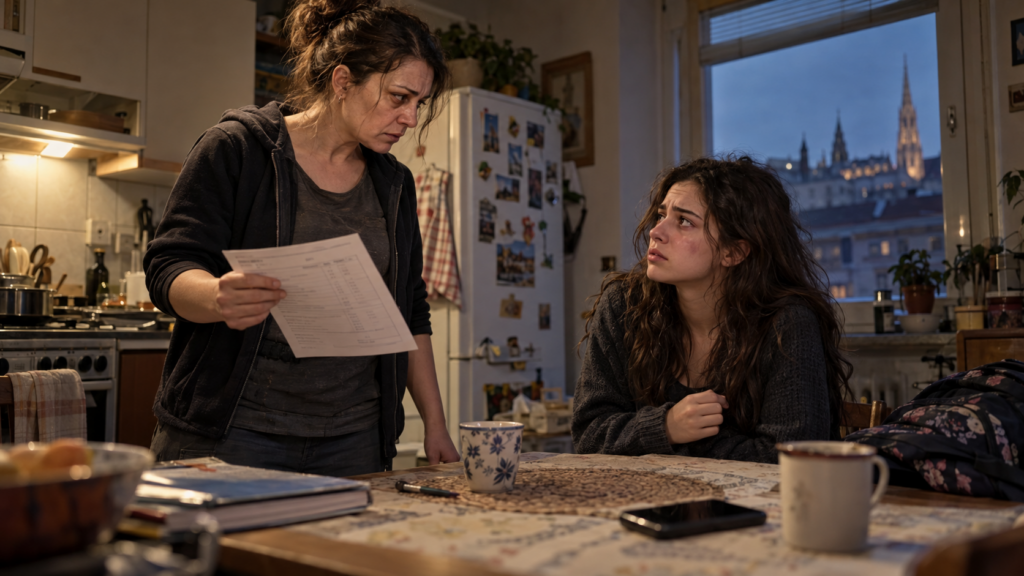
That Friday, when Lena came home, the report was already on the table.
Marta stood beside it.
Her coat was still on.
“You were going to tell me?”
Lena stopped in the doorway.
“Yes.”
“When?”
“I don’t know.”
“That means no.”
“I was.”
“Sit.”
Lena put her backpack down.
“I have homework.”
“Sit.”
She sat.
Marta picked up the report.
“What is this?”
“My grades.”
“Don’t be clever.”
“I’m not.”
“A four in chemistry.”
“I know.”
“You had a two last year.”
“I know.”
“And mathematics?”
“I know.”
“Apparently you know everything.”
Lena stared at the table.
Marta waited.
“Well?”
“What do you want me to say?”
“Explain it.”
“I’m trying.”
“At what?”
“School.”
Marta laughed once.
Not kindly.
“You’re trying?”
Lena looked up.
“Yes.”
“When?”
“Mum.”
“I’m asking.”
“I study.”
“I come home and you’re on your phone.”
“I’m not always on my phone.”
“Every time I see you.”
“You’re barely home.”
The sentence came out before Lena could stop it.
Marta went still.
“What?”
Lena immediately looked away.
“I didn’t mean-”
“No. Say it again.”
“I said you’re not home much.”
“Because I work.”
“I know.”
“For you.”
“I know.”
“You think I enjoy cleaning offices until ten at night?”
“I didn’t say that.”
“You think I want to spend my life serving people who talk to me like I’m stupid?”
“Mum, I didn’t-”
“And while I’m doing that, this is what you bring home?”
She held up the report.
Lena’s face became hot.
“Can you stop?”
“Stop what?”
“Talking like that.”
“Like what?”
“Like I’m doing this to you.”
Marta stared.
“You are fifteen.”
“I know.”
“You have one responsibility.”
“That’s not true.”
“What responsibility do you have?”
“School is not just-”
“Oh, please.”
Lena looked at her.
Marta put the report on the table.
“No, seriously. What is so difficult?”
Lena said nothing.
“Your food is here. Your clothes are here. You have a room. You go to school. You come home. What exactly is so hard?”
Lena’s hands had started shaking.
She put them under the table.
“I’m going through a lot right now, okay?”
Marta’s face changed immediately.
Not concern.
Disbelief.
“Oh, please, Lena.”
Lena swallowed.
“You’re just a fifteen-year-old child. Your life is not that difficult.”
Lena stared at her.
Marta lifted the report again.
“And what are you even doing in school all day? Are you trying at all?”
For several seconds, Lena could not answer.
There were too many answers.
Trying not to be photographed in hallways.
Trying not to cry in the bathroom.
Trying to finish homework after listening to Marta complain until eleven.
Trying to decide whether eating lunch made her look greedy.
Trying not to care when Maren asked whether she had ever considered straightening her hair.
Trying not to look at herself in reflective windows.
Trying not to hate coming home.
None of those sounded like responsibilities when she imagined saying them aloud.
So she said:
“Yes.”
Marta scoffed.
“That report says otherwise.”
Something in Lena gave way.
“You don’t know anything.”
Marta stared.
“Excuse me?”
“You don’t know anything about what happens at school.”
“Because you don’t tell me.”
“I try.”
“When?”
“Whenever I tell you something, you make it about you.”
Marta stood up straighter.
“That is not true.”
“It is.”
“Give me one example.”
Lena laughed.
It came out wrong.
“You literally just did it.”
Marta’s voice sharpened.
“Do not speak to me like that.”
“You asked!”
“I am your mother.”
“That doesn’t mean you’re always right.”
Marta slapped the report onto the table.
“I work myself sick for you.”
“There.”
“What?”
“That.”
“What about it?”
“You always say that.”
“Because it’s true.”
“I didn’t ask you to work two jobs.”
The moment Lena said it, she wished she could take it back.
Marta’s face changed.
Not dramatically.
That was worse.
For a second she looked genuinely hurt.
Then the hurt hardened.
“No.”
She nodded.
“You didn’t ask.”
“Mum-”
“No, you’re right.”
“I didn’t mean-”
“You didn’t ask to be fed. You didn’t ask for rent. You didn’t ask for electricity.”
“That’s not what I meant.”
“I know exactly what you meant.”
“You don’t.”
Marta picked up her handbag.
“I cannot talk to you when you behave like this.”
Lena stared.
“You started this.”
Marta turned.
“Go to your room.”
“I’m not five.”
“Then stop acting like it.”
Lena stood.
Marta pointed toward the hallway.
“Now.”
For one second, Lena considered refusing.
Then she picked up her backpack and went.
Her mother called after her:
“And give me your phone.”
Lena stopped.
“No.”
“Lena.”
“I need it for school.”
“You had it for school. Look how well that went.”
Lena turned.
Marta held out her hand.
Lena looked at it.
Then took the phone from her pocket and placed it on the table.
Harder than necessary.
Marta flinched.
“Don’t slam things.”
“I didn’t.”
“You did.”
“Fine.”
“Don’t say fine like that.”
Lena laughed in disbelief.
“What way am I allowed to say it?”
Marta’s mouth tightened.
Lena walked away before another answer came.
For the next three days, they barely spoke.
Marta called it peace.
Lena experienced it as surveillance without conversation.
Her phone remained in Marta’s bedroom.
At school, Amelie noticed immediately.
“You disappeared.”
“My mum took my phone.”
“For what?”
“Grades.”
“That’s insane.”
“It’s not insane.”
“It’s a little insane.”
Lena shrugged.
Amelie studied her.
“What happened?”
“Nothing.”
“Lena.”
“Nothing.”
Amelie let it go.
That was why Lena trusted her.
Amelie knew when not to demand things.
The bullying became worse the following week because Lukas found a different route.
Someone made a private group chat.
Lena was not in it.
Amelie was.
She refused to show Lena at first.
Then Lena insisted.
The chat contained a photograph from PE.
Not nude.
Not even particularly revealing.
Lena was standing near a bench in her sports shirt, reaching down to tie her shoe.
Someone had zoomed in on her face.
Underneath, Lukas had written:
WHY DOES SHE ALWAYS LOOK LIKE SHE’S PERSONALLY OFFENDED BY OXYGEN
There were laughing reactions.
Then Julia:
stoppp
Then Maren:
she always looks like that 😭
Lena stared.
Amelie took the phone back.
“I’m reporting it.”
“No.”
“Yes.”
“No.”
“He took that in the locker room.”
“It’s not actually in the locker room. It’s by the gym.”
“That doesn’t matter.”
“It does.”
“Why are you defending him?”
“I’m not.”
“Then why won’t you let me report it?”
“Because everyone will know.”
“They already know.”
“No. They know he made a joke. If teachers get involved, then I’m the girl who couldn’t handle a joke.”
Amelie stared.
“So?”
“So I have to stay here for three more years.”
“You don’t have to let them do this for three more years.”
Lena looked away.
“Can we not?”
Amelie sighed.
“Okay.”
But she saved screenshots.
The person who eventually noticed Lena was not a teacher she liked.
It was Herr Baumann, her mathematics teacher.
He was fifty-something, impatient, disorganised, and wore the same brown cardigan so often that students joked it must be part of his contract.
Lena had always assumed he barely knew she existed.
After class one day, he said:
“Lena. Stay a moment.”
Her stomach dropped.
She stood beside his desk.
He handed her test back.
A 4.
“I know,” she said.
He looked at her.
“I haven’t said anything.”
“Sorry.”
“You used to be good at this.”
There it was again.
Used to be.
“My grades are just bad right now.”
“That is an observation, not an explanation.”
Lena stared at the floor.
He waited.
She hated adults who waited.
“What?”
“You tell me.”
“I don’t know.”
“Are you sleeping?”
She looked up.
“What?”
“You look tired.”
“I’m fine.”
He nodded.
“Is there something happening at home?”
“No.”
“At school?”
“No.”
He waited again.
Lena folded the test.
Herr Baumann said:
“You don’t have to tell me.”
“Okay.”
“But I’m going to ask Frau Keller to check in with you.”
Lena’s head snapped up.
“No.”
“She’s the school counsellor.”
“I know who she is.”
“You’re not in trouble.”
“I don’t need a counsellor.”
“That may be true.”
“Then don’t.”
He looked at her.
“I’m still going to.”
Lena hated him for almost a week.
Later she would understand why.
Frau Keller did not ask Lena whether she was sad.
That helped.
She asked practical questions.
How much sleep?
Six hours.
Sometimes five.
Breakfast?
Usually.
Friends?
One.
Home?
Fine.
Bullying?
No.
“Are you sure?”
“Yes.”
“Do you like school?”
“No.”
“That’s honest.”
Lena shrugged.
Frau Keller leaned back.
“Do you want to tell me what happened?”
“Nothing happened.”
“Something doesn’t have to happen all at once.”
Lena looked at her.
That sentence stayed.
Something doesn’t have to happen all at once.
She thought about home.
About school.
About how none of it was catastrophic by itself.
A joke.
A comment.
A bad grade.
A tired mother.
A photograph.
Another comment.
A slammed door.
A report card.
Nothing large enough to justify feeling the way she did.
But perhaps size was not the only measure.
The school contacted Marta.
That went badly.
Marta arrived furious.
Not at Lena.
At first.
“They think there is something wrong in my home?”
Lena sat on the sofa.
“They didn’t say that.”
“They called me in the middle of work.”
“I didn’t tell them to.”
“So what did you tell them?”
“Nothing.”
“Then why are they calling?”
“Because my grades dropped.”
“I already know that.”
“They think I’m stressed.”
Marta laughed.
“Everyone is stressed.”
Lena said nothing.
Marta paced.
“You think I’m not stressed?”
There it was again.
Lena looked down.
Marta noticed.
“What?”
“Nothing.”
“No. That face.”
“What face?”
“The face you make when you think I’m horrible.”
“I don’t think you’re horrible.”
“Then what?”
Lena hesitated.
Marta crossed her arms.
“Say it.”
“You don’t listen.”
Marta stared.
“I don’t listen?”
“No.”
“To you?”
“Yes.”
“That is unbelievable.”
Lena stood.
“See?”
“See what?”
“You asked and now you’re angry.”
“I’m angry because it isn’t true.”
“Then why ask?”
Marta opened her mouth.
Closed it.
Lena had never seen her do that before.
For several seconds, neither spoke.
Then Marta said:
“I have given you everything.”
Lena’s shoulders dropped.
“I know.”
“You say that like it means nothing.”
“It doesn’t mean you know me.”
The words landed differently.
Marta sat down.
Not because she was calm.
Because something had left her legs.
Lena stayed standing.
Marta looked toward the window.
“I know you.”
“You know what food I hate.”
Marta looked at her.
“You know what time my school starts. You know my shoe size. You know I used to like drawing.”
“You still draw.”
“No.”
“Yes, you do.”
“When?”
Marta said nothing.
Lena felt cruel.
She almost stopped.
Then she thought of the report card.
“Do you know why I hate PE?”
Marta looked at her.
“No.”
“Do you know Lukas Steiner?”
“No.”
“Do you know people take pictures of me at school?”
Marta’s face changed.
“What?”
“Do you know they send them around?”
“Who?”
“It doesn’t matter.”
“It does matter.”
“Not now.”
“Of course it matters.”
“You asked what you don’t know.”
Marta stood again.
“Why didn’t you tell me?”
Lena laughed.
Not because it was funny.
“I did.”
“When?”
“Last month I told you boys were making comments.”
“You said boys were annoying you.”
“I said they were taking pictures.”
“No, you didn’t.”
“Yes, I did.”
Marta shook her head.
“I would remember.”
Lena looked at her.
“That’s the problem.”
Marta stopped.
For once, she had no defence ready.
Marta did not become a different mother after that conversation.
That would have been easier.
She still overreacted.
Still made complaints about work into family weather.
Still interpreted criticism as ingratitude.
But something shifted.
Small enough that Lena did not trust it initially.
The next morning Marta returned her phone.
“I’m not saying the grades are fine.”
“I know.”
“And we’re still dealing with them.”
“Okay.”
“But taking this was stupid.”
Lena looked at her.
Marta immediately added:
“Not stupid. I mean… ineffective.”
“That’s basically the same thing.”
“Yes.”
A pause.
Then Marta said:
“Can you show me what they sent?”
Lena’s stomach tightened.
“No.”
Marta nodded too quickly.
“All right.”
Lena expected another demand.
It did not come.
That mattered.
With Amelie’s help, Lena showed the screenshots to Frau Keller.
The school did not turn it into a public spectacle.
That had been Lena’s biggest fear.
Lukas was called in privately.
Then his parents.
Then two other students.
The school required the images to be deleted and issued disciplinary consequences.
It did not transform the social order.
Lukas did not apologise sincerely.
He said:
“I didn’t know you were that upset.”
Lena stared at him.
“You knew I asked you to stop.”
“That’s not the same.”
“It is.”
He looked irritated.
“I said sorry.”
“You said you didn’t know.”
“Fine. Sorry.”
She nodded.
They never became friends.
They did not need to.
The photos stopped.
The comments mostly did too.
Maren avoided Lena for a month.
Julia eventually sat beside her in German as if nothing had happened.
Lena let her.
Not every betrayal required a confrontation.
Sometimes distance was enough.
Marta agreed to attend two sessions with Frau Keller.
The first was a disaster.
Marta spent twenty minutes explaining how hard she worked.
Lena stared at the carpet.
Frau Keller finally said:
“I believe you.”
Marta stopped.
“That isn’t the question.”
“What is?”
“Whether Lena is allowed to struggle even though you struggle more.”
Marta’s face hardened.
“I never said she isn’t allowed.”
Lena looked up.
Marta saw.
“Don’t.”
“Don’t what?”
“Look at me like that.”
Frau Keller intervened.
“What does that look mean to you?”
Marta laughed nervously.
“Like I’m the villain.”
Lena said:
“I don’t think you’re a villain.”
Marta looked at her.
“Then what do you think?”
Lena hesitated.
“Tired.”
Marta’s expression changed.
“And angry.”
Marta looked down.
“And sometimes you make me feel like I’m one more job you hate.”
The room went quiet.
Marta’s eyes filled.
She turned away immediately.
Lena almost apologised.
Frau Keller did not let her.
She simply waited.
Marta wiped under one eye.
“I don’t hate you.”
“I know.”
“I don’t.”
“I know.”
“I worked because I had to.”
“I know.”
Marta’s voice sharpened again.
“So what was I supposed to do?”
Lena flinched.
Frau Keller said:
“That is a different question.”
Marta looked at her.
“You can have had no good options and still have hurt your daughter.”
Marta stared at the floor.
That was the hardest thing she heard all year.
She did not accept it immediately.
But she came back the following week.
Lena’s grades improved slowly.
Not dramatically.
A 3 became a 2.
Another 4 became a 3.
Chemistry stayed terrible.
Marta tried not to comment every time.
Sometimes she failed.
“You studied for this?”
“Mum.”
“Sorry.”
“You literally promised.”
“I know.”
“Then stop.”
Marta pressed her lips together.
“Okay.”
It became almost funny eventually.
Not because the problem vanished.
Because they both started noticing it.
Marta began therapy through a subsidised counselling program connected to her clinic.
She complained about the therapist after every session.
“She asks ridiculous questions.”
“Like what?”
“How I feel when people disagree with me.”
Lena looked at her.
“And?”
Marta glared.
“Don’t enjoy this.”
Lena laughed.
For the first time in months, Marta laughed too.
The larger changes took longer.
Marta reduced the office-cleaning shifts from three nights to two after negotiating a slightly higher wage at the clinic.
It meant money became tighter.
They stopped ordering food entirely.
Lena started tutoring a twelve-year-old neighbour in English for a little spending money.
Marta initially objected.
“You need to focus on your own school.”
“It’s two hours a week.”
“You’ll be tired.”
“I’m already tired.”
Marta opened her mouth.
Then stopped.
“All right.”
That was new too.
______
One evening in early summer, Lena brought home another report.
Marta was at the kitchen table.
She looked at it.
Mathematics: 2.
German: 2.
Chemistry: 3.
English: 1.
She smiled.
Then caught herself.
Lena noticed.
“You can say something.”
Marta looked suspicious.
“Are you sure?”
“Yes.”
“I’m proud of you.”
Lena nodded.
“Thanks.”
Marta touched the paper.
“You worked hard.”
Lena looked at her.
There was an old version of the conversation waiting between them.
You finally tried.
See what happens when you apply yourself.
I knew you could do better.
Marta seemed to hear those sentences too.
She did not say them.
Instead she asked:
“How are things at school?”
Lena almost gave the usual answer.
Fine.
She had become very good at it.
But that afternoon Julia had made a joke about her hair.
Not cruel.
Not harmless either.
Lena had laughed in the moment.
She still did not know whether that had been cowardice or practicality.
She sat down.
“Kind of weird.”
Marta waited.
Lena looked at her.
“Don’t fix it.”
“I didn’t say anything.”
“I know. I’m warning you.”
Marta smiled faintly.
“All right.”
Lena began telling her.
Not everything.
Enough.
Marta interrupted twice.
The first time, Lena looked at her.
Marta stopped.
The second time, she apologised.
It was not miraculous.
It was uncomfortable.
Ordinary.
Better.
Later that night, Lena passed the kitchen on the way to bed and saw Marta still sitting there with the report card.
For a moment Lena thought she was checking the grades again.
Then she noticed the older paper underneath it.
The one with the 4s.
Marta had kept it.
She was looking at both.
Lena leaned against the doorway.
“What are you doing?”
Marta glanced up.
“Nothing.”
“That’s clearly something.”
Marta touched the older report.
“I was awful that night.”
Lena said nothing.
Her mother rarely apologised directly.
Usually she bought something.
Made extra breakfast.
Asked whether Lena needed money.
This time she looked embarrassed.
“I thought if your life was easier than mine, then you didn’t have the right to be unhappy.”
Lena looked at her.
Marta continued carefully.
“That was… not fair.”
“No.”
“I know.”
A pause.
Then:
“I’m sorry.”
Lena did not rush to say it was okay.
It had not been okay.
Marta seemed to understand that.
She folded the old report.
“Are you going to bed?”
“Yeah.”
“Good night.”
“Night.”
Lena turned toward the hall.
Then stopped.
“Mum?”
“Yes?”
“I know you worked hard.”
Marta looked at her.
Lena added:
“That doesn’t mean I wasn’t having a hard time too.”
Marta nodded.
“I know.”
This time, Lena believed she was trying to.

















