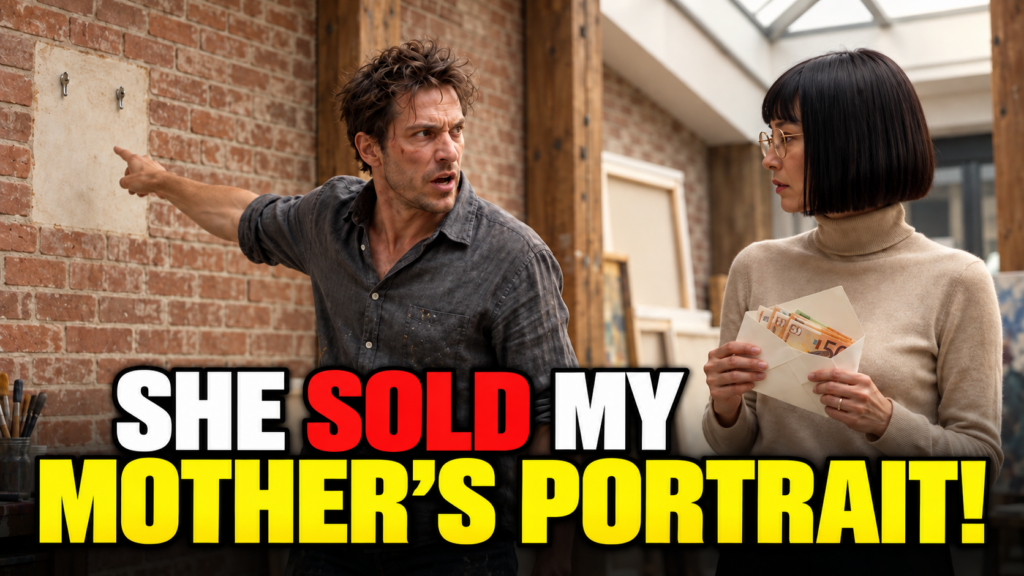
The empty space on the wall frightened me more than a broken window would have.
A thief would have left damage. A thief would have scattered brushes, overturned a chair, forced the lock.
Whoever had taken my painting had straightened the easel beneath it and swept the dust into a neat pile beside the door.
They had treated the disappearance like ordinary housekeeping.
I stood in the middle of my Paris studio with paint drying between my fingers, staring at the pale rectangle on the brick wall. For seven months, that painting had been the first thing I saw each morning.
Now there were only two hooks and a clean patch where the afternoon light had never reached.
Behind me, Claire set her leather bag on the worktable.
She did not ask what was wrong.
That was how I knew she already knew.
I pointed at the wall.
“Where is it?”
She adjusted her gold rimmed glasses and looked past me, toward the skylight.
“We should discuss this calmly, Julien.”
I was thirty two. Claire was thirty eight. For nearly three years, I had allowed her to speak to me as though those six years represented an entire lifetime of wisdom I lacked.
She knew galleries, collectors, the correct names to mention at dinners.
I knew how to make a face appear alive under layers of oil.
“Between us,” she used to say, “we have everything necessary.”
That afternoon, she opened her bag and took out an envelope.
The paper was thick and cream colored. Through its unsealed edge, I could see banknotes.
“Your share,” she said.
I looked from the envelope to the empty wall.
“You sold it?”
She held out the money.
“A serious offer came in. There was no time to hesitate.”
My mother had been dead for eleven months.
The painting was the last portrait I had made of her.
Claire knew that.
She knew why I had refused to put a price beside it. She knew why, whenever someone admired it, I thanked them and turned their attention toward something else.
Yet she stood in my studio holding cash as though grief were a transaction she had completed efficiently.
I knocked the envelope from her hand.
Notes slid across the table and fell among the paint tubes.
She said my name sharply.
I stepped forward and slapped her.
Her glasses twisted sideways. She stumbled back against a wooden easel, caught herself, and stared at me.
The sound seemed to remain in the room after my hand had fallen.
I wanted to tell you this differently.
I wanted the story to begin with a man who stayed composed, gathered evidence, and spoke with perfect restraint.
Instead, it began with an act I had no right to commit.
What she had done did not excuse what I had done. I knew that even before she touched her cheek.
I stepped away.
“I should not have hit you,” I said.
My voice sounded unfamiliar.
Claire straightened her glasses with trembling fingers. For the first time since entering, she looked directly at me.
“You have just destroyed any chance of handling this professionally.”
Perhaps I had.
But the painting was still gone.
“Tell me where it is.”
She picked up her bag.
“I will speak to you when you are capable of behaving like an adult.”
Then she left me with scattered money and an empty wall.
I did not follow her.
I locked the door, sat on the floor, and stared at my hand until evening swallowed the studio.
The portrait was called The Light She Kept.
It showed my mother seated at our old kitchen table, holding a chipped blue cup.
There was nothing grand about it. No dramatic landscape, no expensive clothing, no symbolic arrangement that required an explanation.
Behind her, the kitchen window reflected a narrow strip of morning sky. Her left sleeve was pushed above her wrist.
Her eyes were turned toward someone just outside the painting.
Toward me.
When I was a child, she cleaned offices before sunrise and repaired clothing for neighbors at night.
She had a way of making exhaustion look temporary.
“Give me a minute,” she would say.
Then she would find enough energy to listen.
I had painted her from photographs and sketches, but the expression came from memory. That patient attention. That small suggestion of amusement when I took myself too seriously.
I had never managed to explain to Claire that the painting was not simply an image of someone I missed.
It was the only place where I still felt looked at by her.
During the final weeks of her life, my mother had asked whether painting made me happy.
I told her happiness was a complicated word.
She smiled.
“Complicated people can still answer simple questions.”
“Yes,” I said eventually. “When I forget about selling.”
“Then do not forget that part.”
After her funeral, I worked on the portrait until dawn, slept badly, and worked again.
Some mornings I scraped away everything I had done the night before. Some evenings I stood before the canvas with a brush suspended in the air, unable to touch it.
Claire brought food twice.
Once, she sat beside the worktable and said nothing for nearly an hour.
That silence had mattered to me.
I remembered it whenever her manner became impatient, whenever she spoke about production schedules or market momentum as though paintings emerged from a machine.
She had been kind when I needed kindness.
I let that memory become permission for everything that followed.
We met at a group exhibition where I had sold nothing.
Claire approached after everyone else had gone and asked why my best piece was hung near the toilets.
I laughed because I thought she was joking.
She was not.
Within a month, she arranged a small showing in a gallery I had previously been afraid to enter.
Two landscapes sold.
Then a portrait.
She negotiated prices I would never have dared to request.
With her help, I stopped taking every illustration job that arrived and began paying the studio rent on time.
I trusted her because she had earned trust in concrete ways.
When she asked for a spare key so she could show work while I was out, I gave it to her.
When she suggested keeping my exhibition documents in a shared folder, I agreed.
When she said an artist should concentrate on creating while someone else handled the paperwork, I felt grateful.
The arrangement was simple.
She could offer specified paintings for sale, and she received an agreed commission when a sale closed.
Anything else required my approval.
The portrait of my mother was excluded.
I had written that myself on the inventory sheet because saying it once had not seemed sufficient.
Claire had replied that nobody would force me to sell something personal.
Later, she asked whether I might reconsider if the right collector appeared.
I said no.
Later still, she said refusing a major sale could look immature.
I said no again.
Each refusal became shorter because I thought repetition made my meaning clearer.
I did not understand that she had stopped treating my answer as a decision.
She had begun treating it as an obstacle.
At nine that evening, my friend Luc called.
He restored paintings and old paper for a small workshop, and he had known me long before Claire.
I answered because I needed to hear a voice that expected nothing.
He listened without interruption.
When I told him about the slap, he did not soften his response.
“You were wrong.”
“I know.”
“Knowing is the beginning. You still have to deal with it.”
Then he asked whether I knew where the painting had gone.
I said Claire would not tell me.
“Have you checked the shared folder?”
I had not.
Until that question, the folder had seemed like part of the life that existed yesterday.
I opened my laptop.
Under completed sales, there was a new document bearing the title of my mother’s portrait.
My stomach tightened before I opened it.
The sale price was sixty eight thousand euros.
Claire’s envelope contained much less.
There was an authorization page attached to the invoice.
At the bottom was my signature.
Or something shaped like it.
I had seen that signature before.
It came from a scanned exhibition agreement signed months earlier. The slight upward mark at the end, caused by my pen slipping against a folder, appeared in exactly the same place.
Above it were words saying I authorized Claire to negotiate and complete the sale of The Light She Kept.
The date was from the previous week.
On that date, I had been in Lyon delivering two commissioned portraits.
I had messages, train tickets, and photographs from the client’s house.
But distance alone would not prove that I had refused permission.
The identical signature mattered more.
So did the inventory.
I downloaded the documents, saved the messages in which I had refused to sell, and made copies on a separate drive.
Luc stayed on the phone while I worked.
“Do not write to everyone tonight,” he said. “Do not post anything. You need advice before you decide what to do.”
The buyer’s name appeared on the invoice.
Adrien Moreau.
I recognized it from an arts magazine Claire had once left on my table. He owned a private collection and supported several exhibitions.
I found an email address in the transaction documents.
My fingers hovered over the keyboard.
I wanted to ask how he could purchase a face without asking the person who painted it.
Then I remembered he might have asked.
Claire might have answered for me.
That possibility was worse because it meant my anger had more than one convenient target and only one known cause.
I closed the draft.
At midnight, Claire sent a message.
“You will receive formal correspondence about today’s assault. Any further communication must be in writing.”
I read it several times.
Then I replied with two sentences.
“I accept responsibility for hitting you and will cooperate with the process concerning that incident. I did not authorize the sale of The Light She Kept, and I require its location and the transaction records.”
I did not add an insult.
I did not threaten her.
For once, I let the words do only the work they were meant to do.
The next morning, Luc met me at a neighborhood café with a lawyer’s contact written on the back of a receipt.
He had asked the workshop owner for a recommendation.
The lawyer, Elise Laurent, agreed to see me that afternoon.
I arrived carrying a folder that felt absurdly light for the amount of damage it contained.
Elise read everything before asking questions.
When I described the confrontation, she made me repeat the sequence without excuses.
She then separated the two matters clearly.
“Your response will have consequences of its own. It does not make an unauthorized sale authorized. You need to understand both.”
I told her I did.
She asked for the original representation agreement, the inventory, the messages, and every version of the sale documents I possessed.
She instructed me to preserve them without editing.
She would contact Claire and the buyer through appropriate channels.
“Will I get the painting back?” I asked.
She said she could not promise an outcome before hearing the other side and examining the transaction.
I appreciated the honesty even while resenting how little comfort it offered.
Before I left, she asked whether Claire still had access to my studio and accounts.
“Yes.”
“Change that today.”
I returned to the studio with a locksmith appointment and a list of passwords to replace.
Removing access felt both necessary and strangely disloyal.
I kept remembering the food she had brought, the first landscape she sold, the way she once introduced me as someone worth watching.
Betrayal does not erase kindness from memory.
It makes memory harder to use.
Near the worktable, I found a small strip of packing tape stuck to the floor.
It had caught a pale thread from the cloth I used to protect the painting.
I crouched beside it and cried with a force that embarrassed me even though nobody was there.
For the first time, I understood that the portrait might already be hanging in someone else’s room.
Someone might be deciding whether the blue cup matched their curtains.
I called Luc and asked him to come over.
He arrived with bread and soup.
We ate beside the empty wall.
When I began apologizing for needing company, he shook his head.
“You are allowed to need people, Julien. You just have to choose people who understand the difference between helping you and owning you.”
Two days later, Claire’s response arrived through Elise.
She claimed I had given verbal permission during a studio visit and later forgotten or regretted it because of grief.
The authorization page, she said, reflected that permission.
She described herself as a professional who had saved an unstable artist from financial failure.
She mentioned the slap several times.
Reading her words, I felt the room narrow around me.
It was not enough that she had taken the painting.
She had written a version of me in which my refusal could be dismissed as confusion.
Elise asked whether anyone else had been present at the visit Claire described.
“No.”
“Then we focus on the records we can establish.”
I spent that night searching old messages.
There was one conversation I remembered but could not immediately find.
Claire had asked about a collector interested in the portrait. I had refused, and she had replied with a voice message.
I scrolled through weeks of gallery photographs, opening times, delivery arrangements, and reminders about invoices.
Finally, I found it.
My written response said:
“The portrait is not for sale, now or later. Please stop offering it.”
Her recording began with an audible sigh.
“Fine, Julien. I understand. I will tell him it is unavailable.”
The recording was dated the morning after the supposed verbal authorization.
I sent it to Elise and then sat very still.
It was the first piece of evidence that felt stronger than my own insistence.
Even so, relief did not arrive cleanly.
It came tangled with the sound of someone I trusted acknowledging a boundary she would soon ignore.
On Friday, Adrien Moreau asked, through Elise, whether I would agree to a meeting with him and his adviser.
I expected a man who would discuss ownership without looking at my face.
Instead, he arrived at Elise’s office carrying a notebook and wearing the worried expression of someone who had discovered he was involved in a story he did not understand.
He had not brought the painting.
It was being held safely while the dispute was examined.
He told me Claire had described the portrait as the centerpiece of a new series about domestic memory.
She said I was reluctant to sell because I wanted the work placed thoughtfully.
She had shown him the authorization and assured him she had full permission.
I told him who the woman in the painting was.
He looked down at his notebook.
“I asked about her,” he said quietly. “Claire told me she was a hired model.”
For a moment, I could not answer.
My mother’s chipped cup, her sleeve, the eyes I had struggled to remember, all reduced to a model sitting for a professional exercise.
Adrien continued.
He had transferred the full purchase amount.
Claire had promised to arrange a private visit with me after delivery, then postponed it twice.
He had assumed I was busy.
He now understood why the visit had never happened.
He provided his messages and payment records to his adviser and agreed that no one should move or display the painting while the matter was unresolved.
I wanted to ask him to return it immediately.
Elise had already explained why the process required more than emotion, so I asked only whether it was being cared for.
He said it was secure and undamaged.
When the meeting ended, he stayed behind for a moment.
“I am sorry. I thought I was supporting your work.”
I believed him.
That made the world feel slightly less hostile.
There was another detail in Adrien’s correspondence that I could not stop thinking about.
Claire had told him the sale needed to close quickly because I was moving to a larger studio.
I had never discussed moving.
The room beneath the dusty skylight was imperfect, but I knew how its light traveled across the floor.
Every stain held a memory of work.
The invented move made her urgency sound generous.
She was helping an artist expand, she had written.
In reality, I had been considering whether I could afford to replace a damaged radiator.
Elise asked me to identify each inaccurate statement separately.
At first, I found the exercise almost insulting.
Surely the central lie was enough.
Then I understood what careful attention accomplished.
Betrayal had made everything feel blurred together: the painting, the money, the humiliation, my own violence.
Listing what was true and what was false gave the confusion edges.
I could work with edges.
I could point to a sentence and say, “This did not happen.”
One afternoon, while assembling those records, I found a photograph Claire had taken at my first successful exhibition.
In it, I was holding a glass of wine and looking surprised that anyone wanted to speak to me.
She stood beside me with a hand resting lightly on my shoulder.
I remembered feeling safe.
I almost deleted the photograph, then decided to keep it outside the evidence folder.
It belonged to my life even if I no longer liked what came after.
Luc saw it on the screen and asked what I was thinking.
“That I should have noticed sooner.”
He pulled a stool toward the table.
“Maybe. But she did not begin by handing you a false document. She began by doing good work. You are judging the beginning with information you only received at the end.”
I knew he was right, though I needed to hear it more than once.
Learning from misplaced trust did not require turning every memory into proof that I had been foolish.
The numbers exposed another part of Claire’s story.
The envelope she left in my studio contained twelve thousand euros.
Under our actual agreement, that was nowhere near my share of a sale of sixty eight thousand.
In a statement sent afterward, she claimed substantial expenses and an exceptional placement fee.
Neither appeared in our contract or in any discussion with me.
I had spent years thanking her for negotiating hard on my behalf.
Now I wondered how many times I had mistaken a summary for a complete account.
Elise requested records for the other sales Claire had handled.
I dreaded the answers.
Some transactions matched.
Others contained charges I had never approved.
Each discrepancy was small enough to be explained away in an ordinary conversation.
Together, they formed a pattern.
Claire had been relying on my reluctance to ask questions.
The portrait was simply the first time she had taken something I could not replace by working harder.
A week later, she asked to meet privately.
Her message was brief.
“Lawyers will make this ugly. We can still resolve it between ourselves.”
I read it while standing beside a new blank canvas.
My first instinct was to agree.
I wanted to hear her admit what she had done in the room where she had done it.
I wanted an apology that sounded like the person who once brought soup.
Then I forwarded the message to Elise and replied that any discussion would take place through our advisers.
Claire answered almost immediately.
“After everything I did for you, this is how you repay me?”
I placed the phone face down.
The sentence had worked on me before.
It had persuaded me to accept inconvenient exhibition dates, unexplained deductions, and introductions that made me feel small.
This time, I heard the assumption beneath it.
Because she had helped me once, she believed my future decisions belonged to her.
I did not reply.
The process concerning the slap moved forward separately.
I gave a truthful account and did not claim that anger entitled me to strike her.
I complied with the resulting obligations, paid what was required, and began counseling because I needed to understand how quickly grief and humiliation had overwhelmed my judgment.
None of that restored the moment before my hand moved.
It did help me stop describing that moment as something Claire had made me do.
She was responsible for her choices.
I was responsible for mine.
Accepting that distinction felt less satisfying than blaming her for everything, but it gave me back a part of myself I needed.
In the studio, I began painting small objects because faces were too difficult.
A glass jar.
A folded cloth.
Luc’s work gloves left beside a bowl.
I painted badly for several days.
Then, without noticing the precise moment, I painted honestly again.
Meanwhile, the people connected to Claire’s work began receiving factual inquiries about transactions and permissions.
Elise warned me against imagining this as a public reckoning.
The purpose was to establish what happened and recover what could be recovered.
Still, consequences followed the records.
A gallery suspended a planned collaboration while it reviewed the documents.
Another asked Claire to explain discrepancies in work she had placed.
Adrien withdrew from a future exhibition she was organizing.
Nobody needed a dramatic speech from me.
The evidence created questions she could no longer answer with confidence.
Claire sent one final personal message.
“You think you can manage without me. You have no idea how this world works.”
I saved it with the others.
For the first time, the warning did not frighten me.
I already knew I did not understand every part of that world.
I could learn.
Being inexperienced was not an agreement to be deceived.
Six weeks after the painting disappeared, Elise told me there was a proposed settlement.
I went to her office expecting another delay.
Instead, she laid out terms that addressed the portrait, the buyer’s payment, the money Claire had withheld, and the end of our professional relationship.
The disputed authorization would no longer be relied upon.
The painting would return to me.
Adrien would be repaid under the arrangement negotiated by the advisers.
Claire would account for the other transactions and reimburse the amounts established as improperly deducted.
Elise took me through each provision and its limits.
She told me which matters the agreement resolved and which responsibilities remained separate.
“Does accepting it mean pretending nothing happened?” I asked.
“No. It means choosing an enforceable outcome over the endless search for the perfect apology.”
I signed after taking time to read it twice.
There was no triumphant confrontation.
Claire did not collapse into tears or confess that she had always envied me.
I learned something less theatrical and more useful.
A person can be forced to repair damage without becoming the person you once hoped they were.
The painting returned on a Tuesday morning in a protective crate.
Luc came to help unpack it.
I stood back while he inspected the frame and surface with careful, practiced attention.
“It is all right,” he said.
Only then did I step forward.
My mother looked toward me with the same quiet amusement.
For weeks, I had feared the painting would feel altered by its absence, as though someone else’s room had become part of it.
Instead, it looked like work made by my hands.
Work that had survived an event I could now place behind it.
I touched the edge of the frame and began to cry.
Luc did not interrupt.
We rehung it on the original hooks.
The pale rectangle vanished.
The studio looked familiar again, but I did not.
I was less willing to confuse confidence with honesty.
Less embarrassed by questions about money.
Less impressed by people who insisted they were the only ones capable of helping.
Adrien sent a note that evening.
He was glad the portrait had returned safely.
He also asked whether I would consider allowing him to buy another painting directly, with clear terms, whenever I was ready.
I set the note aside for several days.
I needed to know whether considering a sale made me feel afraid or simply cautious.
Eventually, I invited him to the studio while Luc was there.
He chose a small painting of morning light crossing a chair.
We discussed the price plainly.
There was an invoice, a written agreement, and no suggestion that asking questions ruined the relationship.
When he left, I realized that trust could be rebuilt through ordinary actions.
It did not require forgetting.
Over the following months, Claire lost two gallery relationships and several clients who had examined their own records.
The required repayments strained the professional image she had spent years constructing.
I heard these things through people involved, not through a campaign I had organized.
I felt relief, and sometimes anger that she had needed consequences before respecting a refusal.
But I stopped asking others for updates.
Her difficulties were connected to decisions she had made.
My recovery needed decisions of my own.
I reorganized the shared documents into a system I controlled.
I kept an inventory that clearly marked what was available and what was reserved.
I learned to read agreements slowly.
When a new gallery approached, I took the contract to Elise before signing it.
The director waited without complaint.
That small courtesy told me more than an impressive speech would have.
By spring, I was preparing an exhibition called What Remains.
It included portraits, still lifes, and one painting of an empty wall with two hooks catching the light.
The portrait of my mother appeared in the show on loan from me, with a clear notice that it was unavailable for purchase.
Before agreeing to exhibit it, I sat in the studio and asked myself whether I was sharing something precious or surrendering it.
For the first time, I could feel the difference.
Before the exhibition opened, the gallery assistant asked me what to say if visitors offered an extraordinary amount for my mother’s portrait.
I heard Claire’s old voice in my head, explaining that every refusal had a price at which it became unreasonable.
Then I answered plainly.
“Tell them it is not available. You do not need to call me to check.”
The assistant wrote the instruction beside the inventory entry and moved on to the next painting.
There was no argument.
No lecture about missed opportunities.
I stood there feeling unexpectedly relieved.
Later, a visitor did make an offer.
The assistant declined it exactly as we had agreed, and the visitor chose to discuss another work instead.
Nothing collapsed because I kept something for myself.
The world did not close its doors.
That ordinary exchange repaired a belief I had carried for years: that protecting a personal boundary always required sacrificing a professional future.
On opening night, people gathered before her portrait longer than I expected.
A woman asked whether I had known the model.
“She was my mother.”
The woman nodded, looked again, and said she could see affection in the way the cup had been painted.
It was such a specific observation that I had to turn away for a moment.
Across the room, Luc was talking to someone beside the painting of the empty wall.
Adrien arrived with his wife and greeted me without trying to introduce me as a discovery he owned.
The gallery director asked whether I wanted a break before speaking to the guests.
Nobody told me what I owed them for being there.
When I addressed the room, I spoke about memory, ordinary objects, and how difficult it could be to keep making things after losing someone.
I did not name Claire.
Her conduct had been addressed where it needed to be addressed.
The exhibition was mine.
After everyone left, I sat alone on a bench facing my mother’s portrait.
For years, I had imagined success as a door that someone else had to open.
Claire had encouraged that belief because it kept me waiting for her permission.
Now success looked smaller and steadier.
Rent paid.
Honest work.
People I could question without losing their kindness.
The freedom to say yes because I wanted to, and no because something mattered.
I still missed my mother.
No recovered painting, successful exhibition, or fair agreement could change that.
But missing her no longer meant allowing someone else to decide what I should surrender.
I thought of the question she had asked near the end of her life.
Did painting make me happy?
That night, I could answer without complication.
Yes.
Not every day.
Not without difficulty.
But yes.
I stood, switched off the gallery lights, and looked back once before closing the door.
A little light from the street still reached the portrait.
It caught the edge of the blue cup.
For the first time in months, I did not feel the need to check whether she would still be there when I returned.
The lesson I carried forward was that gratitude should never become permanent permission for someone to cross your boundaries. Protecting what matters requires clear agreements, honest questions, and enough self control to seek justice without creating fresh harm.
Someone else’s betrayal does not remove your responsibility for your own actions. Admitting your mistakes does not remove your right to demand accountability from them.
If someone you trusted sold the one thing you had explicitly refused to part with, would you try to rebuild that relationship, or end it completely?
And as you read Julien’s story, what city or country are you in, and what time is it there?

















