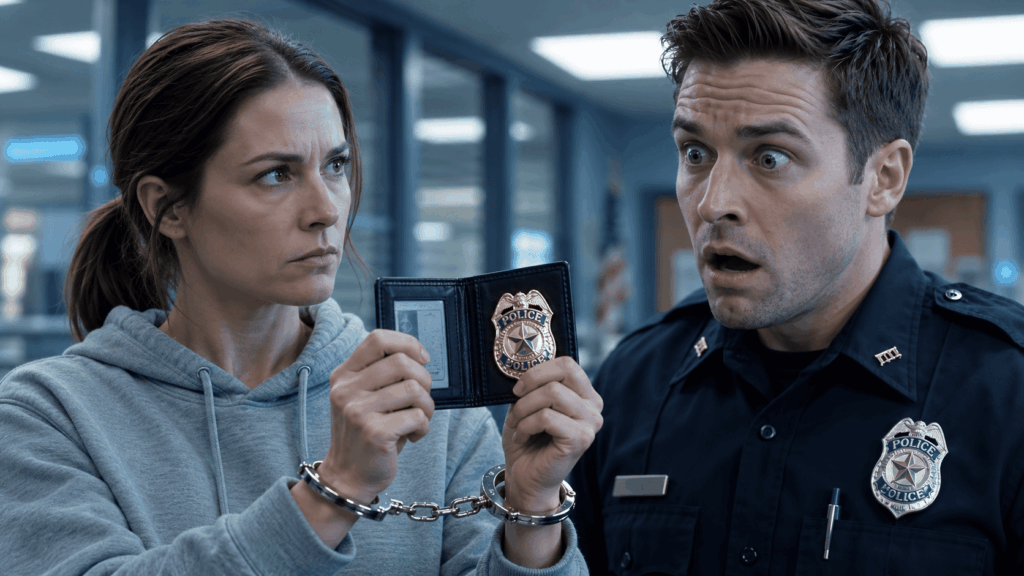
“You’re going to prison for theft!”
Officer Miller snapped the second handcuff around Clara’s wrist with enough force to make the woman behind the reception desk flinch.
Clara stood beneath the fluorescent lights of the police station lobby in a plain gray hoodie and jeans. A small canvas bag rested on the counter beside her.
She looked down at the cuffs, then back at him.
“What exactly are you accusing me of stealing?”
Miller leaned closer.
“You know what you did.”
“That isn’t an answer.”
He gave a short laugh.
Twenty-nine years old and still new to the department, Miller had already learned how to fill a room with his voice. He planted his feet wide, hooked one hand near his belt, and spoke as though every question was an act of defiance.
“You walked in here carrying property that doesn’t belong to you.”
Clara glanced at the canvas bag.
“I came here to return it.”
“That’s what people say when they get caught.”
Behind the reception desk, a civilian employee named Teresa slowly stood.
“Officer, she asked to speak to—”
“I have this handled.”
Clara watched him interrupt her.
Then she asked, “Have you contacted the owner?”
Miller’s smile sharpened.
“I don’t need you teaching me my job.”
For the first time, Clara’s expression changed.
It was not fear.
It was disappointment.
She raised her cuffed hands toward the neckline of her hoodie, where a leather credential holder hung beneath the fabric.
“Then check my badge number, Officer.”
She drew it out.
The gold badge caught the harsh ceiling light.
“I am your new police chief.”
Miller stopped smiling.
A Monday Nobody Had Prepared For
Three hours earlier, Clara had arrived in the city carrying one suitcase and a box of files.
At thirty-two, she was the youngest person ever appointed to lead the department.
The appointment had followed months of complaints, an external review, and the resignation of a chief who had spent more time defending the department’s reputation than examining its conduct.
Clara had not promised the city council miracles.
She had promised to read the records, meet the staff, and listen to residents whose concerns had been dismissed.
Her formal introduction was scheduled for that afternoon.
Until then, most officers knew her name only from an internal announcement.
Some had seen a photograph.
Miller apparently had not.
Clara had planned to spend the morning walking through the neighborhood around the station. She wanted to understand the place before someone handed her a tour designed to impress her.
She bought coffee from a small bakery.
She spoke to the owner about the empty storefront next door.
Then, on a bench near the bus stop, she noticed a black zippered pouch.
Inside were a wallet, a work identification card, a phone, and an envelope containing cash.
A receipt showed the money had been withdrawn that morning.
Clara looked around.
Nobody nearby claimed it.
She kept the contents together, noted where she had found them, and walked toward the police station.
The entrance doors opened into a narrow lobby with scuffed chairs and a noticeboard full of faded flyers.
At the reception desk, Teresa looked up.
“How can I help you?”
“I found this near the bus stop. I’d like to turn it in and get a receipt.”
Teresa smiled.
“Of course.”
That was when Miller emerged from the corridor.
The Story He Chose
Miller noticed the envelope before he noticed anything else.
Teresa had asked Clara to place the pouch’s contents on the counter so she could begin the property record.
The cash lay beside the wallet.
Miller stopped.
“Where did you get that?”
Clara explained.
He asked the same question again, as though repetition might change the answer.
She gave him the location and approximate time.
Then he picked up the work identification card.
“Luis Ortega.”
“Yes. That appears to be the owner.”
“You know him?”
“No.”
“How much money is in the envelope?”
“I haven’t counted it.”
Miller looked at Teresa.
“You counted it?”
“Not yet. I was opening the intake screen.”
He turned back to Clara.
“Convenient.”
Clara waited.
Miller had seen people return wallets before. He had also seen people invent explanations when challenged.
He chose the second possibility immediately.
What troubled Clara was how quickly he stopped looking for anything that might distinguish the two.
She had voluntarily entered the station.
She had asked for a receipt.
The wallet and money were together.
Teresa could confirm all of it.
None of those facts seemed to interest him.
Instead, he asked why Clara had no handbag, whether she lived nearby, and what she did for work.
“I recently moved here,” she answered.
“Unemployed?”
“I didn’t say that.”
His eyes moved over her hoodie.
“You’re making this harder than it needs to be.”
Teresa tried to speak again.
Miller told her to call the duty sergeant.
Then, before the sergeant arrived, he ordered Clara to turn around.
She asked what grounds he had.
He reached for the cuffs.
The Badge
For several seconds after Clara revealed her credentials, nobody spoke.
Miller stared at the badge.
Then at her face.
Then back at the badge.
“That could be fake.”
Clara held it still.
“Verify it.”
His mouth opened, but the words did not come.
Teresa reached for the desk telephone.
Miller lifted his hand.
“Wait.”
Clara looked at him.
“You were willing to arrest me without waiting. You can wait while she makes a call.”
Teresa dialed the administrative office.
A moment later, the door beside reception opened.
Sergeant Daniel Reed entered with a folder under his arm.
He saw Clara.
Then the cuffs.
His expression tightened.
“Chief?”
Clara lowered her hands.
“Good morning, Sergeant.”
Reed turned to Miller.
“What happened?”
“I was investigating suspected theft.”
“Based on what?”
Miller gestured toward the counter.
“She had the property.”
Teresa’s voice was quiet but clear.
“She brought it here to return it.”
Reed looked at the open intake screen.
He put the folder down.
“Remove the cuffs.”
Miller hurried to find the key.
Clara stepped back slightly.
“Sergeant Reed can do it.”
Reed unlocked them carefully.
A red mark circled Clara’s right wrist.
Miller watched her rub it.
“I didn’t know who you were.”
Clara looked up.
“That is what concerns me.”
The Owner of the Pouch
Luis Ortega arrived twenty minutes later.
Teresa had reached him through the emergency contact listed with his employer.
He entered the lobby breathless, still wearing his work boots.
“My wife said somebody found my wallet.”
Teresa asked him to identify the contents.
He described the pouch, the cards, the phone with a cracked corner, and the amount in the envelope.
The cash was for a deposit on a new apartment.
He had taken the pouch from his backpack while waiting for the bus and left it beside him when the bus arrived.
“I realized halfway to work,” he said. “I thought it was gone.”
Reed completed the property checks while Teresa prepared the receipt.
Clara stood nearby.
Luis turned toward her.
“You found it?”
“Yes.”
He closed his eyes briefly.
“Thank you. You have no idea what this means.”
Clara glanced at the envelope.
“I’m glad you got it back.”
Miller remained beside the corridor door.
Nobody had asked him to leave.
Nobody had asked him to continue working either.
Luis noticed the tension.
“Did something happen?”
Clara answered without embellishment.
“There was a problem with how your property was handled. We’re reviewing it.”
Luis looked from her to Miller.
Then his gaze dropped to the mark on her wrist.
He did not need anyone to explain further.
The First Report
Clara’s first instruction as chief was not a speech.
It was a request to preserve the records.
Lobby camera footage.
Miller’s body camera recording.
The property intake entry.
Dispatch communications.
She asked Reed to arrange the preservation through the appropriate staff, and she asked Teresa to write her own account before discussing the incident with anyone else.
Miller finally spoke.
“Chief, can I explain?”
“Yes. In writing, as part of the review.”
“I’d rather tell you directly.”
“You’ll have an opportunity to give a full account. I’m also a witness to what happened, so I won’t be the person deciding the findings.”
He seemed surprised.
Perhaps he had expected an immediate threat.
Perhaps he had hoped for a private conversation that would end with an apology and a handshake.
Clara gave him neither.
She asked for an independent investigator to be assigned through the city’s established process.
Miller was removed from public-facing duties while the incident was examined.
His supervisor escorted him upstairs.
As he passed Clara, he stopped.
“I really didn’t recognize you.”
She looked at him steadily.
“Luis wouldn’t have recognized me either. He still deserved to have his wallet returned without someone innocent being accused.”
Miller dropped his gaze.
Only after he left did Clara let herself sit down.
The adrenaline had begun to fade.
Her wrist hurt.
Teresa brought her a glass of water.
“I should have stopped him.”
“You tried to speak.”
“I could have said more.”
Clara accepted the glass.
“We’ll make sure you can next time.”
The Complaints in the Drawer
That afternoon, Clara’s scheduled introduction took place in a briefing room.
She wore a clean shirt beneath her jacket.
The hoodie sat folded in her office.
She introduced herself, outlined her priorities, and acknowledged that an incident from that morning was under review.
She did not describe Miller as a monster.
She did not turn the meeting into a performance.
But she made one point plainly.
“Questions are part of our work. We should expect them from the public, and we should be able to ask them of one another.”
Afterward, Sergeant Reed knocked on her office door.
He carried a thin folder.
“There are earlier complaints you should know about.”
Clara invited him to sit.
The complaints concerned Miller.
A delivery driver who said Miller had threatened to arrest him over a parking disagreement.
A teenager whose bicycle had been treated as stolen despite a purchase receipt.
A store employee questioned about missing merchandise after calling to report it.
Each complaint had been closed with a brief note.
Miscommunication.
Insufficient evidence.
Officer counseled.
Clara read the notes twice.
“Who counseled him?”
Reed hesitated.
“His training supervisor.”
“Is there documentation?”
“Very little.”
Clara closed the folder.
The problem had begun before she walked through the lobby.
Her arrival had simply made it harder to ignore.
Teresa’s Account
The independent investigator met Teresa in a small conference room several days later.
Teresa had worked at the station for eleven years.
She knew the sound of an angry visitor.
She knew the sound of an exhausted officer.
And she knew what happened when someone wearing a uniform decided that the civilian behind the desk had nothing useful to say.
“I told him she was returning the pouch,” Teresa said.
The investigator asked when.
“Before the cuffs. More than once.”
“Why didn’t you insist?”
Teresa stared at her folded hands.
“The last time I contradicted an officer in front of a visitor, my supervisor told me I’d embarrassed him.”
The investigator waited.
“It went in my performance review.”
That statement opened another line of inquiry.
Teresa had not merely been ignored.
She had learned that speaking could cost her.
Clara received a summary through the proper review channel.
She sat with it for a long time.
Then she requested an examination of the reception staff’s reporting process.
Employees needed a way to flag immediate concerns without gambling their jobs on whether an officer tolerated correction.
An apology to Clara would not solve that.
Recognizing the chief would not solve it.
The next person in a gray hoodie needed the process to work too.
What the Recording Showed
Miller’s written account described Clara as evasive and uncooperative.
He stated that she had refused to explain how she obtained the property.
The recording showed her explaining it repeatedly.
He wrote that the receptionist had been unable to confirm her purpose.
The lobby footage captured Teresa doing exactly that.
He described his warning about prison as an attempt to encourage cooperation.
The investigator asked what cooperation he had sought.
Miller could not identify an unanswered question that justified what followed.
At first, he returned to the same defense.
“I thought she was lying.”
“What information supported that belief?”
“She had cash that wasn’t hers.”
“She brought it to the station.”
“Yes.”
“She asked for a receipt.”
“Yes.”
“Did you contact the owner before using the handcuffs?”
“No.”
“Did you check for a theft report?”
“No.”
“Did you ask the receptionist what she had witnessed?”
“I heard her.”
“But you did not include it in your report.”
Miller shifted in his chair.
The investigator slid the report toward him.
“This review concerns both your actions and whether your account of them is accurate.”
For the first time, Miller seemed to understand that the badge reveal was not the most serious part of his morning.
The important part had happened before it.
The Call Clara Did Not Take
A week into the review, a city council member called Clara.
He described Miller as a young man with a promising future.
His family was respected.
He had made a mistake.
Clara listened.
Then she asked, “Have you read the records?”
“No, but I understand he’s embarrassed.”
“He should have the chance to respond to the evidence. So should everyone affected by his conduct.”
The council member lowered his voice.
“We don’t want your first weeks to become a scandal.”
Clara looked through her office window toward the reception desk.
Teresa was helping an elderly visitor complete a form.
“My first weeks will be difficult if staff believe the outcome depends on whom someone knows.”
She ended the call politely.
Later that evening, she wrote a short note for the investigator recording the contact.
She had been appointed to restore trust.
That meant resisting the pressure to quietly repair the department’s image while leaving its habits intact.
It also meant accepting scrutiny herself.
When the investigator asked whether she had prolonged the confrontation to test Miller, she answered directly.
“No. I came to return the pouch. I identified myself once he restrained me.”
The footage supported her account.
She was relieved.
She would have accepted the question either way.
The Findings
The final review took longer than the gossip.
By then, a blurry photograph of Clara’s badge had circulated online, accompanied by exaggerated versions of the confrontation.
Some claimed she had fired Miller in the lobby.
Others said she had staged the entire incident.
Neither was true.
Clara declined interview requests while the review remained active.
When the findings were complete, the department released a factual summary.
Miller had escalated without adequately establishing the circumstances.
He had disregarded relevant information.
His report contained material statements contradicted by the recordings.
The review also found failures in his training and in the handling of earlier complaints.
Following the disciplinary process, Miller’s employment ended.
His training supervisor was removed from that role and faced separate discipline for documented failures.
Previously closed complaints were reopened where the available evidence warranted it.
Teresa’s performance record was corrected.
Clara read the final report alone.
There was no pleasure in it.
A person had lost a job.
Other people had spent months believing that what happened to them did not matter.
The outcome was necessary.
It was also evidence of how much work remained.
Miller’s Last Visit
Miller returned to the station to collect his personal belongings.
He wore a plain button-down shirt.
Without the uniform, he looked younger.
Reed escorted him through the building.
At the office doorway, Miller asked whether Clara would speak to him.
She agreed to a brief conversation with Reed present.
“I’m sorry,” Miller said.
Clara waited.
“I put the cuffs on you when I hadn’t checked the story. I ignored Teresa. Then I wrote the report the way I wanted it to look.”
It was the first time she had heard him describe the incident without using the words confusion or misunderstanding.
“Thank you for saying that,” she replied.
He swallowed.
“Is there any chance you could change the decision?”
“No.”
His face fell.
“The findings were independently reviewed. An apology doesn’t erase them.”
Miller looked toward the floor.
“I thought being in control meant never letting somebody challenge me.”
Clara rested her hands on the desk.
“You were responsible for what happened in that lobby. Listening would have helped you carry that responsibility.”
He nodded slowly.
Then he left.
Clara did not know what he would do next.
She hoped he would remember the morning accurately.
She had no obligation to give him another uniform so he could prove he had learned.
The Next Gray Hoodie
Two months later, a young woman entered the station carrying a phone she had found outside a grocery store.
She wore a gray sweatshirt.
Teresa greeted her.
A patrol officer passing through the lobby stopped to help.
He asked where she found it.
He wrote down the details.
When the woman asked whether she could receive confirmation that she had turned it in, he nodded.
“Absolutely.”
Clara watched from the corridor without interrupting.
The exchange took only a few minutes.
Nobody raised a voice.
Nobody treated a question as an insult.
The woman left with a receipt.
Later, the officer knocked on Clara’s door.
“Was that the right intake form for a phone?”
She showed him the updated procedure.
He asked another question.
She answered it.
That conversation mattered to her almost as much as the one in the lobby.
A department could publish new rules and still teach its people to hide uncertainty.
Clara wanted them to ask while there was still time to prevent a mistake.
At the reception desk, Teresa began training a new employee.
Clara heard her say, “If something concerns you, speak up. Your observation belongs in the record.”
This time, nobody corrected her.
The Receipt
Near the end of Clara’s first season as chief, Luis Ortega returned to the station.
He brought a small box of pastries from the bakery where Clara had bought coffee on her first morning.
“Our apartment worked out,” he said.
“That’s good news.”
“My wife wanted me to thank the people who helped.”
Teresa took the box to the staff room.
Luis remained at Clara’s doorway.
“I kept the receipt.”
She smiled slightly.
“For the wallet?”
He nodded.
“I know it’s just a piece of paper. But when I thought the deposit was gone, I didn’t know what we were going to do.”
Clara remembered the envelope on the counter.
The ordinary errand that had nearly become an arrest.
“Sometimes a receipt matters.”
Luis thanked her again and left.
Clara returned to her desk.
There were staffing problems to resolve, complaints to read, and a budget meeting she was already late preparing for.
Her appointment had not transformed the department overnight.
Some employees still resisted the changes.
Some residents were not ready to trust them.
She understood.
Trust would come from what happened when she was not standing in the lobby wearing a badge.
Before leaving that evening, Clara passed Teresa’s desk.
A visitor was asking how to file a complaint.
Teresa handed him the form and explained the process.
She did not ask him to lower his expectations.
She did not suggest that nothing would happen.
Clara paused beside the exit.
Then she stepped outside into the cool evening air, wearing the same gray hoodie she had worn on her first morning.
It felt ordinary again.
That was what she had wanted for herself.
It was what she intended to protect for everyone who walked through those doors.

















