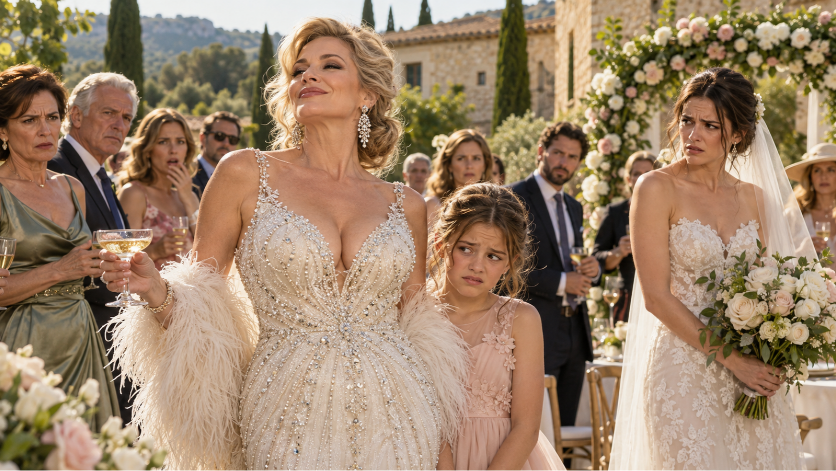
The first argument of Elise Moreau’s wedding day began over a white dress.
It was not the bride’s.
At eight that morning, Marianne stood in front of the bedroom mirror in their house outside Avignon, adjusting a pair of pearl earrings while her eleven-year-old daughter, Sophie, sat on the floor near the wardrobe with one shoe on and the other missing.
“Do I look all right?”
Sophie glanced up.
“Yes.”
Marianne turned slightly.
“Too formal?”
“No.”
“The beadwork isn’t too much?”
“No.”
“You’re not even looking.”
Sophie looked.
Her mother did look beautiful.
The dress was floor-length, soft and fitted without being tight, with delicate beads stitched through the fabric so that it caught the morning light whenever Marianne moved. She had pinned her dark hair up loosely and put on pearl earrings that matched the small clasp at the back of the dress.
It was elegant.
It was expensive-looking.
It was also unmistakably white.
Sophie did not know enough about wedding etiquette to understand why this might become a problem.
She only understood that they were already late.
Her stepfather, Laurent, had called upstairs twice.
The second time, his voice had been calm in the way adults become calm right before they stop being calm.
Marianne touched the side of her hair.
“Maybe I should wear the smaller earrings.”
Sophie dropped her head backwards against the wardrobe door.
“Mum.”
“What?”
“You asked me already.”
“I asked about the dress.”
“You asked if you looked nice.”
“That’s different.”
“It isn’t.”
From downstairs, Laurent called, “If we don’t leave now, we are going to arrive after everyone else.”
“We’re coming!”
Marianne looked at herself again.
“Sophie, seriously. Does it look nice?”
Something in Sophie finally gave up.
“Yes! Fine! You look prettier than the bride, all right? Can we please go now?”
Marianne turned.
Silence.
Sophie immediately knew she had chosen the wrong sentence.
“What did you just say?”
“I said you look pretty.”
“That is not what you said.”
“I’ve said you look pretty about six times.”
“You do not say you look prettier than a bride on her wedding day.”
“I’m not saying it to the bride.”
“That does not make it better.”
“It kind of does.”
“Sophie.”
“I just want to leave.”
Marianne stared at her.
Sophie stared back, already regretting the tone but not the point.
Finally Marianne picked up her handbag.
“You are going to learn how to speak to people properly.”
“Can I learn in the car?”
Marianne gave her a look.
Sophie found her other shoe under the bed.
Five minutes later, they were finally outside.
The wedding was supposed to begin at ten thirty.
By eleven, there was still no groom.
By eleven twenty, someone was still tying ribbons to the backs of chairs.
The venue was an old stone mas jointly owned by several members of Laurent’s family, just outside a small Provençal village surrounded by vineyards and olive trees.
It had pale limestone walls, faded blue shutters, a gravel courtyard and a long garden where family gatherings had been held for decades.
Baptisms.
Anniversaries.
Sunday lunches.
Funerals.
Arguments that were never called arguments afterwards.
The wedding itself looked as though it had been assembled too quickly.
Long tables had been pushed beneath cream-coloured canopies.
White linen fluttered in the warm breeze.
A floral arch stood at the end of the garden, decorated with roses, eucalyptus and olive branches.
Several relatives were still carrying crates of wine from the house.
Someone was arguing with the caterer near the kitchen door.
Laurent stopped as they came through the gate.
“This is it?”
Marianne looked around.
“You said it was small.”
“I didn’t know it was this small.”
Sophie had already stopped listening.
She spotted three other children beside a table stacked with lemonade, cola and breadsticks.
“Sophie.”
“I’m right here.”
“You are walking away.”
“I can still hear you.”
“Stay where I can see you.”
Sophie nodded without turning.
Marianne sighed.
Laurent was looking toward the house.
His niece, Elise, stood in the doorway.
At first, Sophie did not realise she was the bride.
Elise was twenty-four, wearing black leggings, an oversized grey T-shirt and one slipper.
Her hair was half pinned and half falling loose.
Her eyes were swollen.
She looked directly at Marianne.
Then at the white dress.
Her expression changed.
Marianne smiled politely.
“Elise.”
Elise did not smile back.
“Hello.”
Laurent glanced between them.
“Where’s Julien?”
Elise’s jaw tightened.
“He’s coming.”
“What happened?”
“Nothing.”
“You’ve been crying.”
“I said he’s coming.”
Sophie watched for another second before one of the children waved a bag of sweets at her.
She ran off.
She did not see Elise continue staring at Marianne’s dress.
Marianne did.
After a moment, she looked down at herself.
Then back at Elise.
“Oh.”
Elise gave a small laugh.
Not an amused one.
Marianne touched the side of the dress.
“I brought another outfit.”
Laurent stared at her.
“You brought another outfit?”
“I always bring a backup.”
“To weddings?”
“To everything.”
Elise folded her arms.
“Of course.”
Marianne stiffened.
“What does that mean?”
“Nothing.”
“No, say it.”
Laurent stepped between them.
“Can we not start?”
Elise looked at him.
“I didn’t start anything.”
Marianne said, “Neither did I.”
Laurent rubbed his forehead.
They had been there less than five minutes.
Elise had never intended to marry Julien quickly.
She had not intended to marry him at all when they first met.
They met nine months earlier at a birthday dinner in Marseille.
Julien was twenty-seven, charming in the careless way of men who had not yet been punished enough for unreliability. He was handsome, funny, and worked for a building supplier owned by one of his uncles.
They slept together once.
Then again.
Then began seeing each other without ever agreeing on what that meant.
Elise liked him more than she wanted to admit.
Julien liked her too.
The problem was that he seemed to prefer her in private.
In public, he became vague.
When she asked where things were going, he said he disliked labels.
When she asked whether he was seeing anyone else, he said not seriously.
That word stayed with her.
Seriously.
As though betrayal became less real if nobody had submitted paperwork.
Elise should have walked away.
Instead,d she waited.
Part of that came from her mother, Nadine.
Nadine had spent most of Elise’s life treating stability as the highest virtue available to a woman.
Elise’s father died when she was seventeen.
After that, Nadine ran a small beauty supply shop alone and became more practical with every year.
When Elise wanted to study design in Lyon, Nadine asked how she would pay rent.
When Elise wanted to move to Paris, Nadine asked what she would do when the job ended.
When Elise said she was not interested in marriage, Nadine told her people always said that before meeting the right person.
Then Elise missed her period.
At first she said nothing.
Then she took a pregnancy test.
Positive.
The second was unclear.
She told Julien.
He went silent.
“Say something.”
“I’m thinking.”
“You look terrified.”
“I’m thinking.”
“You already said that.”
Julien leaned forward.
“Are you sure?”
“No.”
“Then maybe we should wait.”
“For what?”
“For a doctor.”
Elise stared.
“You think I made this up?”
“I didn’t say that.”
“You didn’t have to.”
That was the first serious argument.
The clinic appointment happened later.
By then, there was no pregnancy.
The doctor could not confirm whether Elise had experienced a very early miscarriage or whether the initial home test had been wrong.
Elise told Julien she had lost it.
To her, that felt true enough.
Julien wanted to see the paperwork.
Elise refused.
To her, that felt like mistrust.
They argued again.
Then Nadine found out.
After that, the problem stopped belonging to Elise and Julien.
It became a family matter.
Julien’s mother cried.
Nadine said people would talk.
An uncle offered the family property for the ceremony.
An aunt knew a florist.
Someone had a cousin who catered weddings.
Another relative could arrange chairs.
Within days, the wedding had become a machine.
Elise objected twice.
Weakly.
Julien objected once.
Also weakly.
Everyone kept moving.
Neither of them stopped it.
Three weeks before the ceremony, Julien asked Elise to meet him at a café in Aix-en-Provence.
He arrived twenty minutes late.
She was already angry.
“You’re late.”
“I know.”
“You didn’t call.”
“I know.”
“You always know afterwards.”
Julien sat.
Elise looked at him.
“What?”
He hesitated.
“What?”
“Were you actually pregnant?”
Her face changed.
“What kind of question is that?”
“A real one.”
“You think I lied?”
“I don’t know.”
“That means yes.”
“No. It means I don’t know.”
Elise laughed.
“You saw the test.”
“I saw a photograph.”
“Oh, my God.”
“Elise.”
“No.”
“You never let me come to the appointment.”
“I told you why.”
“You told me you wanted to go alone.”
“Yes.”Then afterwards, you wouldn’t show me anything.”
“Because I was upset.”
“And now my sister says your mother is still telling people you’re pregnant.”
Elise stared.
“What?”
Julien leaned back.
“That’s what I thought.”
“My mother said that?”
“I don’t know exactly what she said. I know what people think.”
Elise picked up her bag.
“Sit down.”
“No.”
“Elise.”
“No. You think I trapped you.”
“I think everything is moving too fast.”
“Then say that to your mother.”
“I have.”
“And?”
“And she says if I cancel now, everyone will think I left you because you lost the baby.”
Elise stared at him.
“So?”
“So now I’m the bastard either way.”
Her face hardened.
“Poor you.”
“That isn’t what I’m saying.”
“It sounds exactly like what you’re saying.”
“Can you listen for five seconds?”
“No.”
She stood.
Julien lowered his voice.
“I don’t think we should get married.”
Elise froze.
A server passed them carrying two espressos.
The normality of it irritated her.
She sat again.
“What?”
“I don’t think we should.”
“You agreed.”
“I know.”
“You told your family yes.”
“I know.”
“You bought a suit.”
“That is not a reason to marry someone.”
“You told me last week you wanted to try.”
“I did.”
“And now?”
Julien looked at her.
“I’m scared.”
Elise laughed bitterly.
“You think I’m not?”
“I think you want the wedding more than you want me.”
She stared.
“Go to hell.”
He rubbed his forehead.
“I knew you would do this.”
“Do what?”
“Make it impossible to say anything.”
“You just told me three weeks before our wedding that you don’t want to marry me.”
“I’m telling you before.”
“You want credit for that?”
“No.”
“Then what do you want?”
“I want you to admit this is wrong.”
Elise picked up her bag again.
“You should have figured that out before getting me pregnant.”
Julien looked at her.
There it was.
Neither spoke.
Then he said quietly:
“Were you?”
Elise went pale.
She left.
Julien called the next day.
Elise did not answer.
He called again.
Then again.
On the fourth call, she picked up.
“What?”
“We need to talk.”
“We already did.”
“No. You walked out.”
“You accused me of lying.”
“I asked.”
“You didn’t ask. You decided.”
“I didn’t.”
“Fine.”
“Elise.”
“What?”
“There’s something else.”
She waited.
“There’s someone else.”
Elise laughed once.
“Of course there is.”
“It’s not like that.”
“It is always not like that.”
“I was seeing her before you.”
“Before me?”
“Yes.”
“And during?”
Silence.
Elise closed her eyes.
“During?”
“We weren’t exclusive.”
“You told me you weren’t seeing anyone.”
“I said I wasn’t in a relationship.”
“Same thing.”
“No, it isn’t.”
“It is when you’re sleeping with me.”
“We never agreed-”
“STOP TALKING LIKE A LAWYER.”
Julien went silent.
Elise paced across her room.
“Who is she?”
“It doesn’t matter.”
“It matters to me.”
“She isn’t part of this.”
“She was apparently part of you.”
“Elise.”
“Are you still seeing her?”
Another pause.
That was enough.
Elise hung up.
She threw her phone onto the bed.
Not the wall.
She still needed it.
Then she sat on the floor and cried until Nadine came in.
Nadine listened.
Not gently.
Practically.
When Elise finished, Nadine said, “So now you know.”
Elise stared.
“That’s all?”
“What do you want me to say?”
“That the wedding is off.”
Nadine looked at her.
“Do you want it off?”
“Yes.”
“Then call everyone.”
Elise hesitated.
Nadine noticed.
“That’s what I thought.”
“What does that mean?”
“It means you don’t know what you want.”
“I know I don’t want to marry someone with a girlfriend.”
“Then cancel.”
“You say that like it’s easy.”
“It isn’t.”
“Everyone already knows.”
“Yes.”
“The family has paid.”
“Yes.”
“People are travelling.”
“Yes.”
“They think I’m pregnant.”
Nadine looked away.
Elise’s eyes narrowed.
“What did you tell them?”
“Nothing.”
“Maman.”
“I said there was a possibility.”
“There isn’t.”
“I know that now.”
“You knew weeks ago.”
“I was trying to stop people asking questions.”
Elise stared.
“You told people I was pregnant.”
“I said we had reasons for doing this quickly.”
“That is the same thing.”
“No, it isn’t.”
Elise stood.
“Why would you do that?”
“Because when a wedding happens this quickly, people talk.”
“They’re talking anyway.”
“Less.”
“Who cares?”
Nadine’s face hardened.
“I care.”
“Of course you do.”
“Don’t.”
“No, seriously. Of course you do. This whole thing is about what everyone thinks.”
“It is about your life.”
“My life?”
“Yes.”
“You’re the one lying about it.”
Nadine stood too.
“You slept with a man you barely knew. You thought you were pregnant. You told him. His family found out. Now you want me to make all of that disappear.”
“I never asked you to.”
“You never have to ask. Someone always has to.”
Elise stared at her mother.
That sentence stayed with her.
Not because it was entirely fair.
Because part of it was.
The wedding stayed on.
That became stranger with every passing day.
Elise and Julien barely spoke.
Both families behaved as if silence meant progress.
On the morning of the wedding, Elise texted him at six thirty.
Are you coming?
No reply.
At seven fifteen:
We need to decide before people arrive.
Nothing.
At eight:
Julien.
Still nothing.
At nine, his sister called.
“He left home.”
“When?”
“An hour ago.”
“Where is he?”
“I don’t know.”
“Did he say anything?”
“No.”
“You’re lying.”
“I’m not.”
“You all lie.”
“Elise.”
“Tell him if he doesn’t come, don’t bother coming at all.”
His sister paused.
“Maybe don’t say that.”
Elise hung up.
By the time Marianne arrived wearing white, Elise had been awake for five hours, cried twice, argued with her mother three times and removed her makeup once because she hated what the beautician had done.
She was no longer really angry about the dress.
The dress simply gave her anger somewhere visible to land.
At eleven thirty, Laurent found Marianne changing clothes in one of the upstairs bedrooms.
She had replaced the white beaded dress with a loose brown one she kept in the car.
Laurent leaned against the doorframe.
“You didn’t have to change.”
“Yes, I did.”
“Elise said you didn’t.”
“Elise said that while looking at me like she wanted to set me on fire.”
“She’s having a bad day.”
“I noticed.”
Laurent smiled.
Marianne glared.
“Not funny.”
“A little.”
She adjusted one sleeve.
“What’s happening downstairs?”
“No one knows.”
“Where’s Julien?”
“No one knows.”
“Is Elise all right?”
“No.”
“Useful.”
Laurent sat on the edge of the bed.
“My sister says Julien is stuck in traffic.”
Marianne looked at him.
“Do you believe that?”
“No.”
“Does anyone?”
“No.”
“Then why are they saying it?”
Laurent shrugged.
“Because ‘the groom may have changed his mind’ is difficult to serve with lunch.”
Marianne stared.
Then laughed.
Immediately covered her mouth.
“Sorry.”
“Don’t be.”
Downstairs, someone started shouting.
Both stopped.
“That sounded like Elise,” Marianne said.
Laurent stood.
The children had discovered Mentos first.
The colacame afterwards.
There were five of them by then.
Sophie was the oldest and therefore considered the leader, even though she denied responsibility whenever adults appeared.
They took two large bottles outside.
The first attempt produced disappointing foam.
The second was even worse.
One boy suggested they needed flowers.
Nobody knew why.
Sophie said that made no scientific sense.
Then helped him pull petals from the floral arch.
One rose became several.
Several became a branch.
Then somebody dared another child to see how many flowers they could remove before anyone noticed.
Children had a remarkable ability to turn boredom into structural damage.
By the time Elise came outside, one entire side of the arch looked visibly thinner.
She stopped.
Nobody noticed.
Sophie was trying to push several petals into the neck of a cola bottle.
Then Elise screamed.
“What are you doing?”
The children froze.
Sophie looked up.
Elise crossed the courtyard quickly.
“What are you DOING?”
One boy dropped a handful of flowers.
Sophie stood.
“We were just-”
“You destroyed it!”
“We didn’t-”
“Look at it!”
The other child stepped back.
Sophie stared at the arch.
It did look bad.
Elise grabbed the bottle from her hand.
“What is wrong with you?”
Sophie’s face changed.
“I’m sorry.”
“You think sorry fixes this?”
“No.”
“You think this is funny?”
“No.”
“Then why would you do it?”
Sophie had no answer.
Elise’s voice rose.
“I have been waiting here for hours, and you little monsters are out here tearing everything apart!”
Sophie flinched.
She had never been called that by an adult outside her own family.
“I said I’m sorry.”
“I don’t care.”
Marianne came through the doors.
“Elise.”
Elise turned.
The brown dress confused her for half a second.
Then her anger returned.
“Your daughter destroyed my wedding.”
Marianne looked at the arch.
Then at Sophie.
“Did you do this?”
Sophie swallowed.
“Some of it.”
“Some?”
“The others too.”
Marianne closed her eyes briefly.
“Sophie.”
“I said sorry.”
Elise laughed sharply.
“Oh, excellent.”
Marianne looked at her.
“She’s eleven.”
“So?”
“So I’ll deal with it.”
“This is my wedding.”
Marianne looked around.
No guests were seated.
No music was playing.
No groom was present.
She nearly said something.
Elise saw it anyway.
“Go on.”
Marianne said nothing.
“Say it.”
“I wasn’t going to.”
“Yes, you were.”
Laurent came outside.
“What’s happening?”
Elise pointed at the arch.
“They destroyed it.”
Laurent stared.
“Oh.”
“Is that all?”
“No. I mean-”
“You all keep doing that.”
“Doing what?”
“Looking at me like I’m insane.”
“No one thinks you’re insane.”
Elise laughed.
“Your wife arrived dressed like a bride.”
Marianne’s face hardened.
“It was not a bridal gown.”
“It was white.”
“I changed.”
“After everyone saw you.”
“I didn’t know-”
“You knew it was a wedding.”
“Yes, obviously.”
“Then why wear white?”
Marianne stared.
“Do you really want to argue about this now?”
“Why not? We clearly have time.”
“Enough,” Nadine said from behind them.
Elise spun around.
“You stay out of it.”
“I said enough.”
“You told everyone I was pregnant.”
Laurent looked at Nadine.
Marianne looked at Laurent.
Sophie looked at everyone.
Nadine’s face drained.
“Not here.”
“Why? Because people might hear?”
“Elise.”
“You love that, don’t you? What people hear.”
Marianne took Sophie by the shoulder.
“Come inside.”
Elise pointed toward her.
“And she doesn’t touch anything else.”
Marianne turned.
“Don’t speak to my daughter like that.”
“She ruined the flowers.”
” Apologised.”
“I don’t care.”
“Well, I do.”
Laurent stepped forward.
“Both of you.”
Elise looked at him.
“What?”
“You’re upset.”
“Brilliant observation.”
“I’m trying to help.”
“No. You’re trying to make me quiet.”
“That is not the same thing.”
“It always is in this family.”
Nadine said, “Stop embarrassing yourself.”
Elise turned slowly.
“Me?”
Nadine immediately knew she had chosen the wrong words.
Elise stepped closer.
“I’m embarrassing myself?”
“Lower your voice.”
“My groom is missing.”
“Elise.”
“My mother told everyone I was pregnant.”
“Not everyone.”
“Oh, good.”
“Stop.”
“My aunt arrives in white.”
Marianne said, “I changed.”
“My cousins destroy the arch.”
Sophie looked at the ground.
“And everybody keeps acting like the problem is that I’m angry.”
Nadine grabbed her arm.
“Come inside.”
Elise pulled away.
“Don’t touch me.”
“People are watching.”
“LET THEM.”
That stopped everyone.
Elise was crying again.
Not elegantly.
Her face was flushed.
Her hair was unfinished.
Her hands were shaking.
Sophie looked at her and felt afraid in a different way now.
Not of Elise.
For her.
Then a phone rang.
Nadine looked down.
Her expression changed.
Elise saw it.
“Who?”
No answer.
“Who is it?”
“Julien’s mother.”
“Answer.”
“Maybe we should-”
“ANSWER IT.”
Nadine picked up.
“Hello?”
Everyone watched.
Nadine listened.
Her face changed.
“What?”
Elise stepped closer.
“What?”
Nadine turned away.
“No, I understand.”
Elise took the phone.
“Give me that.”
“Elise.”
“Give it.”
She took it.
“Hello?”
Silence.
Then:
“Where is he?”
Another pause.
Elise’s face went still.
“When?”
Everyone watched.
“What do you mean he isn’t coming?”
Nobody moved.
Elise turned away from them.
“No. Put him on.”
Pause.
“I don’t care where he is. Put him on.”
Another pause.
“WHO IS WITH HIM?”
Nadine closed her eyes.
Elise tightened her grip on the phone.
“What girlfriend?”
The courtyard went completely silent.
Julien had not been stuck in traffic.
He had driven to see Camille.
Camille was twenty-six.
She had been seeing him for nearly a year.
Not continuously.
Not honestly.
But enough.
When Julien began seeing Elise, he told Camille it was casual.
When the pregnancy scare happened, he went back to her.
He told Camille he had made a mistake.
Then he told her he had to marry Elise because she was pregnant.
Camille told him never to call her again.
He called anyway.
On the morning of the wedding, he drove to her apartment.
Not with a plan.
Mostly because he did not know where else to go.
She refused to let him upstairs.
They argued in the courtyard for twenty minutes.
Then she finally got into his car because neighbours had begun watching from windows.
That was where his sister found him.
By noon, half the family knew.
By twelve fifteen, Elise did too.
She did not scream immediately.
That surprised everyone.
She handed the phone back to her mother.
Then walked toward the house.
Nadine followed.
“Elise.”
“Don’t.”
“We need to talk.”
“No.”
“People have come.”
Elise stopped.
Turned.
“Then feed them.”
Nadine stared.
“What?”
“We bought food.”
“Elise.”
“Feed them.”
“You can’t just-”
“Yes, I can.”
“What do I tell everyone?”
For the first time all day, Elise laughed.
It sounded awful.
“Tell them the truth.”
Nadine said nothing.
Elise looked at her.
“You remember how?”
Then she went upstairs.
The family lunch happened because nobody knew what else to do.
The tables were set.
The caterer had cooked.
Relatives had driven from Lyon, Nîmes, Marseille and smaller towns nearby.
By one o’clock, plates of roast chicken, gratin dauphinois, vegetables, bread, salads, cheese and fruit covered the long tables beneath the canopies.
There was no ceremony.
No speeches.
No bride.
People ate quietly.
Then less quietly.
Families could metabolise scandal with impressive speed.
By one thirty, conversations had begun again.
Sophie sat beside Marianne.
She picked at a piece of bread.
“Is Elise still getting married?”
“No.”
“Ever?”
“To Julien?”
“I don’t know.”
“Did we ruin it?”
Marianne looked at her.
“No.”
“But the flowers-”
“The flowers were bad.”
Sophie looked miserable.
Marianne continued.
“You are apologising again. And you’re helping clean later.”
“Okay.”
“But you did not ruin the wedding.”
Sophie nodded.
Across the table, Laurent was arguing quietly with Nadine.
“You should have cancelled this weeks ago.”
Nadine glared.
“You know that now.”
“I knew it then.”
“No, you didn’t.”
“I told you it was too fast.”
“You said that after invitations went out.”
“Because that’s when you told me.”
Nadine lowered her voice.
“Do you think I wanted this?”
“You pushed it.”
“I tried to protect her.”
“From what?”
“People.”
Laurent laughed.
“Look around.”
Nadine’s face hardened.
“Easy for you.”
“What does that mean?”
“You left. You live near the city. You come here for family lunches and judge how everyone else handles things.”
“I am not judging.”
“You are always judging.”
Marianne said quietly, “Maybe not today.”
Nadine turned.
“Please don’t.”
Marianne blinked.
“Don’t what?”
“Insert yourself.”
Marianne stared.
Laurent said, “Nadine.”
“No. This is our family.”
Marianne’s face changed.
“I am married to your brother.”
“Yes.”
“So?”
“So maybe today isn’t about you.”
Marianne put down her fork.
“I have spent four hours at a wedding that did not happen while your family shouted at one another.”
“Our family.”
“Fine. Our family.”
“You don’t mean that.”
“Do you hear yourself?”
“Do you?”
Laurent stood.
“Enough.”
Marianne pointed toward Nadine.
“No. She doesn’t get to talk to me like that.”
Nadine laughed.
“You wore white.”
“I CHANGED.”
“After Elise saw you.”
“Because no one told me there was a problem.”
“You need someone to tell you not to wear white to a wedding?”
Marianne opened her mouth.
Then closed it.
That one landed.
Sophie stared at her plate.
Laurent looked between the women.
“Can everyone stop?”
Nadine said, “Tell your wife.”
Marianne said, “Tell your sister.”
“Perfect.”
Laurent sat down.
For ten seconds, nobody spoke.
Then Sophie’s two-year-old half-sister knocked over a glass of juice.
Sophie burst out laughing.
She could not help it.
Marianne tried not to.
Laurent did.
Even Nadine smiled.
For one brief exhausted moment, the argument collapsed under the stupidity of everything around them.
Then Elise came downstairs.
Everyone stopped again.
She had washed her face.
Her hair was down.
She wore the same leggings and T-shirt from the morning.
Nadine stood.
“Are you all right?”
Elise looked at her.
“No.”
“Do you want something to eat?”
“No.”
“People are asking-”
“I don’t care.”
Nadine’s lips tightened.
“You keep saying that.”
“Because I don’t.”
“You will tomorrow.”
“Then tomorrow can be terrible too.”
Laurent said, “Elise.”
She looked at him.
“What?”
“You don’t have to stay down here.”
“I know.”
“Then why are you?”
Elise looked around at the tables.
The unfinished decorations.
The damaged floral arch.
Relatives pretending not to stare.
“Because this is my lunch.”
Nobody answered.
She pulled an empty chair beside Sophie.
Sophie stiffened.
Elise looked at her plate.
Then at Sophie.
“Did you really put flowers in cola?”
Sophie nodded cautiously.
“Why?”
“We thought it might taste like roses.”
Elise stared.
Then unexpectedly laughed.
It came out rough and brief.
Sophie smiled nervously.
“Did it?”
“No.”
“Good.”
Sophie looked at her.
“I’m sorry about the arch.”
Elise nodded.
“I know.”
“Mum says I have to help clean.”
“She’s right.”
“I know.”
Elise picked up a grape.
Then said quietly:
“I’m sorry I shouted at you like that.”
Sophie looked surprised.
“You were angry.”
“I was.”
“Because of the wedding?”
Elise stared at the grape.
“Mostly because of everything.”
Sophie nodded.
At eleven, almost twelve, that made sense.
Julien arrived at four thirty.
That was when the second wedding began.
Not a ceremony.
An argument.
Most distant relatives had gone.
Only immediate family remained.
Elise was in the kitchen washing glasses when someone called her name.
She turned.
Julien stood near the front door.
His wedding suit was still inside a garment bag over one shoulder.
Elise stared.
Nadine rushed in.
“You came.”
Elise looked at her mother.
The hope in Nadine’s voice made something inside her go cold.
Julien set the bag down.
“We need to talk.”
Elise said, “No.”
“Elise.”
“No.”
Nadine said, “At least hear him.”
Elise turned.
“Why?”
“Because this is your life.”
“My life apparently ended at noon.”
Julien stepped closer.
“I didn’t know what to do.”
“So you went to her.”
“Yes.”
Nadine looked shocked.
Julien continued.
“I panicked.”
Elise laughed.
“You keep saying that like panic drove the car.”
“I know.”
“No. You chose.”
“Yes.”
“Say it properly.”
“I chose to go.”
“To your girlfriend.”
“She’s not-”
“DON’T.”
Julien stopped.
Elise stepped closer.
“Do not insult me again by changing words.”
He looked down.
“She was my girlfriend.”
“While you were sleeping with me?”
“Yes.”
Nadine sat down slowly.
Elise stared.
“While you were planning this wedding?”
“For part of it.”
She laughed.
Then covered her mouth.
Julien said, “I wanted to tell you.”
“When?”
“I tried.”
“No. You told me there was ‘someone else’ three weeks ago. That is not telling me.”
“I was scared.”
“So was I.”
“I know.”
“You don’t.”
“I do.”
“No. You got to leave.”
Julien looked at her.
She pointed toward the courtyard.
“Do you know what happened out there today?”
He said nothing.
“My little cousins destroyed the floral arch because they were bored waiting for you.”
Sophie, standing in the hallway, immediately looked guilty again.
Elise continued.
“My mother told people I was pregnant. Half your family knew you were with someone else. And I spent three hours upstairs dressed like an idiot waiting for you to decide whether you could tolerate marrying me.”
“I never wanted you to wait.”
“Then you should have come and said no.”
“I couldn’t.”
“Why?”
“I was ashamed.”
Elise laughed.
“Congratulations. Now everyone is.”
Julien flinched.
Nadine said, “Enough.”
Elise turned.
“Why are you defending him?”
“I’m not.”
“You told me to hear him.”
“That is not defending.”
“You want this fixed.”
Nadine stood.
“I want you to stop making decisions while furious.”
“I already made one.”
“What?”
“The wedding is over.”
“I know.”
“No.”
Elise looked at Julien.
“I mean us.”
Julien nodded slowly.
Nadine said, “Elise-”
“NO.”
Her voice cracked.
For the first time, Nadine stopped.
Elise looked at Julien.
“Do you love her?”
He hesitated.
That was enough.
Elise shook her head.
“Get out.”
“Elise.”
“Go.”
He picked up the garment bag.
At the door, he stopped.
“I never meant to humiliate you.”
Elise looked at him.
“But you did.”
He nodded.
Then left.
The families did not recover gracefully.
For weeks, each side told a different version.
Julien’s relatives said the wedding had been rushed because Elise claimed she was pregnant.
Nadine insisted Julien had manipulated her daughter and abandoned her.
Laurent tried to stay neutral and failed.
Marianne refused to attend two family lunches because Nadine still had not apologised for the argument about the white dress.
Nadine refused to apologise because she believed Marianne should have known better.
They did not speak for five months.
Sophie was punished for the floral arch.
She wrote Elise an apology letter because Marianne required one.
Elise kept it.
Mostly because the final sentence said:
I’m sorry your wedding broke before we broke the flowers.
Elise laughed when she read it.
Then cried.
That sentence was more accurate than most adults had managed.
The difficult part came after the gossip stopped.
Once everyone moved on to another family problem, Elise had to live with herself.
For months, she told the story in a way that made Julien entirely responsible.
He had cheated.
He disappeared.
He humiliated her.
All true.
But there were other truths.
She had known the relationship was unstable.
She had allowed the pregnancy scare to become leverage after she no longer knew whether there had been a viable pregnancy at all.
She did not correct her mother when rumours spread because part of her believed the rumours might keep Julien from leaving.
She had wanted the wedding to prove something.
Not love.
Worth.
That was harder to admit.
She began therapy nearly a year later after having a panic attack at another cousin’s engagement dinner.
She did not tell the family at first.
Nadine found out accidentally.
“You’re seeing a therapist?”
“Yes.”
“Why?”
Elise looked at her.
“Do you want the list alphabetically?”
Nadine sighed.
“I’m asking.”
“No. You’re judging.”
“I’m not.”
“You make that face when you judge.”
“What face?”
“That face.”
Nadine touched her cheek.
“I have one face.”
Elise laughed.
Their relationship changed slowly.
Not because Nadine became gentle.
She did not.
But Elise began saying things she had previously swallowed.
When Nadine criticised her job:
“I didn’t ask.”
When Nadine asked when she would marry:
“Stop.”
When Nadine brought up the old wedding:
“Not today.”
At first, every boundary created another argument.
Then fewer did.
That was progress.
Julien eventually married Camille.
Not immediately.
They separated for nearly two years after the cancelled wedding because Camille did not trust him either.
When they got back together, it was quieter.
No rushed wedding.
No family intervention.
They married at the mairie with fewer than twenty guests.
Elise heard through relatives.
Her first reaction embarrassed her.
She cried.
Not because she wanted Julien.
Because some old part of her still interpreted his happiness as evidence that she had been the defective person in the story.
Then the feeling passed.
Not quickly.
Eventually.
Elise met Mathieu when she was twenty-nine.
He was not dramatic.
That worried her at first.
He answered messages when he said he would.
He showed up on time.
He told her when he was upset.
The first serious argument they had happened because Elise accused him of hiding something after he cancelled dinner twice in one week.
He stared at her.
“My mother is in hospital.”
She froze.
“What?”
“I told you.”
“You said family things.”
“Because she asked me not to tell people.”
“You could have told me.”
“I was going to.”
“When?”
“Tonight.”
Elise crossed her arms.
Mathieu looked at her.
“What did you think I was doing?”
She did not answer.
“Elise.”
“I don’t know.”
“You do.”
She looked away.
Mathieu’s expression softened.
“This isn’t him.”
She hated the sentence.
“Don’t compare yourself.”
“I’m not.”
“Yes, you are.”
“I’m saying I’m not Julien.”
“I know.”
“Do you?”
Elise stared at him.
Then sat down.
Not because the argument was over.
Because for once she wanted to stay in the room while it happened.
They handled it badly.
Then better.
That was how much of their relationship worked.
When Mathieu proposed two years later, Elise said yes.
Then immediately said:
“No large wedding.”
He laughed.
“I didn’t ask for one.”
“No emergency family committees.”
“Agreed.”
“No rumours about pregnancy.”
Mathieu stared.
“I feel there is context missing.”
“There is.”
“And I don’t want it?”
“You absolutely do not.”
Their wedding had twenty-six guests.
It took place at a small restaurant near L’Isle-sur-la-Sorgue with a garden shaded by plane trees.
Nadine complained that the guest list was embarrassingly short.
Elise ignored her.
Laurent came.
Marianne came.
She wore dark blue.
Elise noticed.
Marianne saw her noticing.
Neither spoke for several seconds.
Then Marianne smiled.
“Safe enough?”
Elise laughed.
“Yes.”
Sophie was twenty-one by then.
She stood beside them.
“No floral arch?”
Elise looked toward a small arrangement near the garden entrance.
“There is one.”
Sophie nodded thoughtfully.
“Any cola?”
“Don’t.”
“Just asking.”
Elise laughed hard enough to turn away.
Years later, Sophie told the story of Elise’s first wedding at her own dinner table.
By then, she was married.
Her husband had heard pieces before, but never all of it.
“The groom literally didn’t show?”
“Not until late afternoon.”
“And everybody still ate?”
“The caterer had already cooked.”
He stared.
“That is very French.”
Sophie laughed.
“And your mum wore white?”
“She changed.”
“After the bride saw her?”
“Yes.”
“And you destroyed the flowers?”
“I was one of several people involved.”
Her husband looked at her.
“You have always said ‘the children.’”
“We were children.”
“You were the oldest.”
“That is irrelevant.”
“You put flowers in cola.”
“We were conducting research.”
He laughed.
Then Sophie became quieter.
For years, the story had been funny because humour was easier than remembering how ugly parts of that day had been.
A missing groom.
A frightened bride.
Adults arguing about reputation.
A child absorbing fragments she could not interpret until much later.
She understood now why Elise had screamed.
She also understood why it had been wrong to scream at children.
Both could be true.
That was one of the more irritating discoveries of adulthood.
People rarely remained only the person they had been during their worst afternoon.
At Elise’s second wedding, she had looked completely different.
Not because the dress was better.
Not because the groom showed up.
Because she had not spent the whole day looking toward the gate.
There had been no question about whether Mathieu wanted to be there.
No one needed to manufacture a reason for the marriage.
Nobody had to keep the story together long enough to finish lunch.
At the end of the night, Elise sat barefoot on a low stone wall eating leftover wedding cake from a small plate.
Sophie sat beside her.
“You know,” Sophie said, “technically this is the first wedding of yours I’ve attended that actually became a wedding.”
Elise looked at her.
“You’re banned from speaking.”
“Fair.”
“And from touching the flowers.”
“That happened once.”
“It was memorable.”
Sophie smiled.
After a moment, Elise nudged her shoulder.
“You really thought roses would make cola taste better?”
“We were children.”
“You were eleven.”
“That is still a child.”
“You were the ringleader.”
“Allegedly.”
Elise laughed.
Then looked back toward the restaurant.
Mathieu was inside arguing with Laurent about how to fit leftover food into two cars.
Nadine was giving instructions nobody had asked for.
Marianne was pretending not to hear her.
No one looked elegant anymore.
The formal part of the evening had dissolved into food containers, tired relatives and somebody searching for a handbag.
Elise watched them for a while.
Then Sophie asked:
“Good wedding?”
Elise considered it.
“Yeah.”
“Just yeah?”
Elise smiled.
“Yeah is enough.”
And for once, it was.

















