THE HEIRLOOM
Rain had been falling over Connecticut since sunset.
Not the soft kind.
It came down in hard silver sheets, striking the tall windows of Vane Manor like handfuls of gravel.
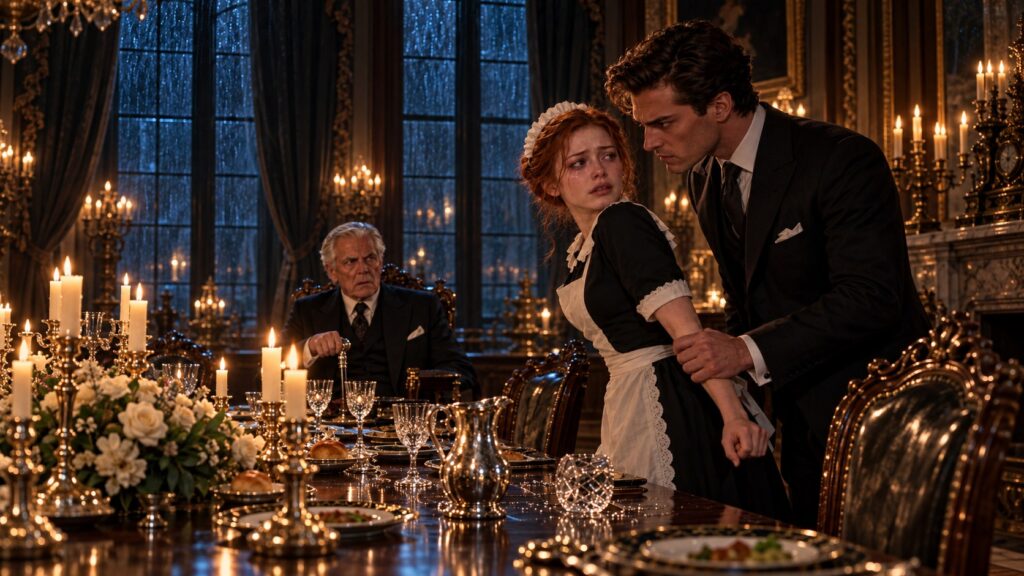
Inside, the great dining room glowed beneath twelve antique chandeliers.
The room was enormous.
Cedar walls.
Oil portraits.
A ten-meter dining table polished so deeply that the candle flames seemed to burn beneath its surface.
At the head of that table sat Thomas Vane.
Seventy years old.
Silver hair combed straight back.
A long scar along his left jaw.
One hand rested around the silver head of a walnut cane.
For almost four decades, Thomas Vane had ruled Vane Maritime.
Cargo terminals.
Shipyards.
Freight routes.
Private ports.
Billions of dollars moved every year under the Vane name.
People called him ruthless.
They were usually careful to say it when he wasn’t in the room.
At his right sat his son.
Julian Vane.
Thirty-five.
Savile Row suit.
Perfect hair.
Perfect watch.
Perfect contempt.
The kind of man who had never had to ask what anything cost.
And standing beside Thomas was Clara.
Twenty-two years old.
The newest member of the household staff.
Red hair tied neatly behind her head.
White gloves.
Black dress.
No jewelry except for a small silver pendant hidden beneath her collar.
She held a silver water pitcher with both hands.
Julian watched her.
Not because he was interested in her.
Because he enjoyed watching people become nervous.
Clara leaned forward.
The pitcher touched Thomas’s crystal glass.
KENG.
The sound was tiny.
But in the silence of the dining room, it was enough.
Julian smiled.
“Your hands seem a little loose lately, Clara.”
She stopped.
Julian lifted his wine.
“Should I find you another job?”
He looked her up and down.
“Somewhere outside the gates?”
Clara swallowed.
Her fingers tightened around the pitcher.
Then, almost unconsciously, she whispered:
“Mors tua, vita mea… Non nobis, Domine.”
Thomas froze.
The fork stopped halfway to his mouth.
The violin music playing from the adjoining salon seemed suddenly too loud.
Thomas slowly lowered his hand.
“What did you say?”
Clara looked frightened.
“I’m sorry, Mr. Vane.”
Thomas turned toward her.
“Say it again.”
Julian frowned.
“Father—”
Thomas slammed his palm against the table.
“Again.”
Clara stared at him.
Then repeated it.
This time clearly.
“Mors tua, vita mea. Non nobis, Domine.”
Thomas’s face changed.
Not anger.
Fear.
The kind of fear that came from recognizing a ghost.
Julian leaned back.
“What is this?”
Thomas ignored him.
“That pronunciation.”
His voice had gone hoarse.
“Palermo.”
Clara’s eyes widened.
Thomas stood.
His chair scraped across the marble.
“Who taught you?”
“My great-grandmother.”
“What was her name?”
Clara hesitated.
“She told us never to use her family name.”
Thomas stepped closer.
“What was her name?”
“Helena.”
Thomas stopped breathing.
Clara continued.
“Helena Vance.”
The silver head of Thomas’s cane slipped slightly beneath his fingers.
“No.”
Clara stared at him.
“She spent the last years of her life in a small town outside Providence.”
Thomas shook his head.
“No.”
“She died when I was twelve.”
“No.”
“She said her family believed she died in Sicily.”
Thomas’s eyes filled with something Clara had never expected to see.
Grief.
Julian stood.
“Father, who the hell is Helena?”
Thomas looked at Clara.
Then at the small silver pendant beneath her collar.
“Take that out.”
Clara’s hand flew to her chest.
“What?”
“The necklace.”
She hesitated.
Then pulled it free.
A small silver medallion hung from the chain.
Old.
Scratched.
Blackened with age.
On its surface was a carved crest.
A ship.
Three stars.
And beneath them:
VANE.
Thomas nearly collapsed.
He caught himself on the cane.
Julian stepped toward him.
“Father?”
Thomas pushed his hand away.
His eyes never left the pendant.
“That belonged to my sister.”
Clara stared at him.
Julian’s face changed.
“Your sister?”
Thomas whispered:
“Helena.”
Silence swallowed the room.
Then Thomas looked at Clara.
“She didn’t abandon us.”
His voice broke.
“She survived.”
Clara’s fingers closed around the pendant.
Thomas stared at her as though forty years had disappeared between them.
Julian stepped forward.
“So what?”
Thomas slowly turned.
Julian frowned.
“So she’s some distant relative.”
Thomas’s face hardened.
“No.”
He looked back at Clara.
“If Helena had descendants…”
Julian’s eyes narrowed.
Thomas finished:
“Then the controlling shares of Vane Maritime never legally belonged to me.”
For the first time in his life, Julian Vane looked afraid.
Clara Bennett had not come to Vane Manor looking for an inheritance.
She had come looking for work.
At least that was what she had told herself.
Her mother had died two years earlier.
Her father had never been part of her life.
The only family Clara remembered clearly was her great-grandmother Helena.
Helena had been strange.
At least that was what Clara thought when she was a child.
She locked every door twice.
Never sat with her back to a window.
Burned letters after reading them.
And refused to speak about the family she had left behind.
But every Sunday evening, Helena taught Clara words no one else understood.
Latin.
Sicilian dialect.
Fragments of French.
Short prayers.
Warnings.
Names of ports.
Names of ships.
Clara had assumed they were memories of the war.
Until Helena died.
When Clara’s mother emptied the house, they found a cedar box beneath the floorboards.
Inside were four things.
An old passport.
Several photographs.
A silver medallion.
And a sealed envelope marked:
IF THE VANE NAME EVER FINDS YOU.
Clara’s mother never opened it.
Neither did Clara.
Not then.
The Vane family seemed like something from another world.
They appeared in newspapers.
Business magazines.
Television interviews.
Their ships crossed oceans.
Their name appeared on terminals from Boston to Singapore.
Clara grew up in apartments where the heat sometimes failed in January.
People like the Vanes did not belong to the same universe.
Then Clara saw Thomas Vane on television.
It was a business profile.
He was standing beside a portrait in Vane Maritime headquarters.
Behind him was the same symbol engraved on Helena’s medallion.
A ship.
Three stars.
Clara sat frozen.
Two months later, she applied for a housekeeping position at Vane Manor.
She told herself she only wanted answers.
She did not expect Thomas to recognize anything.
And she certainly did not expect him to stand before her in the dining room and say the words:
“The company may belong to you.”
Julian laughed.
It was too loud.
Too sudden.
“This is ridiculous.”
Thomas turned toward him.
Julian pointed at Clara.
“She’s a maid.”
Clara’s face hardened.
Thomas did not raise his voice.
“Don’t say that again.”
Julian stared at him.
“What?”
“Like it tells you what she is worth.”
Julian gave a disbelieving smile.
“You’ve known her for what? Ten minutes?”
Thomas looked at Clara’s pendant.
“I’ve known that medallion for sixty-eight years.”
Julian’s smile disappeared.
Thomas reached toward it.
Clara instinctively stepped back.
He stopped.
“May I?”
After a moment, she lifted the chain over her head.
Thomas took the medallion in both hands.
He turned it over.
On the back, barely visible beneath decades of scratches, were three letters.
H.E.V.
Thomas closed his eyes.
“Helena Eleanor Vane.”
Clara stared at him.
“That was her full name?”
“Yes.”
Thomas looked toward one of the paintings.
A woman in a dark blue dress stood beside a younger version of Vane Manor.
Clara had passed the portrait dozens of times.
She had never noticed the red hair.
Thomas pointed.
“My sister.”
Clara walked closer.
The resemblance was impossible to ignore.
Not identical.
But there.
The eyes.
The shape of the mouth.
The hair.
Julian came behind them.
“She died in 1944.”
Thomas looked at him.
“That’s what we were told.”
“She would’ve been a child.”
“Sixteen.”
Thomas touched the edge of the medallion.
“Our parents sent us to Sicily during the war.”
Clara frowned.
“Why?”
“Our mother’s family had property there.”
His voice became distant.
“There was an evacuation after the port was bombed.”
He looked at the portrait.
“I came back.”
“Helena didn’t.”
Thomas swallowed.
“They told us she died during transport.”
Clara whispered:
“She told me she lived in a refugee camp.”
Thomas looked at her.
“How long?”
“Almost two years.”
He closed his eyes.
Julian’s patience broke.
“Fine. Wonderful. A tragic family story.”
Thomas turned.
“But that still doesn’t make her owner of Vane Maritime.”
Thomas’s expression changed.
“Yes, it does.”
Julian went still.
Thomas walked toward the fireplace.
Above it hung a portrait of their grandfather.
Silas Vane.
Founder of Vane Shipping & Iron.
Thomas stared at him.
“My grandfather distrusted banks.”
Julian rolled his eyes.
“I know the story.”
“You know the version I allowed you to know.”
Thomas looked at Clara.
“Silas structured the company under a hereditary trust.”
Clara frowned.
Thomas continued.
“The controlling interest passes through the eldest surviving bloodline.”
Julian’s face slowly tightened.
“Your older sister.”
“Yes.”
“But she was declared dead.”
Thomas nodded.
“So the trust passed temporarily to me.”
“Temporarily?”
Thomas looked at him.
“Until her death could be legally confirmed.”
Julian stared.
Thomas continued.
“It never was.”
The room went silent.
Clara looked at him.
“Then why have you run the company for forty years?”
Thomas’s jaw hardened.
“Because no one asked the right question.”
The following morning, Vane Manor changed.
Lawyers arrived before breakfast.
Three black sedans.
Six attorneys.
Two archivists.
One private trust specialist from Boston.
Julian watched them through the library windows.
His hand was wrapped tightly around a glass of bourbon.
It was nine-thirty in the morning.
Clara entered carrying coffee.
Julian didn’t look at her.
“Leave it.”
She placed the tray down.
As she turned, he spoke.
“How much do you want?”
Clara stopped.
“What?”
Julian faced her.
“How much?”
“I don’t understand.”
“Yes, you do.”
He walked closer.
“You came into this house with that necklace.”
Clara said nothing.
“You knew.”
“I suspected.”
“Same thing.”
“No.”
Julian laughed.
“You expect me to believe you became a maid because you were curious about your family?”
“Yes.”
“Bullshit.”
He pulled out his checkbook.
Clara almost smiled.
“You actually carry one of those?”
His face hardened.
“Name a number.”
“No.”
“One million.”
Clara looked at him.
“No.”
“Five.”
“No.”
“Ten.”
She shook her head.
Julian stepped closer.
“You’ve never seen ten million dollars.”
“That doesn’t mean I have to sell something to you.”
“You don’t even know if the claim is real.”
“Then why are you trying to buy it?”
That stopped him.
Clara saw it.
Fear.
She turned toward the door.
Julian’s voice followed her.
“You think Thomas cares about you?”
Clara stopped.
“He cares about the company.”
She looked back.
Julian smiled.
“He’ll use you as long as you’re useful.”
“Maybe.”
“And then?”
Clara considered him.
“Then I’ll know exactly what kind of man he is.”
Julian’s smile vanished.
Clara opened the door.
Julian said quietly:
“You have no idea what this family does to people who threaten it.”
Clara looked over her shoulder.
“My great-grandmother did.”
Then she walked out.
The first discovery came that afternoon.
The Vane trust was real.
The second discovery was worse.
Helena had not merely been an heir.
She had tried to come home.
The archivist found six letters sent between 1947 and 1951.
All addressed to Silas Vane.
All returned.
Thomas read them alone.
Then he asked Clara to come into his study.
The letters lay across the desk.
Clara touched one.
“Can I?”
Thomas nodded.
The handwriting was Helena’s.
Clara knew it immediately.
She unfolded the paper.
Father,
I have written to you nine times.
I am alive.
I do not know why no one answers.
I have married.
I have a daughter.
Please tell Thomas I kept my promise.
Please tell him I did not leave him.
Clara stopped reading.
Thomas was standing by the window.
His back to her.
“She tried.”
He didn’t turn.
“Yes.”
“All those years.”
“Yes.”
Clara looked at him.
“Who stopped the letters?”
Thomas said nothing.
She understood.
“You know.”
He slowly turned.
“My father.”
Clara’s face went cold.
Thomas continued.
“When I returned from Sicily, I was the only surviving heir.”
“Or he wanted you to be.”
Thomas said nothing.
Clara looked at the letters again.
“Why?”
“Control.”
Thomas’s voice was flat.
“He believed Helena had become… unsuitable.”
Clara stared at him.
“Because she lived in a refugee camp?”
“Because she married someone poor.”
Clara laughed bitterly.
“That’s all?”
“He was Sicilian.”
“So?”
“My father was not a tolerant man.”
Clara stared at Thomas.
“And you?”
Thomas looked at her.
“I was ten years old.”
“For the letters.”
“I never saw them.”
“And later?”
Thomas’s eyes dropped.
That answer was different.
Clara saw it immediately.
“You found out.”
Thomas said nothing.
“When?”
He walked toward the fireplace.
“Twenty-eight years ago.”
Clara felt something collapse inside her.
“You knew Helena survived?”
“I knew there was a possibility.”
“A possibility?”
Thomas gripped the cane.
“My father’s private papers mentioned correspondence.”
“And you did nothing?”
“I searched.”
Clara stared at him.
“For how long?”
“A few months.”
She almost laughed.
“A few months?”
Thomas’s expression hardened.
“The company was collapsing.”
“And?”
“There were unions threatening strikes. Three lenders were ready to call our debt. If Helena’s claim resurfaced—”
Clara understood.
“You stopped looking.”
Thomas looked away.
“You chose the company.”
Silence.
“Just like your father.”
Thomas flinched.
Clara stepped closer.
“You didn’t lose Helena twice.”
Her voice shook.
“You abandoned her the second time.”
Thomas said nothing.
Because there was nothing he could say.
That night, Clara finally opened Helena’s envelope.
She sat alone in the servants’ quarters.
The rain had stopped.
The house was silent.
Inside was not a letter.
It was a key.
Small.
Iron.
And a note.
Clara,
If the Vane family ever finds you, they will ask for proof.
Do not give them the medallion.
The medallion is only the door.
The proof is where Thomas and I used to hide from Father.
He will remember.
Ask him where the lions never sleep.
Clara read the line three times.
Then she ran.
Thomas was still awake.
He was sitting in the library with a glass of brandy.
She entered without knocking.
He looked up.
“What happened?”
Clara put the note in front of him.
Thomas read it.
His face went pale.
“The lions.”
“What does it mean?”
He looked toward the ceiling.
For several seconds, he seemed to become a child again.
Then he whispered:
“The west nursery.”
They went upstairs.
The west wing had been closed for years.
Dust covered the furniture.
Paintings leaned against walls beneath linen sheets.
At the end of the corridor was a nursery.
Two carved wooden lions guarded the fireplace.
Thomas stopped.
“We used to hide things behind them.”
Clara knelt.
The left lion did not move.
The right one did.
Behind it was a keyhole.
Clara inserted Helena’s key.
Click.
A narrow panel opened.
Inside was a leather case.
Thomas stared at it.
Clara removed it.
Inside were documents wrapped in oilcloth.
A birth certificate.
A marriage record.
A letter from Silas Vane.
And the original trust amendment.
Thomas read the first paragraph.
His hands began trembling.
“What?”
Clara asked.
He looked at her.
“My father knew.”
She stared.
“He knew Helena had a daughter.”
Thomas handed her the document.
The amendment had been written in 1952.
It acknowledged Helena Vane as living.
It acknowledged her daughter.
And it preserved the firstborn line’s ownership.
But the amendment had never been filed.
At the bottom was Silas Vane’s signature.
Beside it was another.
Thomas recognized it immediately.
His father’s attorney.
Clara looked at Thomas.
“They buried it.”
“Yes.”
“And you inherited because everyone thought she was dead.”
“Yes.”
Clara looked back at the paper.
Thomas whispered:
“The company should have passed to Helena’s daughter.”
Clara’s grandmother.
Then to Clara’s mother.
Then Clara.
The chain was clear.
Thomas sat down heavily.
For almost forty years, he had called himself owner of an empire that had never fully belonged to him.
Clara stared at him.
“What happens now?”
Thomas looked at her.
“We tell the board.”
A voice came from the doorway.
“No.”
They turned.
Julian stood there.
His face was white.
But his eyes were calm.
Too calm.
“No one tells anyone.”
Thomas stood.
“Julian.”
Julian walked into the room.
“You cannot be serious.”
Thomas held up the document.
“This changes everything.”
“No.”
Julian shook his head.
“It destroys everything.”
Clara watched him.
Julian looked at Thomas.
“The stock price.”
“The lenders.”
“The board.”
“The family trusts.”
“The pension holdings.”
“You announce that the controlling ownership has been wrong for seventy years and the entire company goes into litigation.”
Thomas remained silent.
Julian pointed at Clara.
“For what?”
His voice sharpened.
“For her?”
Clara’s expression hardened.
Thomas answered quietly.
“For the truth.”
Julian laughed.
“The truth?”
He walked toward his father.
“You ran this company for forty years.”
“You fired people.”
“You bought ports.”
“You closed shipyards.”
“You built the entire thing.”
“And now because some servant walks in wearing an old necklace, you’re going to hand her the keys?”
Thomas’s grip tightened around the cane.
“She is family.”
Julian snapped.
“So am I.”
Thomas looked at him.
“Yes.”
Julian waited.
Thomas continued:
“And that’s why this hurts.”
Julian moved quickly.
By sunrise, Clara’s personnel file had disappeared.
By noon, rumors had reached the board that she had manipulated Thomas.
By evening, a story appeared online.
HOUSEKEEPER CLAIMS BILLION-DOLLAR VANE FORTUNE.
Anonymous sources described Clara as unstable.
Opportunistic.
Obsessed.
A former employer was quoted saying she had “always fantasized about wealth.”
The quote was false.
The employer didn’t even exist.
Clara stared at the article on her phone.
Thomas entered the room.
“You need security.”
“No.”
“This is bigger than you think.”
“No.”
He stopped.
Clara looked at him.
“I spent my entire life without security.”
“That was before people knew your name.”
“My name is Bennett.”
Thomas said nothing.
She continued.
“And I’m keeping it.”
Thomas nodded.
“Fine.”
Clara looked at the article.
“Did Julian do this?”
Thomas didn’t answer.
“Thomas.”
“Yes.”
Clara closed her eyes.
“He’s your son.”
“Yes.”
“And you’re still protecting him?”
“No.”
Thomas looked older.
“I’m deciding whether I can survive what I have to do next.”
Clara stared at him.
“You’re seventy.”
Her voice was cold.
“How much longer do you need before you choose courage?”
Thomas looked at her.
The words cut because they were Helena’s words.
Love without courage is just another lie.
He lowered his eyes.
Then took out his phone.
He called the chairman of the board.
“Emergency meeting.”
He paused.
“Tomorrow morning.”
Another pause.
“And Julian is not to be warned.”
The boardroom sat on the sixty-first floor of Vane Maritime Tower.
Twenty-one directors.
Three attorneys.
Two auditors.
Thomas.
Julian.
And Clara.
Julian looked at her as she entered.
“You actually came.”
Clara sat opposite him.
“You sound disappointed.”
Julian smiled.
“You’re about to embarrass yourself in front of some very expensive people.”
Clara placed Helena’s leather case on the table.
Thomas entered last.
Everyone stood.
He motioned for them to sit.
Then he remained standing.
“For forty-three years, I have served as chairman of Vane Maritime.”
No one moved.
Thomas continued.
“I believed my legal authority came from the Vane hereditary trust.”
Julian leaned back.
Thomas looked at him.
“That belief was incomplete.”
The room changed.
Thomas presented the documents.
Birth records.
Marriage records.
Letters.
The concealed amendment.
The medallion.
Then the forensic attorney spoke.
“Based on the documentation currently available, Ms. Clara Bennett is the last surviving direct descendant of Helena Eleanor Vane.”
A board member asked:
“And what does that mean?”
The lawyer looked around the room.
“It means her bloodline holds the controlling beneficial interest.”
Silence.
Then everyone started talking at once.
Julian stood.
“This is insane.”
Thomas slammed his cane against the floor.
The room stopped.
Julian looked at him.
“You’re destroying us.”
Thomas stared at his son.
“No.”
He looked toward Clara.
“My father started this.”
He paused.
“I continued it.”
Then he looked back at Julian.
“And you tried to preserve it.”
Julian’s face changed.
Thomas nodded toward the general counsel.
A screen lit up.
Emails appeared.
Julian to a crisis PR firm.
Discredit her before she gets counsel.
Another.
If the archive materials disappear, no court will ever take this seriously.
Clara stared at him.
Julian went pale.
Thomas continued.
“Security recovered these last night.”
Julian looked at his father.
“You hacked my email?”
“The company owns the system.”
Julian laughed bitterly.
“So this is it.”
Thomas said nothing.
“You choose her over me.”
Thomas slowly shook his head.
“No.”
His voice dropped.
“I am choosing not to become my father again.”
Julian stared at him.
Thomas turned toward the board.
“Effective immediately, Julian Vane is suspended from all executive duties.”
Julian stood.
“You can’t do that.”
“I just did.”
“This company belongs to me.”
Thomas’s eyes hardened.
“That is the lie that destroyed this family.”
Julian looked at Clara.
Hatred filled his face.
She remained seated.
Calm.
Julian pointed at her.
“You think you won?”
Clara looked at him.
“No.”
Julian laughed.
“Then what do you call this?”
Clara glanced at Helena’s medallion.
“An inheritance.”
She looked back at him.
“Not of money.”
“Of consequences.”
The legal process lasted eleven months.
The financial press became obsessed.
DNA testing confirmed Clara’s line.
European archives confirmed Helena’s marriage and daughter.
The original trust was authenticated.
The concealed amendment was genuine.
The final settlement changed Vane Maritime forever.
Clara received forty-one percent of voting control.
A family foundation received another twelve.
Thomas retained a minority stake.
Julian retained wealth.
But no control.
The first thing Clara did surprised everyone.
She did not fire half the board.
She did not sell the company.
She did not buy a mansion.
She created an independent worker protection council across Vane Maritime’s ports.
Then she reopened compensation claims from a shipyard closure Julian had pushed through five years earlier.
Millions were paid to injured workers whose cases had been buried.
Business magazines called her naive.
Then the company’s retention improved.
Insurance losses dropped.
Port productivity rose.
A year later, those same magazines called her “the reformer Vane Maritime never expected.”
Clara ignored both descriptions.
She did not need them.
Thomas stepped down the following spring.
His final morning at the office, Clara found him alone in the boardroom.
The walnut cane rested against the table.
The city spread behind him.
He looked smaller without everyone afraid of him.
Clara placed the medallion on the table.
Thomas looked at it.
“You’re giving it back?”
“No.”
She sat.
“I’m showing you something.”
She turned it over.
Inside the rim was an inscription neither of them had noticed before.
Thomas leaned closer.
It was tiny.
Almost invisible.
HEIRS ARE NOT BORN TO RULE.
THEY ARE BORN TO ANSWER.
Thomas read it twice.
Then laughed quietly.
“My grandfather.”
Clara nodded.
“He understood the family better than any of you.”
Thomas looked at her.
“You hate us.”
Clara thought about it.
“No.”
“That would be easier.”
Thomas smiled faintly.
“Yes.”
Clara picked up the medallion.
“I hate what your family did.”
She looked at him.
“But I’m part of that family too.”
Thomas said nothing.
“That means if I repeat it, I don’t get to blame you.”
For the first time, Thomas looked proud.
It made Clara uncomfortable.
He seemed to notice.
“Sorry.”
She almost smiled.
Thomas reached into his jacket.
He placed an old photograph on the table.
Two children stood beside the lions in the west nursery.
Thomas.
Maybe ten years old.
Helena beside him.
Red hair.
Defiant eyes.
Clara stared at her.
“She looks angry.”
“She usually was.”
“Why?”
Thomas smiled.
“Because I cheated at cards.”
Clara laughed.
It surprised both of them.
Thomas looked down.
“She would have liked you.”
Clara’s smile faded.
“You don’t know that.”
“No.”
He nodded.
“I suppose I don’t.”
Clara stood.
Thomas looked at her.
“Clara.”
She stopped.
“I’m sorry.”
No excuses.
No explanation.
No request for forgiveness.
Just two words.
Clara looked at him for a long time.
Then she nodded once.
Not forgiveness.
Not yet.
But acknowledgment.
For Thomas, it was more than he deserved.
Three years later, Vane Manor opened one wing to the public.
Not as a museum of wealth.
As an archive.
The Helena Vane Historical Collection.
Letters.
Photographs.
War documents.
Records of displaced families.
Stories of women whose names had disappeared from inheritance records.
The silver medallion sat behind glass.
Beside it was a short inscription.
HELENA ELEANOR VANE
1928–2004
SURVIVOR. MOTHER. RIGHTFUL HEIR.
But the original medallion was not actually inside.
That one was a replica.
The real one still belonged to Clara.
She wore it only once a year.
Every December, she visited Helena’s grave in Rhode Island.
No cameras.
No board members.
No security entourage.
Just Clara.
One winter morning, she placed Thomas’s old photograph beside the stone.
Thomas had died six months earlier.
Quietly.
At Vane Manor.
Clara stood before Helena’s grave.
“You were right.”
Cold wind moved through her red hair.
“They remembered the money.”
She looked down at the medallion.
“But they forgot what the heirloom actually was.”
Clara smiled.
“It wasn’t the company.”
“It wasn’t the house.”
“It wasn’t even this.”
She touched the silver pendant.
The real inheritance had been the truth.
A truth one generation buried.
Another ignored.
And a third tried desperately to destroy.
Yet it survived.
In a prayer.
In a key.
In an old woman’s handwriting.
In the memory of two carved lions.
And finally—
in a young maid standing beneath chandeliers while a powerful family laughed at her.
The Vane men had spent seventy years believing inheritance was about ownership.
Helena had known better.
An heir did not inherit only wealth.
An heir inherited every unpaid debt.
Every hidden betrayal.
Every name erased from the record.
And eventually someone had to answer for them.
That was why, on the inside of the Vane medallion, the family’s oldest words had never promised power.
They promised responsibility.
HEIRS ARE NOT BORN TO RULE.
THEY ARE BORN TO ANSWER.

















