Her Parents Demanded She Give Half of Her $120,000 Inheritance to Her Brother—Then He Walked Into the Room
Emma Collins knew something was strange when her mother asked her to come home alone.
Not for dinner.
Not for someone’s birthday.
Alone.
“Your father and I need to talk to you about Grandma’s money,” Linda said.
Emma almost said no.
She had already spent weeks dealing with paperwork after her grandmother Margaret died.
There had been lawyers.
Bank statements.
Property documents.
Emma didn’t want another conversation about money.
But on Sunday afternoon, she drove to her parents’ house anyway.
Her mother had coffee waiting.
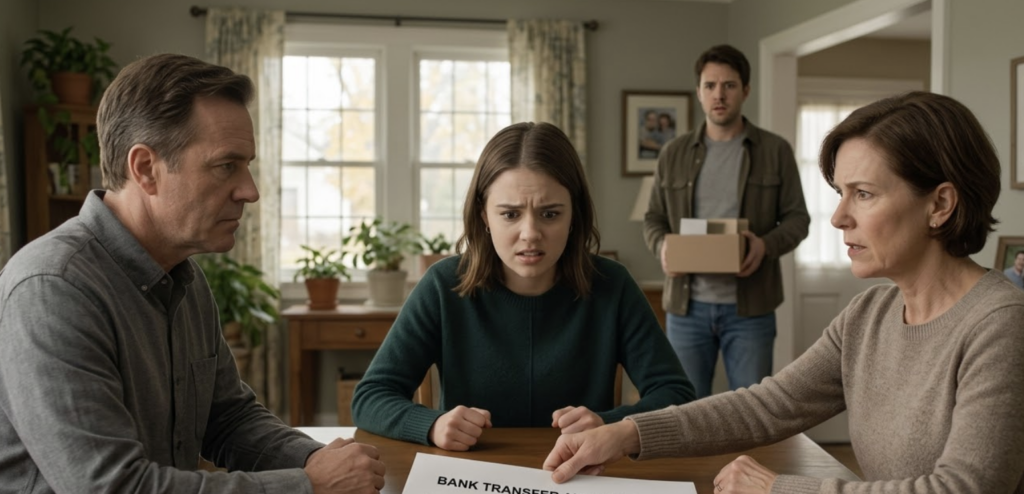
Her father was sitting at the dining table.
And directly in front of Emma’s chair was a single sheet of paper.
She sat down.
“What is this?”
Her father folded his hands.
“We need to talk about what’s fair.”
Emma looked at the paper.
It was a bank transfer authorization.
The amount had already been typed in.
$60,000.
Emma looked up.
“Who am I sending sixty thousand dollars to?”
Her mother answered without hesitation.
“Your brother.”
“Why Would I Give Michael $60,000?”
Emma laughed at first.
She genuinely thought it was a misunderstanding.
Her older brother Michael was thirty-two.
He was married.
He had two young children.
Emma loved him.
But their grandmother’s will had been clear.
Michael received several personal belongings and a smaller cash gift.
Emma received the remaining investment account.
Approximately $120,000 after expenses.
The reason wasn’t a mystery.
Emma had lived only fifteen minutes from Margaret during the final six years of her life.
She drove her to appointments.
Bought groceries.
Fixed things around the house.
Helped organize bills.
Visited almost every weekend.
Michael lived several states away.
There had never been a competition between them.
At least Emma hadn’t thought there was.
Her mother tapped the transfer form.
“Michael has two children.”
Emma stared at her.
“I know.”
“He has a mortgage.”
“I know that too.”
“You don’t.”
Emma slowly put the paper back on the table.
“So?”
Linda’s expression hardened.
“So you don’t need all that money.”
Her Father Called It “Balancing Things Out”
Emma looked toward her father.
She expected him to tell Linda this was ridiculous.
He didn’t.
Instead, he said:
“Grandma wasn’t thinking clearly about everyone’s needs.”
Emma’s expression changed.
“She had an attorney.”
“That’s not what I mean.”
“She knew exactly what she was doing.”
Her mother sighed.
“Emma, nobody is saying you should get nothing.”
“How generous.”
“You’d still have sixty thousand dollars.”
Emma couldn’t believe the conversation.
Her father leaned forward.
“Think about what sixty thousand means to Michael.”
Emma replied:
“Think about what it means to me.”
“You’re twenty-four.”
“And?”
“You have no kids.”
There it was again.
Emma looked between her parents.
“So because Michael has children, my money becomes family money?”
Her mother responded:
“It shouldn’t have been only yours in the first place.”
Then Linda Said Something That Changed the Argument
Emma pushed the transfer form away.
“No.”
Her mother looked stunned.
“What?”
“I’m not signing it.”
“Emma.”
“No.”
Linda’s voice became sharper.
“Your brother needs that money more than you do.”
Emma stood.
“Then you give him sixty thousand dollars.”
Her father’s expression changed.
“That’s disrespectful.”
“No. Asking me to hand over half my inheritance is disrespectful.”
Her mother stood too.
“You got that money because you lived close to Grandma.”
“I got it because Grandma left it to me.”
“And Michael couldn’t live close!”
“I never said he should have.”
“Then stop acting like you earned it.”
Emma froze.
That hurt more than the money argument.
For years, her parents had thanked her for taking care of Margaret.
Now suddenly it was being treated like an accident of geography.
Emma picked up her purse.
Then her mother said:
“You’re seriously going to choose money over your brother?”
Emma turned around.
“You’re the one who brought him into this.”
At that exact moment, the back door opened.
Michael walked into the kitchen.
“What did you bring me into?”
Nobody answered.
Michael Looked at the Transfer Form
Emma watched her parents’ faces change.
That was the first clue.
Michael wasn’t supposed to hear this conversation.
He had arrived early to pick up some boxes stored in the garage.
His mother immediately tried to redirect him.
“We’re just sorting out some of Grandma’s estate.”
Michael walked toward the table.
“What does that have to do with me?”
Emma said nothing.
She didn’t need to.
Michael saw the form.
Then the amount.
Then his own bank information.
He looked at his father.
“Why is Emma transferring me sixty grand?”
Linda answered:
“We’re trying to make things fair.”
Michael looked confused.
“Fair how?”
“You have the kids. The house. Everything is expensive.”
Michael’s expression slowly changed.
“Did I ask for this?”
Linda hesitated.
“No.”
“Does Emma owe me money?”
“No.”
“Then what are you doing?”
That Was Not the Reaction Their Parents Expected
Emma had spent the entire drive over wondering whether Michael already knew.
Maybe he had complained.
Maybe he believed Grandma had treated him unfairly.
Maybe this entire conversation had started with him.
Apparently not.
Michael picked up the transfer form.
“You filled this out?”
Their father said:
“We were going to discuss it as a family.”
Michael looked at Emma.
“Did you agree to this?”
“No.”
He dropped the paper back on the table.
“Then there is nothing to discuss.”
Linda became frustrated.
“Michael, you don’t understand.”
“I understand perfectly.”
“No, you don’t. You have two children to think about.”
Michael laughed.
“So?”
His mother looked stunned.
“So this money could help your family.”
“Mom, it isn’t my money.”
But There Was More to It
Emma thought that would end the argument.
Instead, Michael asked a question.
“Why exactly do you need Emma to give me sixty thousand dollars?”
Their father immediately responded:
“We don’t need anything.”
Michael stared at him.
“That wasn’t my question.”
Linda became defensive.
“We’re trying to help you.”
Michael leaned against the counter.
“I never told you I needed sixty grand.”
“You’ve talked about how expensive the house is.”
“Everybody complains about their mortgage.”
“You said you wanted to renovate the basement.”
Michael actually laughed.
“You tried to take Emma’s inheritance because I mentioned a basement?”
Nobody answered.
Then Michael’s expression changed.
“Wait.”
He looked at his parents.
“What did you tell Grandma?”
The room went quiet.
Emma frowned.
“What do you mean?”
Michael looked at her.
“Grandma called me about money six months before she died.”
Grandma Had Already Asked Michael
Michael explained.
Margaret had called him personally.
She told him she was updating her estate.
She asked whether he was financially stable.
Michael told her yes.
Not wealthy.
Not debt-free.
But stable.
Then Margaret said she intended to leave most of one account to Emma.
Michael hadn’t objected.
“She asked if I thought that was unfair,” Michael said.
Emma stared at him.
“What did you say?”
“I told her it was her money.”
Linda interrupted.
“Michael—”
He ignored her.
“I also told her you did way more for her than I did.”
Emma didn’t know what to say.
Their parents clearly did.
Their father said:
“That doesn’t mean the amounts needed to be so different.”
Michael turned toward him.
“She asked me directly.”
“And you should have thought about your children.”
Michael stared at his father.
“Grandma wasn’t responsible for funding my kids.”
Emma Finally Asked the Obvious Question
“If Michael knew about the inheritance…”
She looked at her parents.
“…why did you tell me he’d be hurt?”
Michael’s head turned.
“You told her what?”
Emma felt something shift.
During the weeks after the will was read, Linda had repeatedly warned Emma not to talk about the money around Michael.
“He’s having a hard time with it.”
“Give him space.”
“He thinks Grandma forgot about him.”
Emma had believed all of it.
Michael now looked furious.
“I never said any of that.”
Linda crossed her arms.
“We were trying to prevent conflict.”
Michael responded:
“You created one.”
Their Father Finally Explained What Was Really Going On
The conversation went in circles for almost twenty minutes.
Then Robert finally admitted something neither sibling expected.
This wasn’t only about Michael.
Their parents hated how Margaret had structured the inheritance.
They believed parents and grandparents should divide money equally between children and grandchildren.
Anything else created resentment.
Emma asked:
“What resentment?”
Their father responded:
“The kind we’re dealing with right now.”
Michael shook his head.
“We weren’t resentful.”
Their father looked at him.
“Maybe not yet.”
That sentence explained everything.
Their parents had been so convinced unequal money would destroy the sibling relationship that they had tried to “correct” the inheritance themselves.
And in doing so, they almost created the exact problem they feared.
Then Emma Learned About the Promise
But there was one final complication.
Michael sat down.
“Mom, did you already promise Megan the basement renovation?”
Linda went pale.
Emma looked between them.
“What?”
Michael explained.
Several weeks earlier, Linda had told his wife Megan that the family might soon have money available to help them renovate their basement into an extra bedroom and playroom.
Megan assumed Linda and Robert were offering their own money.
Michael had told her they shouldn’t accept.
Now he understood where that “family money” was supposed to come from.
Emma stared at her mother.
“You already promised my money to somebody?”
“I didn’t promise anything.”
“You told her money would be available.”
“I said we might be able to help.”
“With MY inheritance.”
Linda stopped talking.
That was the point when Emma stopped being angry and became very calm.
She took the transfer form.
Folded it in half.
Then tore it down the middle.
Michael Made His Own Position Clear
He looked at Emma.
“Don’t give me anything.”
Emma nodded.
“I wasn’t planning to.”
For the first time all afternoon, they both laughed.
Then Michael became serious.
“If you ever WANT to help my kids someday, that’s between you and them.”
Emma nodded again.
“But nobody gets to decide that for you.”
Their father looked disappointed.
“So that’s it? Everyone just keeps whatever they’re given?”
Michael answered:
“Yes.”
Robert shook his head.
“That isn’t how families should work.”
Michael replied:
“No. Families help each other because they choose to. Not because somebody fills out a transfer form behind their back.”
Emma Didn’t Spend the Money
Not immediately.
That surprised her parents.
They seemed to imagine she would buy a luxury car or take a year off work.
Instead, Emma met with a financial adviser.
She paid off the small remaining balance on her student loans.
She kept an emergency fund.
She invested most of what remained.
Then she did something nobody knew about.
She opened two small investment accounts.
One for Michael’s daughter.
One for his son.
Not because her parents asked.
Not because Michael expected it.
She didn’t even tell him for nearly a year.
The accounts were modest.
Nothing close to $60,000.
But Emma made occasional contributions on birthdays and holidays.
When Michael eventually found out, he called her.
“You know you don’t have to do this.”
Emma replied:
“I know.”
“Then why are you?”
“Because I want to.”
Michael laughed.
“Fair enough.”
That difference mattered to her.
A Year Later
The family relationship improved, but slowly.
Emma never gave her parents access to her financial information again.
Michael stopped discussing major expenses around them because every complaint seemed to become a problem they wanted to solve.
Linda eventually apologized.
Not for believing the inheritance was unfair.
She still believed that.
But for trying to pressure Emma into changing it.
Emma accepted the apology.
She didn’t change her decision.
At Thanksgiving the following year, Michael sat beside her.
Their mother mentioned how expensive children’s summer programs had become.
Michael immediately raised his hand.
“Before anyone gets ideas, Emma is not funding summer camp.”
Emma nearly choked on her drink.
Linda rolled her eyes.
Even she laughed.
The argument didn’t disappear from family history.
But it stopped defining the family.
And Emma eventually understood something her grandmother seemed to understand long before any of them.
Fair doesn’t always mean equal.
And generosity only means something when the person giving actually gets to choose.

















