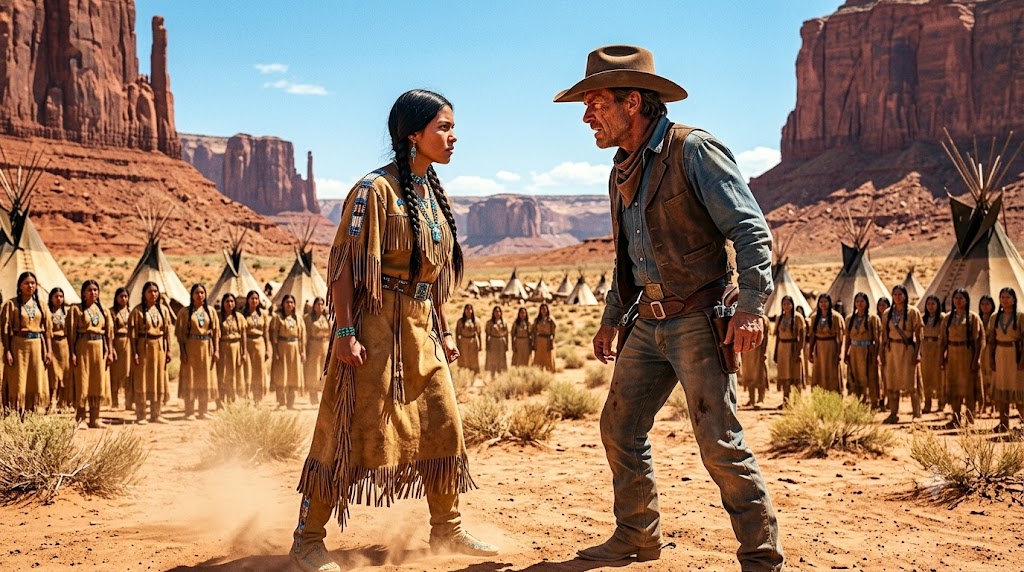
By noon, the canyon had become an oven.
Heat shimmered above the red earth in silver waves, bending the horizon until the distant mesas seemed to float over the valley like ships upon a burning sea. No cloud moved across the enormous western sky. Even the hawks had abandoned the open air, choosing whatever scraps of shadow they could find beneath the stone ledges.
Elias Mercer sat straight in the saddle despite the sweat crawling beneath his shirt.
His horse, a rangy chestnut gelding named Bishop, breathed heavily beneath him.
Ahead sprawled the encampment.
Dozens of painted tipis stood along the shallow bend of a river that had shrunk to a ribbon beneath the summer sun. Horses grazed beyond the cottonwoods. Children watched from the shade. Old men sat silently beneath stretched hides. Women stopped grinding corn or carrying water as Elias rode into the heart of the settlement.
Every face turned toward him.
He had known they would stare.
He had not expected twenty-two women to be waiting in formation.
They stood shoulder to shoulder beneath the glaring sun, each dressed in soft buckskin decorated with beadwork, shells, strips of dyed leather, or small pieces of polished metal that flashed when the wind moved them.
Twenty-two.
Elias counted twice because the situation was too absurd to trust the first number.
He dismounted slowly.
His boots struck the earth.
No one spoke.
At the front of the gathering stood an older woman with silver braided into her dark hair. Her back was straight despite her years, and an eagle-bone necklace rested against her chest. Elias had been told her name was Nita Gray Elk and that arguing with her was something even warriors approached carefully.
She raised one hand.
“Elias Mercer.”
Her English was precise.
Elias removed his hat.
“Ma’am.”
A few younger men exchanged glances, apparently entertained by the word.
Nita ignored them.
“You crossed the Red Knife boundary three days ago.”
“By invitation.”
“You entered our council lodge.”
“Also by invitation.”
“You ate at our fires.”
“I was hungry.”
This time several people smiled.
Nita did not.
“And you asked for passage through the western canyon.”
Elias glanced toward the towering wall of sandstone behind the settlement.
“Yes.”
The western canyon was the only route through the mountains that would allow Elias to reach Fort Brennan before the end of the week.
And reaching Fort Brennan mattered.
A leather satchel rested beneath his saddle blanket.
Inside it were survey maps, signed statements, shipping records, and three letters that might be enough to prevent thousands of acres from being stolen.
If he failed to deliver them, men with money, soldiers, lawyers, and railroad interests would soon descend upon the valley.
Most of the people watching him did not know that.
Not yet.
Nita stepped aside.
Her arm extended toward the waiting women.
“Twenty-two women,” she said.
Elias frowned.
“Beg pardon?”
“Choose one.”
Silence settled over the encampment.
Elias stared at her.
Nita continued.
“She may ride beside you as your wife.”
For several heartbeats, Elias assumed he had misunderstood.
Then he looked at the women.
Some appeared solemn.
One seemed irritated.
Another was suppressing a smile.
A young woman near the far end rolled her eyes as if she had somewhere better to be.
Elias turned back toward Nita.
“You’re serious.”
“I rarely waste breath on jokes.”
His jaw tightened.
“Then I’m afraid you’ve wasted twenty-two women’s time.”
A murmur moved through the gathering.
Nita’s eyes narrowed.
“You asked us for the protection of our western trail.”
“I asked permission to cross it.”
“No outsider crosses alone.”
“Then give me a guide.”
“We are offering you more than a guide.”
Elias took one step backward.
His disbelief hardened into anger.
He swept a hand toward the women.
“You expect me to choose a wife like I’m picking a horse from a corral?”
The murmuring died instantly.
Several men stiffened.
Elias knew he had spoken dangerously.
He did not care.
His gaze moved along the line of women.
“They have names,” he said. “Families. Minds of their own. I won’t point at one because somebody tells me she belongs in my saddle.”
Nita’s expression changed.
Not anger.
Something more complicated.
Assessment.
Elias continued.
“If refusing passage is the price, then I’ll ride around the mountains.”
“You will lose four days.”
“That’s my problem.”
“It may become ours.”
Before Elias could answer, movement erupted from the line.
One of the women stepped forward.
Not cautiously.
She came through the dust like a storm.
She was perhaps twenty-six, maybe twenty-eight, though something in her eyes made guessing her age feel foolish. Her dark hair hung in two long braids bound with narrow red leather. A faded blue cloth had been tied around one wrist. A knife rested at her waist, though her hand remained nowhere near it.
She stopped inches from Elias.
He was taller.
It did not feel that way.
Her eyes were dark, furious, and entirely unimpressed.
“You talk too much,” she said.
Her English was better than his manners.
Elias raised an eyebrow.
“That’s been mentioned.”
She pointed toward the line behind her.
“You think you understand what happened here?”
“I understand I was told to select a human being.”
“No.”
Her voice sharpened.
“You were told to choose the woman you would be willing to die beside.”
The canyon went silent.
Then she stepped closer.
“And then,” she said, “she decides whether you are a man worth following.”
Elias stared at her.
Behind them, someone coughed.
The young woman did not blink.
The balance of power shifted so completely that Elias almost laughed.
Almost.
Instead he looked at Nita.
The older woman’s mouth had curled into the faintest smile.
“You might have explained that part.”
Nita shrugged.
“I wanted to see what kind of man you were before explaining anything.”
Elias put his hat back on.
“And?”
The young woman before him answered.
“Undecided.”
A few people laughed openly now.
Elias looked down at her.
“What’s your name?”
“Mara.”
“Mara what?”
“Mara is enough until I decide otherwise.”
He nodded.
“Fair.”
She folded her arms.
“Well?”
“Well what?”
“Choose.”
Elias looked past her at the twenty-one women still standing.
Then back at Mara.
“You already stepped out.”
“I stepped out because you insulted us.”
“You’re the only one who threatened me with a lecture.”
“I can threaten you with other things.”
“I believe you.”
The corner of her mouth moved.
Barely.
Elias pointed toward her.
“Her.”
The settlement went quiet again.
Mara’s amusement vanished.
Nita turned to her.
“He chooses Mara.”
Mara stared at Elias for an uncomfortable amount of time.
Then she walked around him.
She examined his boots.
His revolver.
His worn coat.
The repaired saddle.
Bishop.
Finally she stopped in front of him again.
“No.”
Elias blinked.
“No?”
“No.”
Someone behind them burst into laughter.
Elias turned slowly toward Nita.
The older woman looked positively delighted.
“You told me to choose.”
“You chose.”
“You neglected to mention she could immediately reject me.”
“I did mention it.”
“After making me look like an idiot.”
“That was not difficult.”
The entire camp erupted.
Even Elias laughed this time.
Mara did not.
She was studying him.
After the laughter faded, she said, “Ask me properly.”
Elias sighed.
“Mara, will you ride with me through the western canyon?”
“No.”
He rubbed his forehead.
“Mara.”
“Ask why.”
“Why?”
“Because you still think you need a guide.”
“And I don’t?”
“No.”
She looked toward the western mountains.
“You need someone who knows why men are waiting there to kill you.”
The laughter disappeared.
Elias stopped breathing.
Mara turned back.
For the first time, there was no challenge in her expression.
Only warning.
“Now,” she said quietly, “ask me again.”
Elias had spent most of his thirty-seven years learning not to trust sudden changes in weather, whiskey offered free of charge, or men who smiled during business negotiations.
He added beautiful women delivering warnings about assassins to that list.
An hour later, he sat inside Nita Gray Elk’s tipi while Mara crouched opposite him over a hide map of the canyon.
A small coal fire smoldered between them despite the heat.
Nita sat beside the entrance.
Three council elders completed the circle.
Elias placed his own survey map over Mara’s.
“You said men are waiting.”
Mara nodded.
“How many?”
“Six that we know of.”
“Who?”
“White men.”
“That narrows it down to half the territory.”
“One wears a railroad coat.”
Elias went still.
Mara noticed.
“You know him?”
“Maybe.”
He removed the leather satchel from his shoulder and placed it beside him.
Nita’s gaze immediately dropped to it.
“What do you carry?”
“Trouble.”
“That was already obvious.”
Elias exhaled.
“Three months ago, I was hired by the Continental Western Railroad to survey a possible route between Brennan and Carson Ridge.”
Mara frowned.
“You work for the railroad?”
“Worked.”
“That is not an answer I like.”
“Neither did my employer.”
He unfolded his survey.
A thick black line crossed the western canyon.
“When I reached this valley, I discovered their proposed route didn’t stop at the pass. It crossed directly through your northern grazing lands.”
Nita leaned forward.
“We were told the railway would remain south of the river.”
“That’s what the federal map says.”
Elias tapped the parchment.
“This is the internal map.”
Silence.
One of the elders muttered something in their language.
Mara’s expression hardened.
Elias continued.
“The company found coal beneath the northern ridge.”
“How much?”
“Enough to make a few men extremely rich.”
“And our people extremely inconvenient,” Mara said.
Elias looked at her.
“Exactly.”
Nita’s voice dropped.
“What is inside the satchel?”
“Proof that the railroad falsified survey documents. Proof they bribed the territorial land agent. And correspondence showing they intend to provoke an incident here.”
Mara’s face changed.
“What kind of incident?”
“The kind newspapers will call an attack.”
No one spoke.
Elias hated the words even as he said them.
“They need the government to believe this valley is unstable. Dangerous. If violence breaks out, soldiers will come. Once that happens, the railroad can pressure Washington to redraw the boundary.”
Nita stared at him.
“And you learned this how?”
“I was supposed to sign the false survey.”
“Did you?”
“No.”
“Why?”
Elias considered giving her something noble.
The truth seemed safer.
“Because my father spent twenty years teaching me that a thief wearing a suit is still a thief.”
Mara watched him closely.
“What happened after you refused?”
“They fired me.”
“That all?”
“No.”
He lifted his shirt slightly.
A healing scar ran along his ribs.
“They also tried persuasion.”
Mara leaned forward.
Her eyes followed the scar before returning to his face.
“You escaped.”
“Barely.”
“And now?”
“I have to reach Fort Brennan. Judge Samuel Hollis is holding a federal land hearing in two days. He’s one of the few men in the territory who isn’t owned by Continental Western.”
Nita exchanged a look with the elders.
“If the documents reach him?”
“The railway project stops. At least temporarily.”
“And if they do not?”
Elias looked toward the satchel.
“By winter, this valley may belong to men who’ve never seen it.”
The fire cracked.
Outside, children were laughing.
The ordinary sound made the room feel heavier.
Mara reached for Elias’s map.
Her finger traced the canyon.
“The road through here is watched.”
“I assumed that.”
“There is another trail.”
Nita looked sharply at her.
“Mara.”
“The high trail.”
One of the elders protested.
Mara answered rapidly in their language.
The argument lasted less than a minute but contained enough emotion to fill an hour.
Finally Nita looked at Elias.
“The high trail has not been used in years.”
“Why?”
“Rockfall. Narrow ledges. No water after the second ridge.”
“Sounds pleasant.”
“You will not survive it alone.”
Elias looked at Mara.
She stared back.
“Ask again,” she said.
This time he understood.
Not marriage.
Not ownership.
Not some ritual he could reduce to his own assumptions.
Trust.
Partnership.
Perhaps something older than either word.
Elias removed his hat.
“Mara, daughter of this valley, will you ride beside me?”
She considered him.
“And if men come?”
“We ride through them.”
“If you must choose between the papers and me?”
Elias hesitated.
That hesitation lasted only a heartbeat.
But Mara saw it.
“The papers,” she said.
“No.”
Her brow furrowed.
“No?”
“If I choose papers over the person helping me carry them, then I’m no better than the men I’m fighting.”
Something shifted behind her eyes.
She looked toward Nita.
The older woman nodded once.
Mara stood.
“I will ride.”
Elias rose.
“Thank you.”
She pointed at him.
“I did not say I would marry you.”
“I’m devastated.”
“You should be.”
They left before sunset.
Mara rode a gray mare with black stockings and a scar across its shoulder. She carried a rifle in a leather scabbard, two canteens, dried meat, a blanket, and almost nothing else.
Elias had packed enough for three days.
Mara removed half of it.
“You don’t need this.”
“That’s coffee.”
“You do not need coffee.”
“Now we have our first serious disagreement.”
She tossed the coffee sack back into his saddlebag.
“Fine. Die carrying it.”
They rode northwest beneath the falling sun.
The camp disappeared behind them.
For two hours, neither spoke.
The land changed as they climbed.
Cottonwoods gave way to juniper. Red sand became broken stone. Shadows filled the canyon cuts long before darkness touched the higher cliffs.
Elias had crossed difficult country before.
Mara moved through it differently.
She seemed to read signs invisible to him.
A snapped stem.
A disturbed patch of dust.
Birds rising from a distant slope.
Once she lifted her hand and stopped him.
“What?”
She pointed.
Elias saw nothing.
Then a flicker of movement appeared along a ridge half a mile away.
A horse.
Then another.
“Someone following?”
“Watching.”
“Railroad?”
“Maybe.”
Elias’s hand drifted toward his revolver.
Mara noticed.
“If you shoot at everything watching you, the mountains will become very loud.”
“I prefer knowing what’s behind me.”
“I prefer knowing what’s ahead.”
“That why you rejected me?”
“You were standing ahead of me.”
He glanced sideways.
She was smiling.
Only slightly.
They made camp after dark beneath an overhanging shelf of stone.
No fire.
Mara insisted.
Elias ate dried venison and drank water.
He stared mournfully at his coffee pot.
“You cannot be serious,” Mara whispered.
“I’m grieving.”
“For coffee?”
“For civilization.”
She looked around at the moonlit canyon.
“You call the thing building railroads through people’s homes civilization?”
The humor left him.
“No.”
“Then choose your words carefully.”
Elias nodded.
“That was poorly said.”
Mara seemed surprised by the immediate apology.
“You admit mistakes quickly.”
“I make enough of them to practice.”
She studied him.
“What did you think today?”
“About what?”
“When you saw the women.”
He leaned back against the stone.
“You want the polite answer?”
“No.”
“I thought your people were trying to trade a woman for access to the canyon.”
Her jaw tightened.
“I know.”
“And I was angry.”
“At us.”
“At the idea.”
“That matters?”
“Yes.”
“Why?”
Elias looked toward Bishop, sleeping nearby.
“My mother was married at sixteen.”
Mara waited.
“To a man twice her age,” Elias continued. “Not my father. First husband. Her family had debts. He had money.”
Mara’s expression softened.
“She left him?”
“Eventually.”
“What happened?”
“He broke her arm.”
The words sat between them.
“She waited until he fell asleep. Took his horse and sixty dollars from his desk.”
Mara almost smiled.
“I like your mother.”
“So did my father. Met her two years later.”
“She chose him?”
“Every day for twenty-eight years.”
Mara looked toward the stars.
“That is different.”
“From what?”
“The way men speak of women in towns.”
“You’ve spent time in towns?”
“Enough.”
“Which ones?”
“Brennan. Santa Fe. Denver once.”
“That’s more traveling than most ranchers I know.”
“My father believed knowing two worlds might keep me alive in both.”
“Did it?”
Her face became unreadable.
“He died trying.”
Elias did not ask how.
Not yet.
After a while Mara said, “What happened today was not an old marriage ceremony.”
“I suspected that.”
“It was Nita’s test.”
“Of me?”
“Of all of us.”
Elias turned.
“How?”
“The women volunteered.”
“All twenty-two?”
“Yes.”
“Why?”
“Because whoever rode with you might not return.”
Elias looked at her differently now.
“You volunteered before knowing me.”
“I knew what you carried.”
“Then why the performance?”
“Nita wanted to know whether you saw us as people.”
“And if I had chosen immediately?”
“No one would have gone.”
Elias laughed under his breath.
“So the only correct choice was refusing the choice.”
“Perhaps.”
“That woman is terrifying.”
“Yes.”
Silence returned.
Then Elias asked, “Why did you volunteer?”
Mara’s fingers tightened around the edge of her blanket.
“My father’s name was Tomas Red Bird.”
Elias waited.
“He worked as an interpreter between our council and the territorial office. Two years ago, he discovered boundary markers had been moved.”
Elias sat straighter.
“He confronted the land agent.”
“He disappeared on his way home.”
The night seemed suddenly colder.
“Was his body found?”
“No.”
“I’m sorry.”
“I do not need sorry.”
“What do you need?”
Her eyes found his.
“The truth.”
At dawn they discovered the first dead horse.
It lay in a narrow wash half a mile from camp.
No rider.
Mara dismounted.
Elias followed.
A saddle remained strapped to the animal.
“That horse was shot,” he said.
Mara crouched beside the tracks.
“Yesterday.”
“You recognize it?”
“No.”
She studied the ground.
“Three riders stopped here. One horse fell. Two continued.”
“Which direction?”
She looked up the canyon.
“The same direction we are going.”
Elias swore.
They mounted and rode hard.
By midmorning, clouds gathered over the western peaks.
Not rain clouds.
Dust.
Wind screamed through the canyon gaps.
Mara led him away from the main trail toward a steep incline where barely enough earth existed for horses to climb.
Bishop stumbled twice.
“Easy,” Elias murmured.
The trail narrowed.
To their right, the mountainside rose nearly vertical.
To their left waited several hundred feet of empty air.
Mara did not slow.
“Is this the high trail?”
“Yes.”
“You could’ve lied.”
“About what?”
“Calling it a trail.”
She looked back.
“Scared?”
“Reasonably.”
“Good.”
“Why good?”
“Fearful men pay attention.”
They climbed another hundred yards.
Then Mara stopped.
Her rifle appeared in her hands.
Elias saw the problem a moment later.
A man sat on horseback above them.
Black coat.
Gray hat.
Rifle across his saddle.
“Mercer!” the man called.
Elias recognized the voice.
Silas Rourke.
Continental Western’s chief security man.
A former cavalry scout who had discovered that corporations paid better than governments for the same willingness to kill.
“Silas.”
“Been a long ride chasing you.”
“I’d apologize, but you look like you needed exercise.”
Rourke smiled.
Two more men appeared behind him.
Mara whispered, “Three.”
“There’ll be others below.”
“How many?”
“Silas never travels with fewer than six.”
Rourke raised his voice.
“Give me the satchel, Mercer.”
“And then?”
“You ride home.”
“You promise?”
“I do.”
Elias looked at Mara.
She shook her head.
He called upward.
“My friend says you’re lying.”
Rourke studied Mara.
“You found yourself a little mountain bride?”
Elias saw Mara’s expression go cold.
“Silas.”
“What?”
“Careful.”
Rourke laughed.
Mara lifted her rifle.
She fired.
The bullet struck the rock beside Rourke’s horse.
The animal reared violently.
Rourke cursed and fought the reins.
Elias stared at Mara.
“You missed.”
“No.”
A slab of stone cracked loose beneath Rourke’s horse.
The ledge collapsed.
Not enough to send horse or rider over the edge, but enough to block the narrow approach in an explosion of dust.
“Ride!” Mara shouted.
They drove their horses forward.
Gunfire cracked behind them.
A bullet struck stone near Elias’s head.
Another ripped through the rolled blanket on Bishop’s saddle.
The high trail curved around the mountain.
They vanished from Rourke’s line of sight.
Mara pointed toward a narrow gap.
“There!”
They pushed through.
The trail descended sharply into a maze of sandstone formations.
For ten minutes they rode without stopping.
Finally Mara pulled up beneath a cliff.
Elias looked behind them.
Nothing.
“You planned that?”
“The rock?”
“Yes.”
“I noticed the crack yesterday.”
“You came through here yesterday?”
“Three days ago.”
“You could’ve mentioned that.”
“You talk enough for both of us.”
Despite himself, Elias grinned.
Then Mara’s smile disappeared.
Blood stained her sleeve.
“Mara.”
“It is nothing.”
“You’re hit.”
“Grazed.”
He dismounted immediately.
“So did your blanket.”
“My blanket doesn’t bleed.”
She tried to move away.
He caught her wrist gently.
“Let me see.”
Her eyes flashed.
“Ask.”
Elias released her instantly.
The lesson landed.
“May I?”
Mara looked at him for several seconds.
Then nodded.
The bullet had cut along the outside of her upper arm. Painful, bloody, but shallow.
Elias cleaned the wound with water.
Mara watched his hands.
“You are careful.”
“I’ve been shot before.”
“That does not make you a doctor.”
“It makes me opinionated about bandages.”
She almost laughed.
Then she winced.
He tied the cloth securely.
“There.”
Mara flexed her arm.
“Acceptable.”
“High praise.”
She met his eyes.
They were closer than either had realized.
For a moment the canyon vanished.
No railroad.
No gunmen.
No mission.
Just sunlight catching the loose strands of her hair.
Elias stepped back first.
“We should move.”
Mara looked away.
“Yes.”
They reached Willow Spring shortly before dusk.
Or what should have been Willow Spring.
The pool was dry.
Mara dismounted and stared at the cracked mud.
“That is impossible.”
“Springs fail.”
“Not this one.”
She walked upstream.
Elias followed.
Two hundred yards into a narrow ravine they found the answer.
Dynamite.
The watercourse had been deliberately collapsed beneath tons of rock.
Elias crouched.
“Rourke.”
Mara touched the shattered stone.
“They knew we would use the high trail.”
“Then someone told them.”
She stood slowly.
“Someone in the camp?”
“Or someone who knows your trails.”
Her gaze hardened.
“My people do not sell our roads.”
“Every people has men who sell something.”
Mara turned on him.
“You think one of us betrayed you?”
“I think Rourke knew where we’d go.”
“That is not proof.”
“No.”
“Then do not accuse.”
“I didn’t.”
“You thought it.”
“I think a lot of things.”
“That is your problem.”
She walked away.
Elias let her.
They rationed what water remained.
Enough for perhaps a day.
Fort Brennan was still almost sixty miles away.
By midnight, thunder rolled over the mountains.
Mara sat beneath a juniper, awake.
Elias joined her.
“You should sleep.”
“So should you.”
“I can’t.”
“Neither can I.”
Lightning flickered far to the south.
After several minutes Mara said, “My father trusted white officials.”
Elias said nothing.
“He believed agreements mattered if both sides understood the words.”
“That sounds reasonable.”
“He was wrong.”
“Maybe the men were wrong.”
“That distinction did not save him.”
“No.”
She looked at Elias.
“You defend your world often.”
“Do I?”
“Yes.”
“Maybe because you speak of it like every person in it is the same.”
“And we are all different?”
“Yes.”
“Then perhaps we both make the same mistake.”
Elias considered that.
“Fair.”
Mara looked surprised.
“You say that often.”
“What?”
“Fair.”
“My father used to say most fights grow because somebody values winning more than being fair.”
“Was he wise?”
“No. He once tried to milk a bull.”
Mara stared at him.
Then she laughed.
Not the restrained half-smile he had seen before.
A real laugh.
Bright and sudden.
Elias found himself staring.
She noticed.
“What?”
“Nothing.”
“You are looking strangely.”
“I’ve never heard you laugh.”
“That is because you are rarely funny.”
“Cruel.”
Her smile lingered.
Then she asked, “Were you married?”
The question caught him.
“No.”
“Why?”
“I nearly was.”
“What happened?”
“She realized she wanted a banker.”
“And you were a cowboy.”
“Surveyor.”
“With a cowboy hat.”
“It’s a good hat.”
“She chose the banker?”
“Yes.”
“Are you angry?”
“No. She has three children and a house in St. Louis. Last I heard, she was happy.”
“You do not hate her?”
“For choosing the life she wanted?”
Mara shook her head.
“No.”
“Then no.”
She studied him again.
“What?”
“I am reconsidering.”
“What?”
“Whether you are worth following.”
Elias smiled.
“Progress.”
“I did not say the answer improved.”
The traitor found them the next afternoon.
His name was Daniel Crow.
Mara recognized him first.
They were riding through a cedar basin when she suddenly drew her rifle.
A lone horseman approached with both hands visible.
“Mara!” he shouted.
She did not lower the weapon.
“Daniel?”
Elias moved beside her.
The young man appeared exhausted. Blood darkened his forehead.
“Do not shoot.”
Mara dismounted.
Daniel nearly fell from his horse.
She caught him.
“What happened?”
“They attacked the camp.”
Mara went rigid.
“When?”
“After sunrise.”
“How many?”
“Rourke sent men. They fired from the ridge. No one was killed, but two were wounded.”
Elias felt sick.
“The incident,” he said.
Daniel nodded.
“They want retaliation.”
Mara grabbed Daniel’s coat.
“Nita?”
“Alive.”
“My mother?”
“Alive.”
Her shoulders sagged.
Only slightly.
Then Daniel looked at Elias.
“They took the papers.”
Elias froze.
“What?”
“Copies.”
“What copies?”
Daniel looked ashamed.
“I told Nita to make copies of everything before you left.”
Mara stared.
“You knew?”
“I suspected something might happen.”
“You did not tell us?”
“I was trying to protect the evidence.”
Daniel looked away.
“They forced me to show them where the copies were.”
Mara’s voice became dangerously quiet.
“Forced?”
Daniel did not answer.
Elias understood first.
“You told them.”
Daniel closed his eyes.
Mara stepped backward.
“Why?”
“My brother is in prison in Brennan.”
“You betrayed the council for him?”
“They said they would release him!”
“They are liars!”
“I know that now!”
Mara struck him.
Not hard enough to knock him down.
Hard enough to make the meaning clear.
Daniel accepted it.
“They’re going to Fort Brennan,” he said. “Rourke too. He knows about Judge Hollis.”
Elias turned toward the mountains.
“How far ahead?”
“Four hours.”
“We’ll never beat them on horses.”
Daniel shook his head.
“There is another way.”
Mara laughed bitterly.
“You have given enough directions.”
“I deserve that.”
“Yes.”
“But listen.”
He pointed north.
“The mining company built a supply rail spur last year. It runs through Coldwater Cut. There is a maintenance engine near the old quarry.”
Elias frowned.
“You know how to operate it?”
Daniel looked at him.
“No.”
Mara looked at Elias.
He smiled faintly.
“My father worked rail before ranching.”
She stared.
“You know?”
“A little.”
“That is not confidence.”
“It’s honesty.”
Daniel said, “If the engine still runs, you can reach Brennan before midnight.”
Mara mounted.
Elias looked at her.
“You trust him?”
“No.”
Daniel lowered his head.
Mara continued.
“But I trust that he hates himself right now.”
She kicked the gray mare forward.
“That may be enough.”
The maintenance engine was small, ugly, and built like a metal coffin.
Elias loved it immediately.
They found it beneath a wooden shed beside the abandoned quarry.
The boiler still held pressure from workers who had fled when Daniel approached earlier that day.
Elias climbed into the cab.
Mara stared at the machinery.
“This is a terrible horse.”
“It doesn’t bite.”
“It screams.”
“That’s personality.”
Daniel remained behind with the horses.
Before they left, Mara handed him her rifle.
“Return to the camp.”
He stared at her.
“You trust me with this?”
“No.”
“Then why?”
“Because trust is not always given after someone deserves it.”
Daniel swallowed.
“Sometimes it is given so they have a chance to.”
Elias watched the words hit him.
Daniel nodded.
“I will bring it home.”
Mara climbed into the locomotive.
Elias opened the throttle.
The engine jerked so violently Mara nearly fell.
She caught a metal rail.
“You said you knew how!”
“I said a little!”
The locomotive crawled forward.
Then faster.
Steam screamed.
The wheels hammered over the rails.
They plunged into Coldwater Cut as sunset burned behind the mountains.
For nearly three hours, they raced east.
Night swallowed the desert.
The railway became a silver line in moonlight.
Brennan’s lights appeared near eleven.
Then Elias saw a lantern ahead.
Red.
He swore.
“What?”
“Track switch.”
“Meaning?”
“Meaning somebody expects us.”
A freight wagon had been pushed across the rail.
Mara grabbed the cab wall.
“Can we stop?”
“Not in time.”
“Then what?”
Elias pulled the brake lever.
Metal screamed.
Sparks burst from the wheels.
The locomotive shuddered.
Too fast.
“Jump!”
They leapt.
Elias hit gravel and rolled.
Pain exploded through his shoulder.
Behind them the maintenance engine struck the wagon.
Wood shattered.
Iron shrieked.
The locomotive toppled sideways in a cloud of steam.
For several seconds Elias heard nothing but ringing.
Then—
“Mara!”
No answer.
He staggered upright.
“Mara!”
A shadow moved near the ditch.
“I am here.”
He reached her.
Blood marked her temple, but she was standing.
“You hurt?”
“Ask me tomorrow.”
Hoofbeats sounded.
Three riders emerged from the darkness.
Rourke had waited.
Elias drew.
Gunfire erupted.
He and Mara dove behind the wrecked wagon.
Bullets punched through wood.
“How many shots?” she asked.
“Six.”
“You have six?”
“Five.”
“Why five?”
“I shot a snake yesterday.”
She stared at him.
“You never told me.”
“You were asleep.”
Another shot struck the wagon.
Mara grabbed a broken piece of wood.
“What are you doing?”
“Being useful.”
“This isn’t a knife fight.”
“No.”
She pointed toward a lantern hanging from the overturned locomotive.
Oil spilled beneath it.
Elias understood.
“You are frightening.”
“Thank you.”
He fired twice toward the riders.
They scattered.
Mara threw the wood.
The lantern fell.
Flames rushed across the spilled oil.
The horses panicked.
One rider fled.
Another was thrown.
Rourke jumped from his saddle.
He came toward them on foot.
“Mercer!”
Elias emerged.
“You’re persistent, Silas.”
“Give me the satchel.”
“No.”
Rourke raised his revolver.
Mara appeared beside Elias.
Rourke laughed.
“You two really became partners.”
Mara said, “He is still being evaluated.”
Even then, Elias smiled.
Rourke did not.
“Last chance.”
Elias slowly removed the satchel.
He held it out.
Mara turned toward him.
“Elias.”
“Trust me.”
Rourke approached.
Elias tossed the bag.
It landed between them.
Rourke bent.
Elias kicked the revolver from his hand.
Rourke lunged.
They crashed into the dirt.
Rourke was bigger.
Stronger.
Elias was angrier.
Neither advantage proved decisive.
Rourke struck his injured ribs.
Elias lost his breath.
Rourke reached for the gun.
Mara stepped between them.
Her boot came down on the weapon.
Rourke froze.
She held no rifle.
No knife.
Only his gun beneath her foot.
“You planning to shoot me?” he asked.
“No.”
“Then move.”
“No.”
He stepped toward her.
Elias rose behind him.
Mara met Rourke’s stare.
“You confuse mercy with weakness.”
Sirens sounded in the distance.
Not police sirens.
Army bugles.
Riders approached from Brennan.
Rourke looked toward them.
Elias smiled.
“Judge Hollis travels with federal marshals.”
Rourke’s face emptied.
“You planned this.”
“No.”
Elias picked up the satchel.
“But I was hoping civilization might occasionally prove useful.”
Mara looked at him.
“Choose your words carefully.”
“Right.”
The hearing began the next morning.
By noon, Continental Western’s territorial project had been suspended.
By evening, Rourke and two company officials were in federal custody.
Within a week, the land agent resigned.
Within a month, newspapers from Denver to Chicago were reporting that Continental Western had attempted to manipulate federal boundaries for access to coal deposits.
Nothing became perfect.
Elias learned quickly that justice moved slower than trains and required considerably more paperwork.
But the valley remained where it belonged.
Autumn arrived.
Then winter.
Elias returned to the Red Knife valley three months after the hearing.
Snow dusted the mesas.
The river ran stronger.
He rode into camp alone.
Children recognized Bishop and ran alongside him.
Nita Gray Elk waited near the council lodge.
“So,” she said.
“So.”
“You returned.”
“I said I would.”
“Men say many things.”
“I’m learning.”
Her eyes moved toward the edge of camp.
Mara stood beside the river.
Elias dismounted.
“Is she still angry with me?”
“Yes.”
“For what?”
“You left.”
“I had court testimony.”
“She knows.”
“Then why is she angry?”
Nita smiled.
“Ask her.”
Elias sighed.
“You people enjoy watching me suffer.”
“It has become a winter tradition.”
He walked toward the river.
Mara heard him coming but did not turn.
“You took your time.”
“Hello to you too.”
“You said October.”
“It is October.”
“The twenty-eighth.”
“I never specified the day.”
She faced him.
He had remembered her differently.
Memory had failed.
She was more beautiful.
Not softly.
Not delicately.
She looked like the country itself—difficult, sun-weathered, impossible to own.
He removed his hat.
“I brought something.”
“If it is coffee, leave.”
“It is not coffee.”
“Then perhaps you learned.”
He handed her a folded document.
She opened it.
Her eyes moved across the page.
Then stopped.
“What is this?”
“A federal investigation report.”
“I can read.”
“Then why ask?”
She glared.
He smiled.
Her eyes returned to the document.
The name appeared halfway down.
Tomas Red Bird.
Her father.
Mara stopped breathing.
Elias spoke quietly.
“He discovered the survey fraud two years before I did.”
She kept reading.
“He was detained by Rourke’s men.”
Her hand trembled.
“They took him north.”
Elias nodded.
“Did they kill him?”
“No.”
She looked up sharply.
“No?”
“Your father escaped.”
Mara stared at him.
“Where?”
“He made it to New Mexico. He was injured. A mission family found him. He didn’t remember his name for nearly a year.”
Her lips parted.
“He is alive?”
Elias nodded.
“Alive.”
The paper slipped from her hands.
He caught it before the wind did.
“Where?”
“Santa Fe.”
“Why is he not here?”
“He is.”
Mara froze.
Elias looked behind her.
An old man stood near the cottonwoods.
Thin.
Gray-haired.
Walking with a cane.
Mara made a sound Elias would remember for the rest of his life.
Not a word.
Not quite a cry.
She ran.
Her father opened his arms.
Mara struck him with enough force to nearly knock both of them into the snow.
Then she held him.
The entire camp began emerging from the tipis.
Nita covered her mouth.
Someone shouted.
Children ran.
Men who had survived war openly wept.
Elias stepped away.
This moment did not belong to him.
He returned to Bishop.
Tightened the saddle.
And prepared to leave.
“You always run at the wrong time.”
Mara’s voice stopped him.
He turned.
She stood twenty feet away.
Her eyes were red.
Her father remained among the gathering crowd.
“I thought you’d want time.”
“I do.”
“Then I’ll come tomorrow.”
“You traveled three months to bring my father home.”
“The marshals did most of the traveling.”
“You found him.”
“I found a report.”
“Elias.”
He stopped arguing.
Mara approached.
“You never answered something.”
“What?”
“Why did you choose me that day?”
“Because you were yelling at me.”
“I am serious.”
“So am I.”
She waited.
Elias looked toward the canyon.
Then at her.
“Because everyone else stood still.”
Mara frowned.
“You moved.”
“That is your reason?”
“No.”
He stepped closer.
“My reason is that you looked at me like you weren’t afraid of what I might think of you.”
Her expression softened.
“And I’d spent most of my life around people who shape themselves into whatever the room expects.”
He paused.
“You didn’t.”
Snow drifted between them.
“You were entirely yourself.”
Mara said nothing.
Elias continued.
“And I think I knew, even then, that if I ever had to ride into something dangerous with another person beside me…”
He smiled.
“It should probably be the woman already angry enough to tell me exactly how stupid I was.”
Mara laughed through her tears.
“You were very stupid.”
“I was.”
“You still are.”
“Frequently.”
She moved closer.
“So.”
“So?”
“You chose the woman you would be willing to die beside.”
Elias looked into her eyes.
“Yes.”
“And she was supposed to decide whether you were worth following.”
“I remember.”
Mara reached up.
She took the brim of his hat.
For one terrible second, Elias thought she might throw it into the river.
Instead she pulled him down.
And kissed him.
It was not delicate.
It was not hesitant.
It was Mara.
Certain.
Warm.
Alive.
When she released him, Elias had forgotten several useful words.
Mara smiled.
“That does not mean I will marry you.”
Elias blinked.
“I didn’t ask.”
“Good.”
“I might someday.”
“You might.”
“And if I do?”
“I may say no.”
“I’d expect nothing less.”
She started walking back toward the camp.
After several steps, she looked behind her.
“You coming?”
Elias glanced at Bishop.
Then at the road.
Then toward Mara.
“Am I worth following now?”
She considered the question with exaggerated seriousness.
“Undecided.”
“Mara.”
She laughed.
“Come inside, Elias.”
He followed.
Not because tradition demanded it.
Not because either belonged to the other.
And not because one world had defeated another.
He followed because somewhere between the red canyon walls, gunfire, broken agreements, a screaming little locomotive, and a road neither had expected to travel, two stubborn people had discovered something rarer than victory.
They had learned how to stand beside each other without asking the other to kneel.
Years later, people would tell stories about the railroad dispute and the surveyor who exposed it. Some would exaggerate the gunfight. Others would turn the journey through the mountains into legend.
Children would insist Elias Mercer had fought twenty men.
Mara would correct them.
“Six.”
Elias would object.
“There may have been seven.”
“There were six.”
“One was very large.”
“That does not make him two men.”
Their children would laugh.
And when strangers asked how the two of them had met, Elias would usually say that twenty-two women had been lined up beneath a burning desert sun and that he had been commanded to choose a wife.
Mara would wait until he reached the dramatic part.
Then she would interrupt.
“He refused.”
Someone would always ask why.
And Mara, older now but still carrying the same fire in her eyes, would look across the room at the man who had once ridden into her valley believing that courage meant standing alone.
Then she would smile.
“Because before a man can ask a woman to ride beside him,” she would say, “he must first understand that she was never waiting to be chosen.”
And Elias would raise his cup.
“To be fair,” he would add, “she chose me eventually.”
Mara would give him the same look she had given him beneath the canyon sun all those years ago.
“No,” she would say.
“I decided you were worth following.”
And every time, without fail, Elias Mercer would smile as though he had just heard the answer for the first time.

















